
A solar input capacity well above the Rover 20A
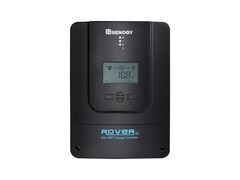
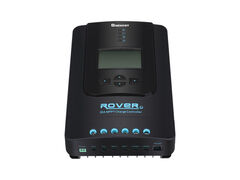
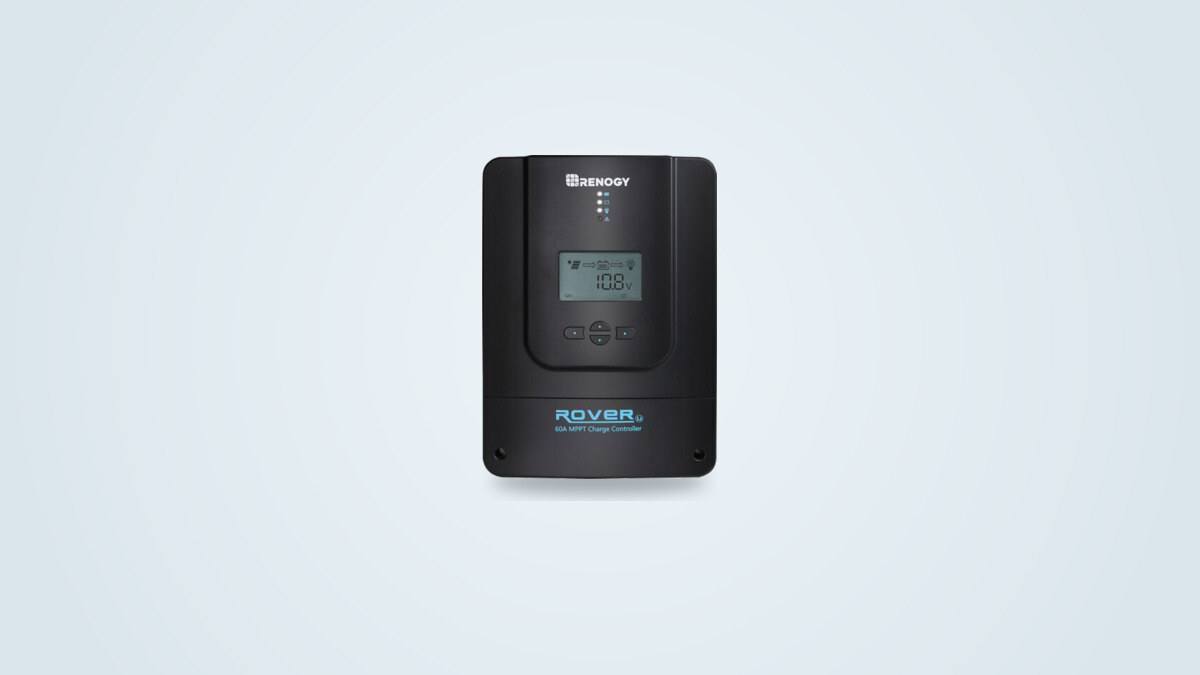
The Renogy Rover 60A is the most capable controller in the Rover range: 150V of maximum solar input voltage and 60A of charge current, against 100V and 20A for the Rover 20A already in the catalogue. Together, these two figures set the maximum PV power the controller accepts at each system voltage: 800W at 12V, 1600W at 24V, 2400W at 36V and up to 3200W at 48V. That is enough headroom to wire a noticeably larger panel array than a typical 20A or 40A controller can handle.
This sizing is worth planning before buying the panels: open-circuit voltage rises in cold weather, so leaving a safety margin below the 150V ceiling is safer than cutting it close, a precaution that applies to any MPPT controller in this class.
Rated MPPT efficiency, and what moves it in practice
Renogy rates the Rover 60A at up to 99% MPPT tracking efficiency and 98% conversion efficiency, figures in line with MPPT technology against a basic PWM controller, which typically tops out at 70 to 80% tracking efficiency. Those figures assume ideal conditions: stable sunlight, lossless wiring and moderate temperatures. Partial shading on part of the array, an undersized cable run or a large temperature swing all pull that efficiency down in practice, a characteristic of the whole MPPT category rather than something specific to this unit.
The voltage of the panel string also shapes how much headroom the MPPT algorithm actually has to work with. Wiring panels well below the system's nominal voltage, say low-voltage panels feeding a 48V system, narrows its ability to hunt for the optimal power point; pushing close to the 150V ceiling with no margin, on the other hand, risks an overvoltage cutout, particularly in cold weather when open-circuit voltage climbs. Correct sizing depends as much on the number of panels and how they are wired, in series or in parallel, as on the controller itself.
Another structural limit, shared with most controllers of this format: the Rover 60A has a single MPPT tracker. On a roof with multiple planes facing different directions, one tracker cannot optimise each string independently; panels of the same orientation need to be grouped onto the same string, or multiple controllers used if the orientations differ too much.
Automatic 12/24/36/48V detection: the 60A's versatility
The Rover 20A tops out at 12V and 24V systems. The Rover 60A goes further: it automatically detects 12V, 24V, 36V and 48V systems, with no user input and no switch to flip. Coverage of the less common 36V tier, found on some RV and off-grid setups, sets the Rover 60A apart from rival controllers that require a manual selection for that intermediate step.
The 48V tier in particular is gaining ground on newer installations, especially when the distance between panels and battery bank makes it worth cutting line losses by running at higher voltage and lower current on the cable run. In practice, this flexibility has one clear payoff: it leaves room to upgrade an existing setup to a higher system voltage without having to replace the controller.
Built-in LCD screen, Bluetooth as an option
The built-in LCD screen shows battery voltage, charge current and instantaneous solar output directly, along with fault codes if something goes wrong. Like the rest of the Rover range, it is not backlit: reading it gets difficult at night or in dim light, worth bearing in mind for a controller mounted somewhere poorly lit.
For remote monitoring, the Rover 60A has an RS232 port that works with an optional Bluetooth module, BT-1 or BT-2, linking it to the Renogy DC Home app. That module is not included as standard and is an extra cost to budget for upfront if phone-based monitoring matters.
Battery compatibility: from lead-acid to lithium, carefully
For lead-acid batteries, sealed, gel or flooded, charging runs through the preset profiles supplied with the unit across 4 stages, with no manual tuning required. The Rover 60A offers four charge profiles in total, for sealed lead-acid, gel and flooded batteries, plus a fully configurable User profile. Charging a lithium LiFePO4 battery has to go through that User profile: there is no one-tap lithium preset on this controller. Setting it up correctly means knowing the voltage thresholds the battery manufacturer recommends, a step worth taking seriously: a poor setting can over or under-drive a lithium pack that does not necessarily carry its own BMS protection against a badly calibrated charge voltage upstream.
A remote temperature sensor ships with the Rover 60A as standard, as on the rest of the range: it lets the controller compensate charge voltage against the battery's actual temperature, rather than the housing's own internal temperature, a real plus for a setup exposed to large seasonal swings.
Electronic protections, running with no supervision
The controller includes the full set of protections standard for this category: reverse polarity on both the panel and battery sides, overcharge and short-circuit protection, an internal overheat cutout, and a night-time reverse-current block to stop the battery draining back into the panels after dark. These protections run continuously, with no human oversight: a solar controller stays wired in around the clock, often for years without anyone touching it, which makes their reliability just as important as their charging performance.
No product recall has been identified for this model.
Build quality, passive cooling and the IP32 housing
The die-cast aluminium housing doubles as a passive heatsink: there is no fan, which keeps things silent but leaves all the cooling to the surface of the heatsink itself. At everyday loads, 20 or 30A, there is a comfortable thermal margin; pushed closer to the rated 60A in hot ambient conditions, a noticeable rise in temperature is to be expected, the normal behaviour of a housing with no active cooling rather than a design flaw.
The protection rating remains IP32, as on the rest of the Rover range: the housing tolerates dust and limited vertical dripping, but needs to sit somewhere sheltered, never directly exposed to rain or sea spray. It measures 285 x 205 x 102 mm and weighs 4.3 kg, well above the Rover 20A's 1.4 kg. Wiring runs through screw terminals sized for the cable gauges a 60A rating calls for; a properly torqued connection at those terminals is the most common point to watch during installation, as with any controller in this power class. It carries CE, RoHS, UL1741 and CSA C22.2 certification, and the manufacturer's warranty runs for 2 years.
Against the Victron SmartSolar range, and its own smaller sibling
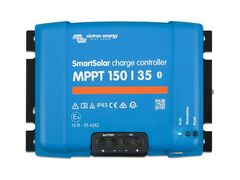
With matching maximum PV voltage (150V), the most useful comparison is between the Rover 60A, the Victron SmartSolar 150/35 already in the catalogue, and its own smaller sibling, the Rover 20A.
| Criterion | Renogy Rover 60A | Victron SmartSolar 150/35 | Renogy Rover 20A |
|---|---|---|---|
| Max PV voltage | 150V | 150V | 100V |
| Charge current | 60A | 35A | 20A |
| Compatible systems | 12/24/36/48V | 12/24/36/48V | 12/24V |
| Built-in screen | LCD | No (app only) | LCD |
| Bluetooth | Optional (BT-1/BT-2) | Built-in | Optional (BT-1) |
| Weight | 4.3 kg | 1.25 kg | 1.4 kg |
| Price observed | around £215 | around £150 | around £75 |
Against the SmartSolar 150/35, the Rover 60A costs noticeably more (around £215 versus around £150) but still works out cheaper per amp of charge current, and keeps an LCD screen that Victron reserves for its Bluetooth app, built in as standard on the Victron side. The real trade-off sits there: with Victron, no module to add for remote monitoring; with Renogy, a BT-1 or BT-2 module is still needed for that same feature, though the on-unit screen removes the need for it for a quick daily check. Against its own smaller sibling, the Rover 20A, the 60A doubles the charge current, moves from 100V to 150V of solar input and adds automatic detection of the 36V tier, at the cost of more than triple the weight.
Who the Rover 60A suits, and when to pick a different size
The Rover 60A suits a setup that has outgrown a 20A or 40A controller: a van or motorhome running several panels, a cabin or an off-grid site with a sizeable array, or any project that might need to move up to a higher system voltage (36 or 48V) to cut line losses. Automatic detection across all four voltage tiers also makes it a sensible pick for anyone still undecided on their setup's final voltage.
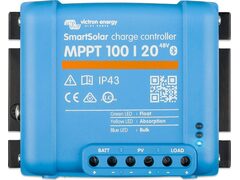
It is not worth it for a small setup with one or two panels close to the battery: a Rover 20A or a Victron SmartSolar 100/20, both cheaper and just as dependable at that scale, cover that need comfortably. The Rover 60A is also not the right pick for anyone who wants Bluetooth monitoring ready to go with no extra cost or setup: the Victron SmartSolar 150/35, despite its noticeably lower price in this market, includes Bluetooth as standard. Like any MPPT controller, the Rover 60A does not replace an inverter for 230V output, nor a dedicated BMS for a lithium battery with no protection of its own: its job stops at charging between the panels and the battery bank. For a large multi-voltage setup on a controlled budget, with the willingness to configure a lithium profile by hand, the Rover 60A remains a solid, coherent choice.