Panasonic Eneloop Pro AA: our full review

A genuine 2500 mAh with a real advantage for power-hungry devices, but a cycle count that drops off far faster than the standard Eneloop, and a diameter at the top end of the AA tolerance that can be a tight fit in some devices.

Our rating
3.8/5
Actual delivered capacity: 4.4 out of 5 (weighting 25%)Capacity4.4Long-term endurance: 3.2 out of 5 (weighting 25%)Endurance3.2Extreme-temperature performance: 3.6 out of 5 (weighting 20%)Temperature3.6Versatility across devices: 4.2 out of 5 (weighting 15%)Versatility4.2Build and safety: 3.4 out of 5 (weighting 15%)Build3.4

How is this rating calculated?

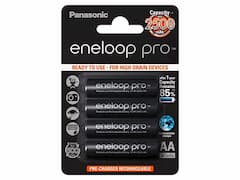
Panasonic Eneloop Pro AA rechargeable batteries in a pack of four

The essentials

The Eneloop Pro AA lives up to its capacity claim: the advertised 2500 mAh shows up at or very close to nominal across the great majority of discharge conditions, including high current draw, which makes it a genuine choice for power-hungry devices such as a camera flash or a heavily used game controller. The trade-off is far more pronounced than the datasheet suggests: Panasonic advertises up to 500 cycles, but the real cycle count before a noticeable capacity loss falls to somewhere around 150 to 170 recharges, roughly a third of the stated figure, a much steeper gap than the one seen on the standard Eneloop. A second point is worth knowing before buying: the Pro AA's diameter (around 14.5 mm) sits at the top end of the standardised tolerance for an AA cell (13.5 to 14.5 mm), which can make it too tight a fit in some devices with narrow tolerances, such as an older torch or an external flash battery grip. It is also slightly heavier than the standard Eneloop, not lighter. For occasional use in a power-hungry device, the Pro AA remains a sound choice; for daily use and maximum longevity, the standard Eneloop remains the safer pick.

Strengths

  • Real capacity that reaches or comes close to the advertised 2500 mAh, even at high current draw
  • Excellent performance under heavy demand: camera flash, game controllers, power-hungry toys
  • 85% charge retention after one year, a very good result in absolute terms
  • Supplied pre-charged and ready to use straight away
  • Sold in packs of 4, a format consistent with the rest of the Eneloop range

Limitations

  • Real cycle count that falls to around 150 to 170 recharges, well below the advertised 500
  • Diameter at the top end of the AA standard, which can cause a fit issue in some devices
  • Heavier than the standard Eneloop, contrary to a common assumption about high-capacity versions
  • Charge retention lower than the standard Eneloop over the very long term (85% over 1 year versus 70% over 10 years)
  • Price noticeably higher than the standard Eneloop for a shorter real service life
Panasonic Eneloop Pro AA 2500mAh: see the full details and price →

The high-capacity version, built for power-hungry devices

Camera flash, intensive game controller use, a motorised toy: the Eneloop Pro AA targets devices that drain a standard battery quickly. Its advertised capacity of 2500 mAh, against 1900 mAh for the classic Eneloop, makes it the highest-capacity cell in the AA range.

2500 mAh
Advertised capacity
150-170
Estimated real cycles
4
Batteries per pack

A capacity that lives up to its claim, even at high current

The real capacity of the Eneloop Pro AA holds at or very close to the advertised 2500 mAh across most discharge conditions, including at high current, where many rechargeable batteries lose a significant share of their rated capacity. It is a solid result that justifies this cell's premium positioning for demanding uses.

The real trade-off: a cycle count well below the claim

This is where the trade-off of the Pro version really plays out. Panasonic advertises up to 500 recharge cycles, but the real cycle count before a noticeable capacity loss sits at around 150 to 170 recharges, roughly a third of the stated figure. This gap is proportionally far larger than the one seen on the standard Eneloop, whose advertised figure is also optimistic, though to a lesser degree. Charge retention at rest remains good in absolute terms (85% after one year), but it stays below the standard Eneloop's performance over the very long term (70% after 10 years). The Pro AA is therefore built for immediate capacity, not for longevity.

No detailed manufacturer data on cold weather

As with the rest of the Eneloop range, Panasonic does not publish detailed data on how the Pro AA holds up at extreme temperatures. NiMH chemistry remains adequate in temperate use, without matching a primary lithium battery designed specifically for severe cold.

A diameter at the top end of the AA standard

A lesser-known point is worth flagging before buying: the diameter of the Eneloop Pro AA, around 14.5 mm, sits at the top end of the standardised tolerance for an AA battery, which runs from 13.5 to 14.5 mm. In practice, this can make it too tight a fit in some devices with narrow mechanical tolerances, such as an older torch or an external battery grip for a camera flash. It is also slightly heavier than the standard Eneloop, by around 12 to 15%, contrary to an intuition that often pairs higher capacity with lighter weight. For a recent device with a standard battery compartment, this point has no consequence; for an older device or one with tight tolerances, it is worth checking before investing in a full pack.

Consistent build quality, a fit worth checking

Nothing points to a particular safety issue (leakage, overheating) with the Eneloop Pro AA. The point to watch concerns only the mechanical fit mentioned above, specific to this high-capacity version's diameter, not the build quality of the cell itself.

Against the standard Eneloop and the Energizer Ultimate Lithium AA

How do you choose between the Eneloop Pro AA and the other two AA batteries in our selection?

Technical comparison: Eneloop Pro AA against the Eneloop AA and the Energizer Ultimate Lithium AA (prices observed, for guidance only)
CriterionEneloop Pro AAEneloop AAEnergizer Ultimate Lithium AA
TypeRechargeable NiMHRechargeable NiMHDisposable lithium
Advertised capacity2500 mAh1900 mAhNot disclosed (mAh)
Estimated real cycles150 to 170Several hundred to ≈ 1000Single use
Retention85% / 1 year70% / 10 years25 years (storage)
Price observed (x4)£22.15≈ £17.54 (prorated x8)£9.38

The Eneloop Pro AA makes sense for a power-hungry device used occasionally, where immediate capacity matters more than longevity. For everyday use in low-drain devices, the standard Eneloop remains the more cost-effective choice over time. The disposable Energizer Ultimate Lithium AA is a useful addition to the drawer for backup use or severe cold.
The rating in detail

Our rating
3.8/5
Actual delivered capacity 4.4
Long-term endurance 3.2
Extreme-temperature performance 3.6
Versatility across devices 4.2
Build and safety 3.4
Panasonic Eneloop Pro AA 2500mAh: see the full details and price →

The product and its alternatives

Panasonic Eneloop Pro AA 2500mAh

Panasonic Eneloop Pro AA 2500mAh

See price (13)

The high-capacity version of the Eneloop: 2500 mAh to last longer in power-hungry devices like camera flashes, game controllers or demanding toys.

View product
Panasonic Eneloop AA 1900mAh

Panasonic Eneloop AA 1900mAh

See price (54)

The benchmark AA rechargeable batteries: up to 2100 charge cycles, ready to use and able to keep 70% of their energy after 10 years of storage.

View product
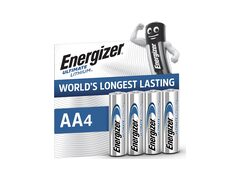
Energizer Ultimate Lithium AA (x4)

Energizer Ultimate Lithium AA (x4)

See price (71)

The longest-lasting AA battery in the world: the Energizer Ultimate Lithium takes on the most power-hungry devices, from deep cold to heat, with 25 years storage.

View product

Frequently asked questions

No, that is a theoretical ceiling. The real cycle count before a noticeable capacity loss sits at around 150 to 170 recharges, about a third of the advertised figure. This is a larger gap than on the standard Eneloop.

In most cases, yes, but its diameter sits at the top end of the AA standard. Some devices with narrow mechanical tolerances (an older torch, an external flash battery grip) may reject it or accept it only with difficulty.

No, it is the opposite: the Pro AA is around 12 to 15% heavier than the standard Eneloop, due to its higher capacity. It is neither a real advantage nor a real drawback in use, simply a common assumption worth correcting.

For any device that drains a standard battery quickly: camera flash, intensive game controller use, a motorised toy, a powerful torch. For low-drain everyday use and long-term storage, the standard Eneloop remains preferable.

Yes in absolute terms (85% after one year), but it remains below the standard Eneloop's performance over the very long term (70% after 10 years). The Pro AA is built for immediate capacity, not for extended storage.