
The advertised charging current, confirmed in practice
For two AA batteries, the charging current sits around 1500mA, with occasional higher peaks. This figure is consistent with the charging times given by Panasonic: around 1h30 to 2h for two AA eneloop pro batteries, and 3 to 4h for a full set of four. For a single AAA battery, charging takes around 1h40.
The real weak point: recognition of certain batteries
This is the most important point to know before buying. The charger can display an error or refuse to charge certain batteries that are otherwise in good condition, including recent eneloop cells from the brand itself. The likely cause is the internal resistance measurement taken at insertion: an older battery, or one that has already seen heavy use, can show an internal resistance close to that of a non-rechargeable alkaline battery, which the charger rejects as a safety measure. This behaviour protects against a real risk (charging a battery that could not handle it), but it sometimes appears overly cautious, ruling out batteries that are still functional. This issue does not affect every unit: many years of extended use never encounter it, but the problem remains real.
The LCD screen, this model's central argument
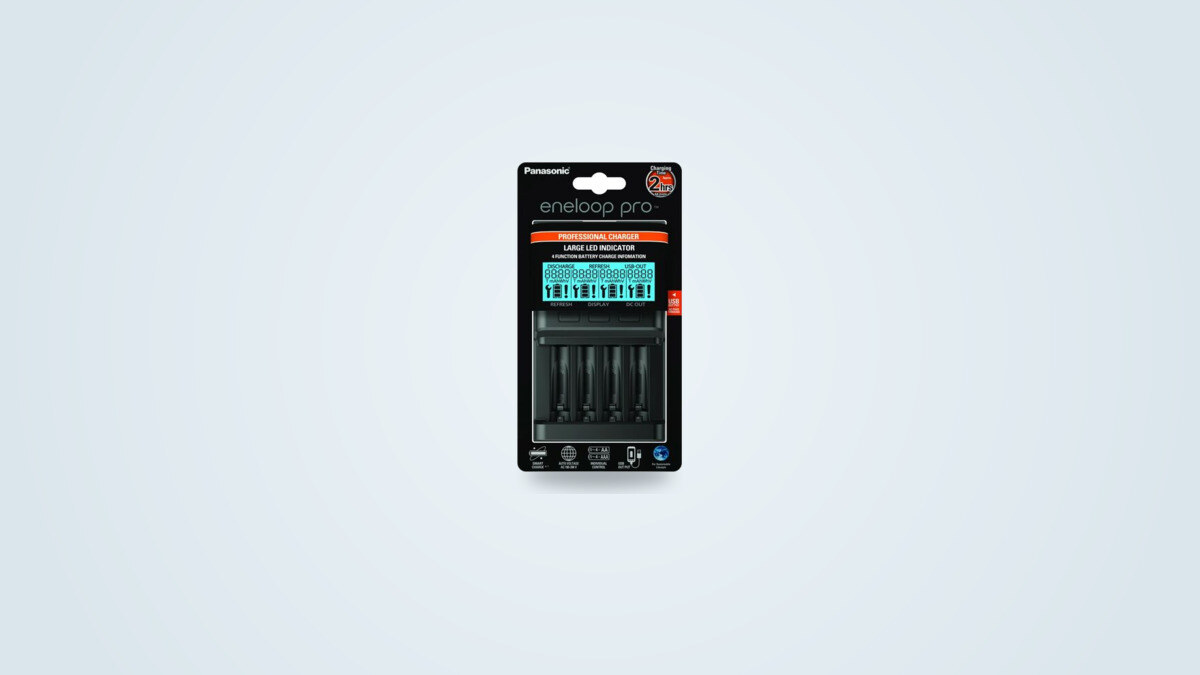
This is what sets the BQ-CC65 apart from the rest of the eneloop range: an LCD screen shows for each slot the voltage, the restored capacity in mAh and Wh, and the remaining charge time. Enough to spot a tired battery before even recharging it, or to objectively check that a battery still holds its advertised capacity. Without a screen, the BQ-CC55, its little brother, makes do with simple LEDs and an otherwise identical charging current.
Refresh mode, useful but worth putting into perspective
Refresh mode fully discharges a battery before recharging it, which can give a little capacity back to an old battery left unused: measurable capacity does return on batteries several years old this way. Its real usefulness on modern eneloop batteries, whose memory effect is already low by design, remains debatable for everyday use. The mode applies to all inserted batteries at once, with no individual per-slot setting, unlike some higher-end competing chargers.
The backup USB output, a secondary function
The USB output delivers around 1.15A, slightly above the advertised 1A. It does not, however, work at the same time as battery charging: plugging in a device for a quick top-up pauses charging for as long as it is used. The output also cuts off automatically after around a minute if the connected device draws less than 100mA, which makes it poorly suited to very small, low-consumption devices.
Price and availability
The observed price sits around £45 to £70, a clear step up from basic battery chargers. It is not always the most competitive price on the market for this specific model: other retailers sometimes offer a noticeably lower price. The product is also not sold in Japan through official channels, only available in Europe and through a limited resale market elsewhere.