
Panasonic Eneloop AAA: our full review

800 mAh as the typical rating, 750 mAh as the guaranteed minimum: the Eneloop AAA shares the strengths of its bigger AA sibling, along with one quirk of its own tied to the smaller size, the sometimes fussy compatibility of certain entry-level chargers.

Our rating
3.9/5
Actual delivered capacity: 4.0 out of 5 (weighting 25%)Capacity4.0Long-term endurance: 4.0 out of 5 (weighting 25%)Endurance4.0Extreme-temperature performance: 3.8 out of 5 (weighting 20%)Temperature3.8Versatility across devices: 4.0 out of 5 (weighting 15%)Versatility4.0Build and safety: 3.8 out of 5 (weighting 15%)Build3.8

How is this rating calculated?

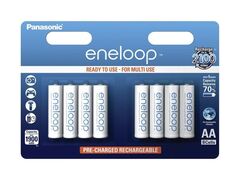
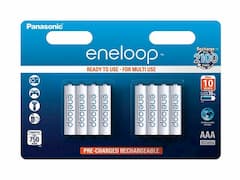
Panasonic Eneloop AAA rechargeable batteries in a pack of four

The essentials

The Eneloop AAA carries over the formula that made the AA format a success, scaled down to the smaller size. The 800 mAh figure highlighted on the packaging is the typical value; the minimum actually guaranteed by Panasonic is 750 mAh, a nuance that changes nothing in everyday use but is worth knowing. Its charge retention (70% after 10 years) remains a solid figure, while the real cycle count, as with the AA, sits well below the stated 2100 cycles. One quirk specific to the AAA format deserves a mention: NiMH cells are slightly shorter than an alkaline battery, a gap that is more noticeable on this small size, and some entry-level chargers with rather stingy contact springs struggle to detect or properly charge an AAA cell sitting flat in its slot. Beyond that, the Eneloop AAA comfortably covers the format's typical uses: remotes, mice, headlamps, light toys.

Strengths

  • Very low self-discharge, on par with the AA range
  • Real capacity matches the typical 800 mAh rating in most uses
  • Shipped pre-charged and ready to use straight away
  • Compact format suited to everyday low-drain devices
  • Sold in packs of 4, an economical option compared with disposable batteries

Limitations

  • Minimum guaranteed value of 750 mAh, versus the 800 mAh typical value shown on the pack
  • Real cycle count well below the 2100 stated by the manufacturer
  • Sometimes tricky compatibility with entry-level chargers whose contacts are poorly suited to the AAA format
  • 1.2V output instead of 1.5V, worth watching on a handful of sensitive devices
  • No detailed manufacturer data on performance in extreme temperatures
Panasonic Eneloop AAA 800mAh: see the full details and price →

The AAA version of the benchmark range

Remotes, wireless mice, headlamps, small toys: the Eneloop AAA targets compact devices that draw little current but still deserve a battery that is reliable and holds its charge well in storage.

800 mAh
Stated typical capacity
70 %
Capacity kept after 10 years
4
Batteries per pack

800 mAh typical, 750 mAh guaranteed minimum

The 800 mAh figure, highlighted on the packaging and by most retailers, is the typical capacity of the Eneloop AAA. The minimum value actually guaranteed by Panasonic is 750 mAh, a distinction that is common across the rechargeable battery industry but rarely spelled out on product pages. In practice, this nuance changes nothing in everyday use: the real capacity remains well matched to the needs of AAA-powered devices, which are generally low-drain.

Charge retention that lives up to the Eneloop reputation

As with the AA format, charge retention at rest remains the best-established strength: 70% of capacity kept after 10 years of storage, a figure that sets a quality rechargeable battery apart from a budget model that goes flat within weeks. The number of recharge cycles follows the same logic as the AA: Panasonic states up to 2100 cycles, but real-world performance sits well below that, more in the range of several hundred to around a thousand cycles depending on the end-of-life criteria used. The marketing figure should be read as a theoretical ceiling rather than an expected average.

NiMH chemistry with no detailed manufacturer data on cold weather

As with the whole NiMH Eneloop range, Panasonic does not publish detailed data on how the AAA performs in extreme temperatures. NiMH chemistry behaves correctly in temperate use, without being the benchmark on this point next to a primary lithium battery designed specifically for severe cold.

Charger compatibility worth watching on the small format

One quirk is specific to the AAA format: a NiMH cell is slightly shorter than an equivalent alkaline battery, a gap of a few tenths of a millimetre, which is more noticeable on this small size than on an AA. Some entry-level chargers, with rather stingy contact springs, then struggle to properly detect an AAA cell simply sitting flat in its slot, or need a light press to make contact. This is not a flaw in the battery itself, but a compatibility point worth checking with the charger in use, particularly on very budget models.

Consistent manufacturing, no notable safety issues

Nothing points to a particular safety issue (leakage, overheating) with the Eneloop AAA. Manufacturing consistency remains a strength of the brand, in line with the rest of the Eneloop range.

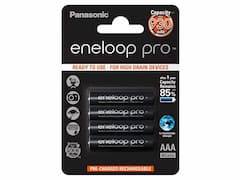
Against the Eneloop Pro AAA

How to choose between the standard Eneloop AAA and its higher-capacity Pro version?

Technical comparison: Eneloop AAA against the Eneloop Pro AAA (observed prices, indicative only)
CriterionEneloop AAAEneloop Pro AAA
Typical capacity800 mAh930 mAh
Stated cycles2100500
Retention70% / 10 years85% / 1 year
Pack sizePack of 4Pack of 4
Observed price£13.63≈ £21.03

The standard Eneloop AAA remains the more sensible choice for the vast majority of everyday, low-drain devices, with better long-term retention. The Pro AAA mainly makes sense for devices that drain standard AAA batteries quickly, such as a wireless mic or a powerful headlamp, at the cost of a more limited real cycle count.
The rating in detail

Our rating
3.9/5
Actual delivered capacity 4.0
Long-term endurance 4.0
Extreme-temperature performance 3.8
Versatility across devices 4.0
Build and safety 3.8
Panasonic Eneloop AAA 800mAh: see the full details and price →

The product and its alternatives

Panasonic Eneloop AAA 800mAh

Panasonic Eneloop AAA 800mAh

See price (37)

The benchmark AAA rechargeable batteries: up to 2100 charge cycles, ready to use and able to keep 70% of their energy after 10 years of storage.

View product
Panasonic Eneloop Pro AAA 930mAh

Panasonic Eneloop Pro AAA 930mAh

See price (7)

The high-capacity AAA version of the Eneloop: 930 mAh to last longer in power-hungry devices, wireless mics, headlamps or demanding mice.

View product
Panasonic Eneloop AA 1900mAh

Panasonic Eneloop AA 1900mAh

See price (54)

The benchmark AA rechargeable batteries: up to 2100 charge cycles, ready to use and able to keep 70% of their energy after 10 years of storage.

View product

Frequently asked questions

800 mAh is the typical capacity, the one highlighted on the packaging. 750 mAh is the minimum value actually guaranteed by Panasonic. Both figures are correct and consistent with each other; it is not a contradiction.

That is the theoretical ceiling stated by Panasonic, but real-world use sits well below it, from a few hundred to around a thousand cycles, as with the AA format in the same range.

A NiMH cell is slightly shorter than an alkaline one, a gap that is more noticeable on the small AAA format. Some entry-level chargers with rather stingy contact springs can struggle to make contact: this is not a flaw in the battery.

The Pro AAA offers a higher capacity (930 mAh versus 800 mAh), ideal for power-hungry devices, but handles fewer recharge cycles and holds its charge at rest slightly less well. The standard Eneloop AAA remains preferable for everyday, low-drain use.

Yes, it ships pre-charged using solar power and is ready to use straight away, holding its charge for a long time thanks to its low self-discharge.