The benchmark rechargeable AA battery
Game controllers, remotes, wireless mice, camera flashes: the Eneloop AA targets everyday devices that chew through batteries. Its core promise is not raw capacity, but the ability to stay charged through long periods in storage.
Real capacity that lives up to its promise
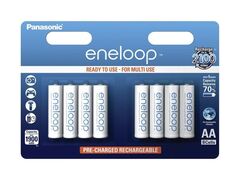
The real capacity of the Eneloop AA sits at or slightly above the advertised minimum of 1900 mAh, with the normal variation you would expect depending on discharge current and cell generation. That result fits the product's reputation: unlike budget rechargeable batteries, whose real capacity often disappoints against the figure printed on the pack, the Eneloop AA broadly delivers what it advertises.
Exemplary charge retention, an overstated cycle count
Charge retention at rest is the Eneloop AA's best-established strength: the manufacturer figure of 70% of capacity retained after 10 years of storage holds up over time, with older cells still showing a similar order of magnitude. That is what sets a quality rechargeable battery apart from a budget model that goes flat in a drawer within a few weeks.
The number of charge cycles is another matter. Panasonic advertises up to 2100 cycles, but real-world use falls well short of that, somewhere in a wide range from a few hundred to around a thousand cycles depending on which degradation threshold counts as end of life. A notable point that is rarely covered elsewhere: the longevity of genuinely authentic Eneloop cells can vary considerably depending on their manufacturing site, which explains part of the gap between user experiences without this being a case of counterfeiting. The 2100-cycle figure should therefore be read as a theoretical laboratory ceiling, not as an average you can expect in real use.
An NiMH chemistry with no detailed cold weather data
Unlike primary lithium batteries, which often advertise a precise operating temperature range, Panasonic does not publish detailed data on how the Eneloop AA performs in extreme temperatures. NiMH chemistry behaves correctly in moderate conditions, without being the benchmark on this point next to a lithium battery designed specifically for deep cold.
A universal format, from camera flash to remote control
Real capacity close to the rated figure translates into satisfying behaviour on both high, short-burst drain devices (camera flashes, motorised toys) and low, continuous drain devices (remote controls, clocks). Its 1.2V output, against 1.5V for an alkaline battery, has no real consequence in the vast majority of uses, with the exception of the rare device that is very sensitive to supply voltage.
Consistent manufacturing, no notable safety issues
Nothing points to a particular safety issue (leaks, overheating) with the Eneloop AA. Manufacturing consistency remains one of the brand's selling points, though there is no figure that allows a precise comparison against competitors on this specific point.
Up against the Eneloop Pro AA and the Energizer Ultimate Lithium AA
How should you choose between the standard Eneloop AA and the two other AA batteries in our selection?
| Criterion | Eneloop AA | Eneloop Pro AA | Energizer Ultimate Lithium AA |
|---|---|---|---|
| Type | Rechargeable NiMH | Rechargeable NiMH | Disposable lithium |
| Advertised capacity | 1900 mAh | 2500 mAh | Not disclosed (mAh) |
| Advertised cycles | 2100 | 500 | Single use |
| Retention | 70% / 10 years | 85% / 1 year | 25 years (storage) |
| Price observed (pack) | ≈ £19 (x8) | £22.15 (x4) | £9.38 (x4) |
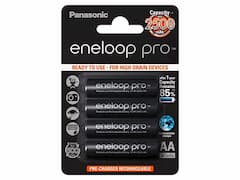
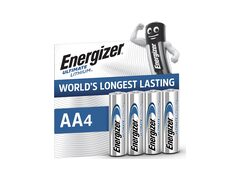
The standard Eneloop AA remains the most balanced choice for everyday use and long-term storage. The Eneloop Pro AA takes over for current-hungry devices, at the cost of a more limited real cycle count. The disposable Energizer Ultimate Lithium AA never recharges, but it brings a genuine range boost on high-drain devices and better cold weather performance, for backup or outdoor use.