
A successful start on diesel and petrol with a weak battery
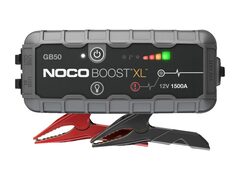
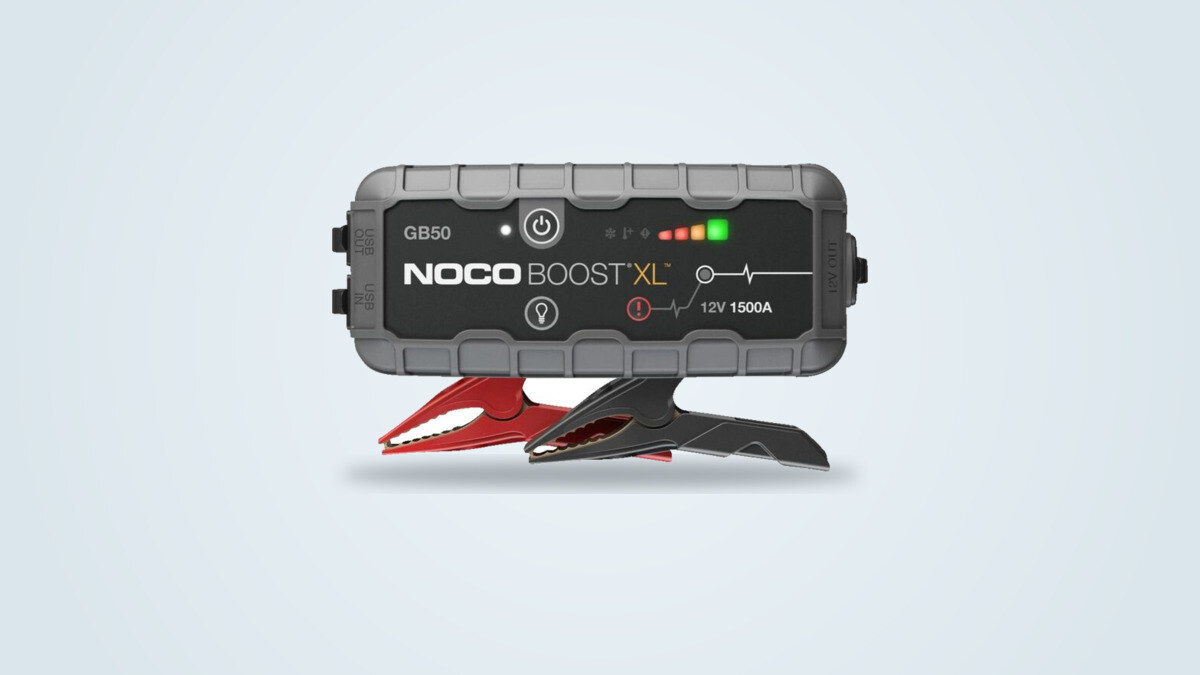
Under a protocol published in Germany (three successful jump-starts required, a five-second maximum cranking time per attempt, fifteen seconds of rest between each try), the GB50 successfully starts two real-world cases: a Jeep Wrangler 2.8 L diesel with a very depleted 94 Ah battery, and a Ford Focus 1.5 EcoBoost petrol with a weak 65 Ah battery. The result: the “recommended” rating, a positive verdict that stops short of the top spot in the comparison, edged out by a lead-acid unit from the same selection.
The GB50's clamps stand out as among the best in this selection, slim and with a wide jaw opening, a concrete advantage for anyone reaching awkwardly placed battery terminals. In exchange, the unit comes out as the heaviest in its category in this comparison, and the box does not include a mains charger.
No independent measurement was found, however, for the exact peak current in amps: only a pass/fail result is published under this protocol, not a measured figure for the current actually delivered.
1500 A, diesel up to 4.5 L: the range's strategic sweet spot
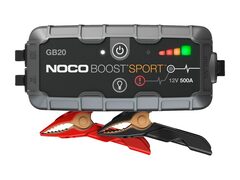
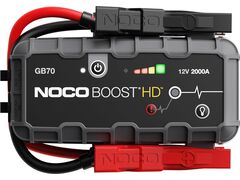
The GB50 occupies a calculated position in Noco's Boost range. The GB40 below stops at 1000 A and 3.0 L of diesel: enough for a diesel city car, but short as soon as a family saloon or an SUV is involved. The GB70 above climbs to 2000 A and 6.0 L of diesel, but weighs and costs noticeably more. Between the two, the GB50 lifts the approved diesel rating from 3.0 to 4.5 L for just a couple of pounds more than the GB40, a threshold that covers most of the mid-capacity diesel fleet in Europe.
A recurring switch flaw, with a plausible cause identified
This is the most important point to know before buying. Several independent, non-commercial accounts, including one detailed teardown, describe switches that stop responding after only a few presses on certain units, with a plausible cause being entry-level components that leave too little clearance in the housing for their travel. The delay before it appears ranges from a few days to two or three months after purchase.
A related flaw, battery swelling that deforms the casing, also comes up for the GB70, the next model up in the range, which suggests a shared point of vigilance for this generation of products rather than a problem isolated to the GB50 alone.
UltraSafe protection, and no safety recall to date
UltraSafe technology (clamps stay inert until the connection is correct, with detection and blocking of reverse polarity) is identical to the rest of the range and remains the main safety argument over conventional jump leads. No safety recall has been found for Noco's Boost range to date, unlike some direct competitors that have been the subject of battery failure reports to US consumer product safety authorities. This absence of a recall does not guarantee the absence of a future problem, but it remains a favourable signal about the product's track record.
10 W USB-C charging input: this generation's acknowledged weak point
Like the rest of the Boost range of this generation, the charging input is 10 W USB-C, which takes several hours for a full charge. No mains charger is included in the box. It is better to plug the unit in the night before a trip rather than at the last minute, a limitation that the newer GBX range fixes with much faster USB-C Power Delivery charging.
GB50 or GBX55: two distinct ranges, not to be confused
The GB50 belongs to the original Boost line-up (GB20/GB40/GB50/GB70/GB150), still in Noco's catalogue. Noco also sells a newer line-up in parallel, Boost X (GBX45/GBX55/GBX75/GBX155), with revised thermal management and much faster USB-C Power Delivery charging. The GBX55, in particular, sits close to the GB50 in positioning (1750 A, a full recharge in about 1.5 hours versus 5 hours) at a comparable price: a reader searching for “Noco 1500 A” or comparing reviews online can genuinely mix up the two ranges, which look similar. No evidence of an internal redesign of the GB50 itself under the same name has been found: the risk of confusion lies in choosing between two distinct ranges, not in a silent evolution of this specific model.
Observed price and availability
The observed price for the GB50 sits around £106. Noco, founded in 1914 in Cleveland, Ohio, under the name Nook & O'Neill, remains a family-run company with no funding round identified, originally specialised in battery maintenance before diversifying into electronics. The GB50 is officially distributed in Japan, alongside the rest of the Boost range.
Against the GB40 and the GB70
The choice largely comes down to the diesel displacement of the vehicle to cover.
| Criterion | Noco GB40 | Noco GB50 | Noco GB70 |
|---|---|---|---|
| Peak current | 1000 A | 1500 A | 2000 A |
| Diesel | Up to 3.0 L | Up to 4.5 L | Up to 6.0 L |
| LED torch | 100 lumens | 200 lumens | 400 lumens |
| Observed price | ≈ £104 | ≈ £106 | ≈ £184 |
For just a couple of pounds more than the GB40, the GB50 lifts the approved diesel rating from 3.0 to 4.5 L, the gap between a diesel city car and a family saloon or an SUV: that alone justifies the step up for most motorists. The GB70 keeps the advantage beyond 4.5 L of diesel, so for a van or a large SUV, at the cost of a heavier and pricier unit.
Who it suits, and who it does not
It suits anyone with a family saloon, an SUV or a small diesel van up to 4.5 L, who can store it away from strong direct heat rather than on the rear parcel shelf in full sun.
It does not suit anyone who needs a fast recharge before an imminent departure (the 10 W USB-C input takes several hours), nor anyone with a heavy goods vehicle or a diesel tractor beyond 4.5 L, for whom the GB70 or a 24 V model remains necessary.