
What the Turbo, 3000-lumen mode is actually worth
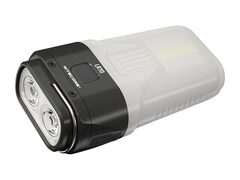
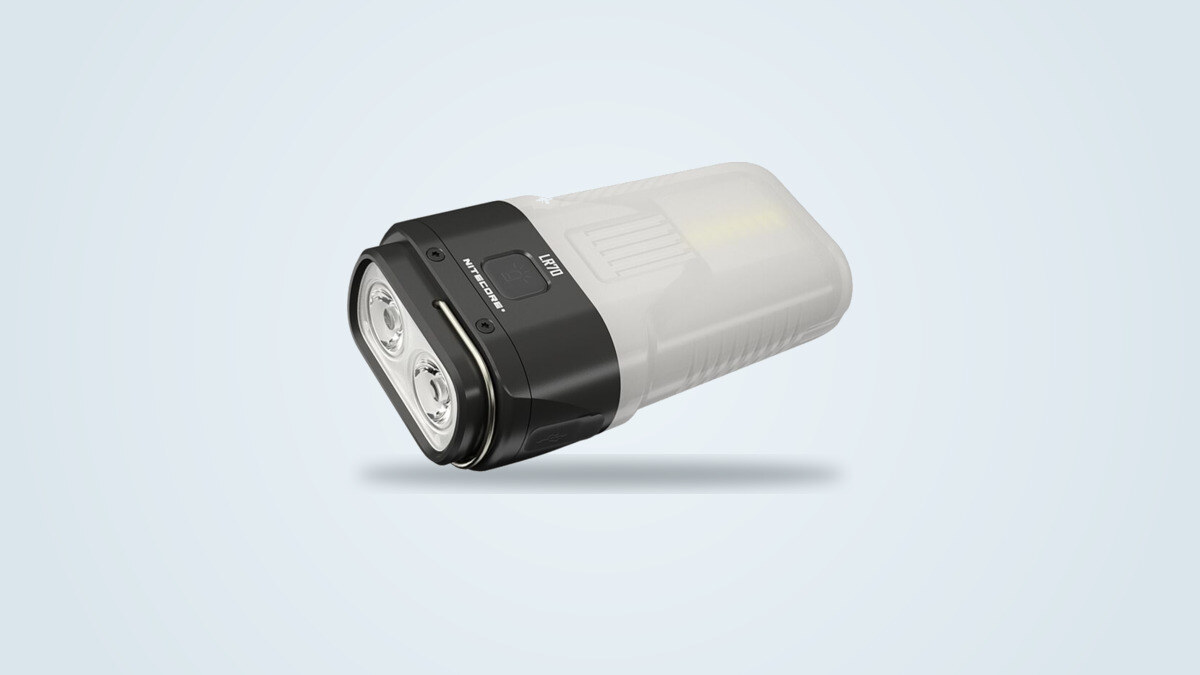
The Nitecore LR70's head packs two Luminus SST40 LEDs behind a TIR lens, for a claimed peak of 3000 lumens on Turbo. The maker rates that lens at over 94% optical efficiency, with a beam that reaches 300 m and a peak intensity of 23,100 cd. On paper, those are the numbers of a genuine long-throw torch, not a token beam bolted onto a lantern.
One detail in the spec sheet is worth flagging before any enthusiasm sets in: of the torch mode's five levels, four carry a runtime rated by the maker itself. Turbo is the only one that does not. On the official spec table, that field is simply left blank where every other level shows a value in hours. That gap lines up with a built-in ATR (Advanced Temperature Regulation) system, whose job is to adjust output according to operating conditions and protect the electronics and LEDs. The interface points the same way: Turbo sits outside the normal short-press cycle of levels, it needs a dedicated double press to reach, and it automatically reverts to the previous level after 30 seconds of inactivity. Everything about the design signals a mode built for a short, deliberate burst rather than sustained lighting.
The most useful level for planning an actual evening is Higher (1000 lm, 160 m), the brightest of the five to carry a rated runtime (10 hours). Turbo is best kept for the moment that genuinely calls for reach: spotting a trail, an animal, or the entrance to a campsite in total darkness, not for lighting a site for hours on end.
Runtime, mode by mode: torch and lantern
That same consistency runs through all eight lighting levels of the LR70 (five on the torch, three on the white lantern), plus four dedicated red-light modes. Every level carries its own rated runtime, except Turbo and the two special red modes (SOS and beacon), which are built for intermittent signalling rather than continuous use.
| Mode | Brightness | Runtime |
|---|---|---|
| Torch, Turbo | 3000 lm | not rated |
| Torch, Higher | 1000 lm | 10 h |
| Torch, High | 300 lm | 21 h |
| Torch, Mid | 35 lm | 100 h |
| Torch, Low | 1 lm | 600 h |
| Lantern, High | 400 lm | 7 h |
| Lantern, Mid | 55 lm | 60 h |
| Lantern, Low | 5 lm | 200 h |
| Red, High | 10 lm | 80 h |
| Red, Low | 2 lm | 260 h |
Two practical readings follow: on the lantern's most economical level (5 lumens), 200 hours is comfortably enough for a full week of bivouac night lighting without going near an outlet. At full brightness (400 lumens), plan on a single full evening (7 hours) rather than a whole weekend. The four red modes (reached with a direct double press) draw on a separate reserve from the white modes, rated at 80 hours on high and 260 hours on low: enough for extended safety signalling (SOS, flashing beacon) without ever touching the main lighting reserve.
One thing all three functions have in common is worth keeping in mind: the torch, the lantern and the power bank all draw from the same 10,000mAh reserve. Extended use of one of the lighting modes leaves that much less for topping up a phone, and the other way round.
The 360° lantern: quality light, with one caveat
In lantern mode, the LR70 relies on 20 high colour-rendering LEDs (CRI ≥ 90, fixed at 4000K), a figure plenty of camping lanterns at this price point simply do not publish. A high CRI makes a real difference under the light: food, faces and gear keep true colours instead of the dull grey-blue cast of cheap LEDs.
The translucent polycarbonate diffuser spreads light evenly around the rest of the housing, and the folding metal D-ring built into the base lets the unit hang (inside a tent, from an awning, off a branch) rather than always sitting flat. Switching modes takes no fiddling: a short press of the lantern button cycles Low, Mid, then High in white light; a double press jumps straight to the red sequence. Moving between torch and lantern mode is a single short press of the other button, with no menu to navigate and no need to turn the unit off first.
The power-bank function: the third role, not the first
The LR70's third function is the one that puts it in the power bank category: its two 21700 cells, rated 5000mAh each (10,000mAh, roughly 37Wh combined), can recharge a phone or a small device through the same USB-C port used to power the unit itself. Rated output covers 5V/3A, 9V/2A and 12V/1.5A, for a maximum of 18W.
One technical point deserves a plain statement: the maker's manual lists only Quick Charge (QC) among the supported output protocols. Some retail listings also mention USB PD in their marketing copy, but the LR70's official technical documentation makes no mention of it anywhere, on input or output. A recent device that only triggers fast charging over PD will still charge here, just not necessarily at its top speed.
The LR70 does offer a dedicated low-current mode, entered by holding both buttons together: useful for wireless earbuds, smartwatches and other small devices that sometimes refuse to charge properly on an output calibrated for a phone. That is a touch plenty of basic power banks skip entirely. Another real limit worth knowing: if USB output draw gets too high while a lighting mode is active, the unit automatically switches the light off to prioritise charging, a reminder that both functions share the same internal electronics rather than running fully independently.
Recharging the LR70 itself takes about 2 hours 50 minutes with a 9V/2A QC charger, or 4 hours with a standard 5V/2A charger; the lighting function stays usable while it charges. The battery-level indicator, however, stays basic: a single LED that blinks three times above 50%, twice below that, once under 10%, with no graduated gauge or exact percentage. With a single USB-C port shared between input and output, there is also no charging two devices at once. That 37Wh reserve works out to roughly one to two full charges of a modern smartphone (whose battery typically runs between 15 and 20Wh), after USB conversion losses: enough to bail someone out, not enough to replace a dedicated power bank.
Build quality, water resistance and handling
The LR70 weighs 271 g for 113 x 60 x 34 mm: a size that fits in a jacket pocket or a side bag pouch, noticeably more compact than a dedicated work light. The shell pairs a translucent polycarbonate body, which lets the lantern's LED strip show through even when off, with an aluminium-alloy base that houses the electronics and both buttons.
The IP67 rating (fully dust-tight, protected against temporary immersion) and 1 m drop resistance put the LR70 at the most complete protection level of its direct comparison set, covered further below. The two electronic buttons, one on the front for the lantern and one on the side for the torch, differ in shape and size and sit slightly proud of the shell: a deliberate ergonomic choice that lets them be told apart by feel, in the dark, without mixing them up. A rubber flap protects the USB-C port when not in use, and a folding metal D-ring on the base doubles as a carry handle or a hanging point.
The maker's own documentation flags a genuine thermal point to note: the unit heats up noticeably during extended high-output use, to the point that its manual explicitly warns against prolonged skin contact under those conditions and against covering the unit while it is lit. The ATR system mentioned above exists precisely to keep that heat in check by trimming output rather than letting the electronics absorb the consequences.
One design choice will weigh differently depending on how the unit is used: its two 21700 cells are sealed inside the shell and are not user-replaceable. That fits with the goal of full waterproofing (fewer seals and hatches, fewer possible leak points), but it is a departure from the LR60 in the same lineup, built instead around a compartment for interchangeable 21700, 18650 or CR123 cells. Once the LR70's capacity has meaningfully dropped after hundreds of cycles, the whole unit will need replacing rather than just its two cells.
Why the power-bank grid does not tell the whole story
The LR70 sits in the "Multi-function devices" sub-category of the site's power-bank section, which calls for a word on how its score is built. To stay comparable across the whole catalogue, this review is scored on the same standard six-axis grid as any plain power bank: capacity and runtime, output power, size, connectivity, recharging and build quality.
Yet the two traits that make the LR70 worth a second look, a genuine 300 m beam and a high-CRI lantern, both covered in the first three sections above, appear in none of those six axes: the grid was built for devices whose only job is charging something else, not for judging beam quality or how faithfully a lantern renders colour. Judged purely as a power bank, an 18W, single-port, QC-only device stays modest next to the catalogue's dedicated batteries, several of which top 60 or even 150W. Judged as a light source, that same device brings together a rare combination that no plain power bank offers: a genuine long-throw beam and a quality diffuse lantern.
This editorial choice is worth stating plainly: the score below reflects the formal power-bank grid, built to compare batteries against each other. Anyone choosing mainly between a combined torch-and-lantern and a dedicated power bank should weigh things differently, giving most of the weight to the lighting sections above rather than to the connectivity and output axes that follow in the score.
Against its own lineup and direct rivals
Within Nitecore's multi-function lantern lineup, the LR70 sits alongside the older LR60, dimmer (280 lm at most) but built around interchangeable 21700, 18650 or CR123 cells rather than sealed ones. Outside the brand, two rival multi-function lanterns keep coming up in the same searches: the Goal Zero Lighthouse 600 and the BioLite AlpenGlow 500.
| Spec | Nitecore LR70 | Nitecore LR60 | Goal Zero Lighthouse 600 | BioLite AlpenGlow 500 |
|---|---|---|---|---|
| Capacity | 10,000mAh (≈ 37Wh) | 10,000mAh | ≈ 5200mAh | 6400mAh (23.6Wh) |
| Max output | 3000 lm (torch) | 280 lm | 600 lm | 500 lm |
| Long-throw beam | Yes, 300 m | No | No | No |
| Cells | Sealed | Interchangeable | Sealed | Sealed |
| Water resistance | IP67 | IP66 | Not documented | IPX4 |
The LR70 is the only one of the four with a genuine torch-style beam, with a throw and peak intensity that nothing else in this set matches: the LR60, the Lighthouse 600 and the AlpenGlow 500 remain ambient lanterns, with no long-distance spot mode. It also carries the most complete water-resistance rating of the group: the Lighthouse 600's documentation mentions no IP figure at all, and the AlpenGlow 500 tops out at IPX4 (splash resistant, not immersion rated). In return, its street price sits above all three depending on the market, in line with adding a genuine torch function that none of the other three offer.
Across the catalogue, other Nitecore multi-function devices already reviewed (NWL30, Carbon 6K, NB10000, Pocket 10000) all land between 3.8 and 4.0 out of 5: a sign of consistency across the brand in this segment, one the LR70 fits into rather than breaks.
Brand reliability and warranty
Nitecore (a brand of SysMax Innovations) has specialised in portable lighting since the mid-2000s, and is generally well regarded among flashlight enthusiasts for the seriousness of its design and after-sales support. The LR70 carries the brand's standard warranty policy: exchange within 15 days for a confirmed defect on arrival, free repair for 24 months, then a limited warranty (labour covered, parts at the customer's cost) beyond that period.
The trust caveat worth keeping in mind is the one already raised above: sealed cells simplify waterproofing and design, but they tie the whole unit's useful life to that of its two internal cells, with no economical way to replace just them once capacity has meaningfully dropped. The ATR thermal-management system, by limiting prolonged heat spikes, should if anything help the electronics and cells age well over normal use.
Who the LR70 is for, and who should look elsewhere
The Nitecore LR70 is aimed first at anyone wanting to reduce to one object what usually takes a torch, a camping lantern and a backup battery: campers, hikers on a bivouac, campervan or van owners, and anyone putting together a kit for power cuts or the unexpected. The dedicated red modes (steady, low, SOS, flashing beacon) also make it a sensible pick for an emergency kit, on top of an ordinary backup light, with the bonus of being able to bail out a phone too.
It suits less well anyone chasing the best power bank for the money: capped at 18W on a single USB-C port and documented to Quick Charge only, the LR70's power-bank function is comfortably outclassed by dedicated batteries in a similar price range, Nitecore's own included. It will not suit anyone who wants to keep swapping cells on a device year after year, either: the LR60 from the same brand, or a headlamp with removable AA or 18650 cells, serves that specific goal better. Finally, at 271 g and a street price well above a simple lantern, the LR70 is not aimed at the gram-counting ultralight hiker or the tightest of budgets.
For everyone else, anyone happy to pay a bit more to carry a single object that throws a beam far, lights a campsite with faithful colour, and can bail out a phone when needed, the LR70 remains a solid, honestly documented proposition.