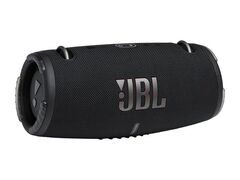


15 hours announced, a much wider real-world range depending on volume
JBL rates the Xtreme 3 for up to 15 hours of battery life, from a 36.3 Wh Lithium-ion battery, the largest of the JBL multi-function speakers covered on this site so far. That battery life depends heavily on listening volume, far more than on a less powerful speaker: the harder the amplifier works, the faster it drains.
At a fixed, moderate volume, battery life comfortably beats the manufacturer's claim: it reaches around 19 h38 under these conditions, more than 4 hours above the 15 hours announced. At a high volume, closer to what this speaker is built for (a large garden, a beach, a big gathering), it drops to somewhere between 7 and 9 hours. In between, at a medium to sustained volume, it sits around 12 to 14 hours.
| Volume condition | Battery life |
|---|---|
| Fixed, moderate volume | ≈19 h38 |
| Medium to sustained volume | 12 to 14 hours |
| High volume | 7 to 9 hours |
| Manufacturer's claim | Up to 15 hours |
This wide gap is nothing unusual for a 100W speaker: the Xtreme 3 is built to be pushed hard. The practical takeaway is simple: for a long day at sustained volume, it is safer to plan around 7 to 9 hours than the 15 hours on the product sheet.
The power bank function: two ports, a shared 12.5 W output
The Xtreme 3 belongs to the catalogue's multi-function speakers: its battery is not just for music, it can also bail out a smartphone or a small device. Two ports sit at the back: a USB-A port delivering up to 10 W (5 V / 2 A), and a USB-C port, also used to recharge the speaker itself, delivering up to 7.5 W (5 V / 1.5 A) as an output.
The detail worth knowing before plugging in two devices at once: these two ports do not add up. JBL caps the total output at 5 V / 2.5 A, or 12.5 W combined, no matter how many devices are connected. Charging a smartphone on the USB-A port while topping up a small device on the USB-C port means sharing that 12.5 W between the two, not stacking 10 W plus 7.5 W.
Out of the battery's 36.3 Wh, and with a typical USB conversion efficiency of around 80 to 85%, the energy actually transferable is close to 29 to 31 Wh. A current smartphone typically holds between 11 and 20 Wh, so the Xtreme 3 can fully recharge one with a comfortable margin left over, but it is not meant to replace a dedicated power bank: plugging in, unplugging, and going back to the music remains the main point of these ports.
A full recharge in 2h30, with the right charger
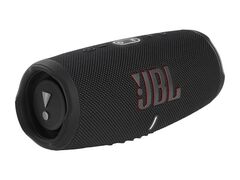
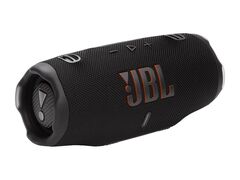
For a 36.3 Wh battery, the Xtreme 3 recharges quite quickly: a full charge takes 2 hours and 30 minutes with a USB-C charger capable of 20 V / 3 A, or 60 W, the maximum the speaker accepts. That is faster than the JBL Charge 5 (4 hours for just 27 Wh) and the JBL Charge 6 (3 hours for 34 Wh), an improvement that comes down to the higher input power the Xtreme 3 accepts.
| Model | Capacity | Full charge |
|---|---|---|
| Xtreme 3 | 36.3 Wh | 2 h30 |
| Charge 6 | 34 Wh | 3 hours |
| Charge 5 | 27 Wh | 4 hours |
With a less powerful USB-C charger, or a basic 5 V charger, that time stretches out in proportion: real-world charging speed depends directly on the charger's own power, not just on the battery's capacity. The USB-C cable is included in the box; a mains adapter capable of the full 60 W needed for the fastest charge is not always included, which is worth checking before buying.
IP67 water resistance, on condition the charging port cover is closed
The Xtreme 3 is IP67 rated: full protection against dust, and resistance to temporary submersion up to 1 metre for 30 minutes. Enough to set it down by a pool, out in the rain, or on a beach without a second thought.
That rating still comes with a simple condition that is easy to overlook: the rubber cover protecting the charging port, at the back of the speaker, has to be properly closed. Left open or not fully clicked shut, water resistance is no longer guaranteed under the same conditions. It is a nuance that a plain IP67 badge on a spec sheet does not always spell out, even though it directly governs the outdoor use this speaker is bought for.
This is the same water resistance as the JBL Charge 5, and one step behind the newer IP68 rating on the JBL Charge 6 (submersion up to 1.5 metres for 30 minutes), released five years later.
The real trade-off: close to 2 kg, double a Charge 5 or a Charge 6
At 1.968 kg for 29.9 x 13.6 x 13.4 cm, the Xtreme 3 is by far the bulkiest of the JBL multi-function speakers covered on this site. It weighs roughly double a Charge 5 (980 g) or a Charge 6 (960 g), for a battery capacity only 7% larger than the Charge 6 and 34% larger than the Charge 5.
This weight does not mainly come from the battery: it mostly comes from the four drivers, the two passive radiators and the reinforced chassis needed to sustain 100W continuously. The upshot for buyers stays the same: this is not something you slip into a bag for the day without noticing, unlike a Charge 5 or a Charge 6, and even less a dedicated power bank you would carry daily just for its backup function.
Build quality and long-term durability: no recall, a battery that will age like any other
On sale since October 2020, the Xtreme 3 has several years of track record with no official recall to date. Charging faults (a damaged port, a faulty charger) come up occasionally in online troubleshooting threads, which is fairly ordinary for a device sold since that date, not a sign of a widespread failure.
Like any Lithium-ion battery built into a device that is not designed for easy user replacement, the Xtreme 3's battery will gradually lose capacity over charge cycles: that is a normal process, and no reliable figure is available for this specific model on how many cycles it takes before the loss becomes noticeable. The USB-C charging port, shielded by its waterproof cover, is not exposed the same way as the bare USB-C port on a JBL Charge 5.
Against the Charge 5 and the Charge 6: three speakers, three trade-offs
| Criterion | Xtreme 3 | Charge 6 | Charge 5 |
|---|---|---|---|
| Price | £283.06 | £128.27 | £144.79 |
| Battery capacity | 36.3 Wh | 34 Wh | 27 Wh |
| USB output to charge a device | USB-A 10 W + USB-C 7.5 W (12.5 W combined) | USB-C, 10 W | USB-A, 10 W |
| Full charge | 2 h30 | 3 hours | 4 hours |
| Water resistance | IP67 | IP68 | IP67 |
| Weight | 1.968 kg | 960 g | 980 g |
| Multi-speaker pairing | PartyBoost | Auracast | PartyBoost |
On the battery side, the Xtreme 3 wins on raw capacity and on charging speed, and offers two external charging ports instead of one. It clearly loses on bulk, with a weight that doubles both its siblings for barely more capacity, and it stays on the Charge 5's IP67 rating rather than the newer IP68 on the Charge 6. None of the three qualifies as a genuinely versatile power bank: the charging function stays an occasional rescue across all three, not the main point of the device.
Who it suits, and who it does not
It suits anyone after the largest energy reserve among JBL's multi-function speakers on this site, who likes having two different ports to charge a device, and is not bothered by a bulky shape for a fairly static use (garden, patio, a beach trip by car).
It does not suit anyone after a light companion to carry around every day (a Charge 5 or a Charge 6 fit that better), nor anyone counting on the power bank function as a main energy reserve rather than an occasional rescue.