
Actual efficiency: 93 to 94% against a stated 96.7%
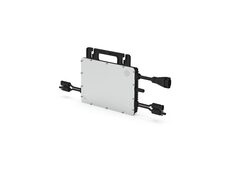
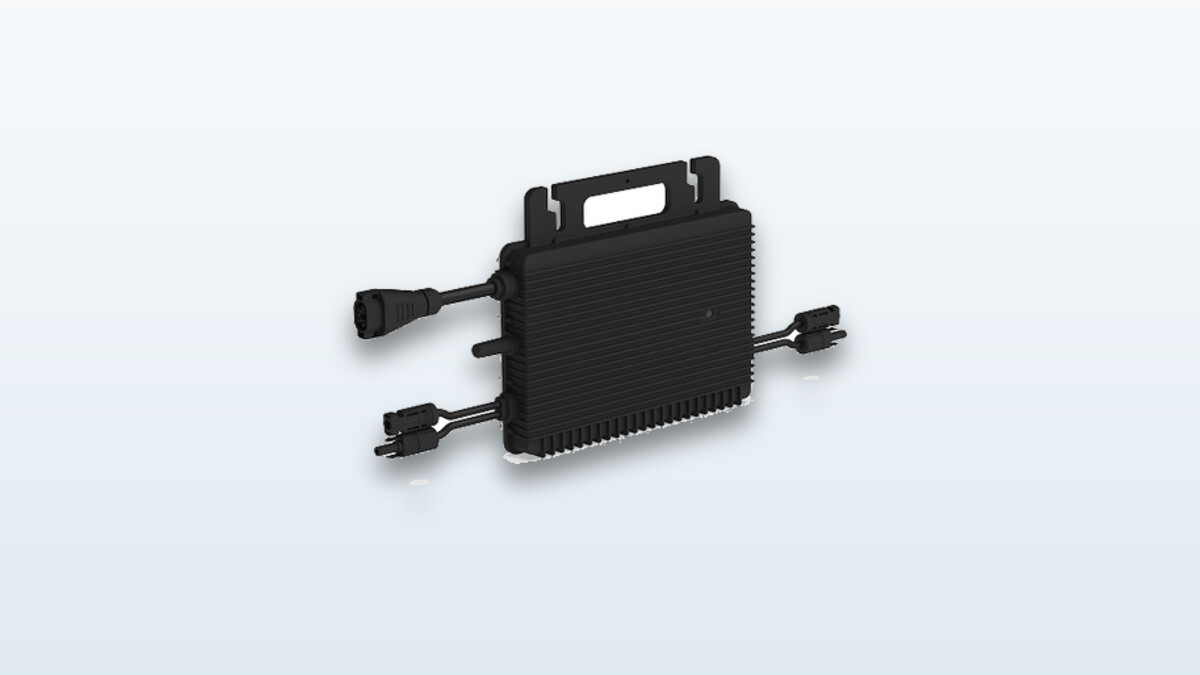
Real-world efficiency sits around 94.2%, against a stated 96.7% under the CEC standard. A second, less precise figure converges around 93%. The gap with the manufacturer's claim is real but modest, and the resulting score remains very good in absolute terms for a micro-inverter. Peak output power also reached 815 W, slightly above the rated value.
The independence of the two MPPT trackers, confirmed
Internally, the device behaves like two separate 400 W inverters, not a single inverter with a shared MPPT tracker. With two 450 W modules wired to a single input, a deliberate oversizing scenario, power output on that input stays capped at around 408 W in AC output. In practice, a shaded or poorly oriented panel does not penalise the other panel's output, a real advantage over single-tracker inverters.
The real weak point: WiFi and the monitoring app
This is the product's most persistent weakness: for more than a year, the built-in WiFi and the S-Miles Cloud app have regularly lost connection, with production data no longer appearing in the app even though the local WiFi signal stays green. The cause identified repeatedly is not hardware related: the module only operates on 2.4 GHz, and some home routers isolate WiFi devices from each other by default, blocking the upload to the cloud without cutting the local connection. Firmware updates have also sometimes been fragile to apply remotely.
An important point to remember: this instability concerns monitoring and data display, not the energy conversion itself. The inverter continues to convert energy normally even when the app shows nothing.
IP67 durability: what it covers
The device was immersed in water for one hour, with no prior drying, without affecting its operation. After 3h at full load with a 20 °C ambient temperature, the internal temperature reached 51 °C and the surface temperature 47 °C, consistent with well-controlled fanless operation. No structured feedback on several years of real-world weather exposure was found, however, either positive or negative.
Real firmware bugs, but resolved
Several converging signals, none of major severity: abrupt power fluctuations in one specific case, which resolved on their own after a few days, and an abnormal power limitation at high voltage, identified as a frequency-regulation bug and fixed by a later firmware update. These are real, fixed software bugs, not recurring hardware failures.
Regulatory compliance in France
In France, a CACSI declaration (self-consumption agreement without grid injection) with Enedis is required, free of charge, and processed online within 2 to 4 weeks. It applies specifically to installations where the inverter does not exceed 800 W AC, with no injection into the grid. A Consuel certificate is not required at this power level. The HMS-800W-2T delivers exactly 800 VA, a power rating that appears deliberately set at this threshold to stay within the simplest regulatory regime.
Regulatory compliance in Germany
In Germany, the VDE-AR-N 4105 standard specifically governs this type of installation. Since May 2024, the legal injection cap has risen from 600 to 800 W, exactly this device's native power output, with no manual limiting required. This is the most mature market in the world for this type of product, and the HMS-800W-2T is widely cited there as a reference point in the storage-free micro-inverter segment.
Price: consistent in France, notably cheaper in Germany
The catalogue price of €195.95 is consistent with observed French market prices, between €179 and €196 depending on the retailer. On the German market, however, the device alone commonly sells between €112 and €130, a clear gap that is not necessarily abnormal (different distribution margins, offers sometimes bundled with panels), but one worth knowing before buying.
Positioning and who this device is for
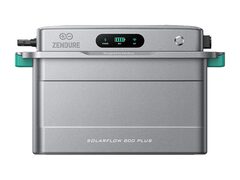
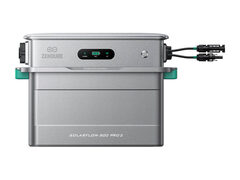
Against hybrid competitors like the Zendure SolarFlow 800 or the EcoFlow Stream, which add a storage function, the Hoymiles HMS-800W-2T remains a pure micro-inverter: all energy not consumed instantly goes back to the grid, with no way to recover it in the evening. In exchange, it offers one of the best warranties in its segment (12 years, extendable to 25 years, against 5 years for EcoFlow) and a reliability reputation backed by the manufacturer's position as the world's number one. Against the APsystems EZ1-M, its closest direct competitor in the storage-free segment, the stated efficiency is nearly identical. This is a sound choice for anyone who wants a simple entry point into balcony self-consumption, with the option of adding storage some other way later.