
A 1.8-pound booster, not a classic battery charger
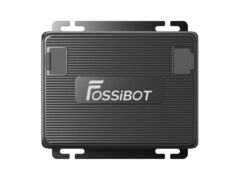
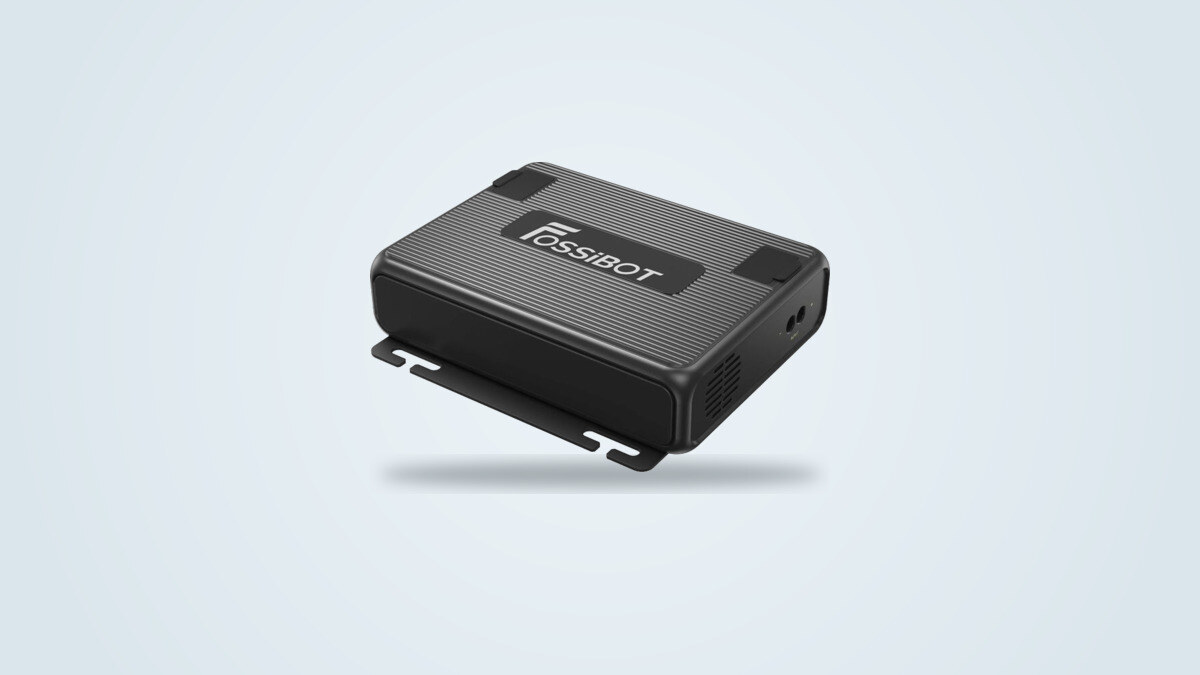
The Fossibot FAC580 is a DC-DC charger built to recharge a power station while driving, by drawing on the spare capacity of the vehicle's alternator. Priced at £179, it claims up to 580W of output, roughly six times a standard cigarette-lighter socket, at a stated conversion efficiency of 92%. It works on both 12V and 24V electrical systems, and stands out for a very compact footprint: 182 x 162 x 47 mm for 0.8 kg.
Its real quirk lies in its architecture. Where a classic alternator charger outputs 12V or 24V to recharge a lead-acid or lithium service battery directly, the FAC580 delivers a fixed 45 to 80V, meant for the solar input (MC4 connector) of a power station. In other words, it does not really charge a battery at all: it feeds the power station's own solar charge controller, which then manages the actual charging of its internal battery. That distinction, missing from most product listings, shapes everything that follows in this review.
What the claimed 580W are really worth
Fossibot documents two power tiers, driven purely by the voltage measured at the input rather than any genuine engine-speed sensor. The manufacturer labels them as two "modes" (engine running / engine off), though the exact thresholds differ slightly depending on which of its own official stores states them:
| Fossibot's framing | Input voltage | Max. output power |
|---|---|---|
| Engine running | 13.2 to 14V | 300W |
| Engine running | above 14V | 580W |
| Engine off | 12 to 12.75V | 300W |
| Engine off | above 12.75V | 580W |
Either way, the underlying logic is the same: below roughly 13V, output is capped at 300W; above that, it climbs to 580W. Most alternators hold above 14V from idle onward, which should let the FAC580 reach its full claimed output without needing a high engine speed, but that behaviour rests on the manufacturer's own documentation: no independent measurement confirms it so far.
Below 12V, the FAC580 automatically cuts its output to protect the starter battery from excessive discharge. On the input side, it accepts up to 45A, for an output capped at 15A across 45 to 80V. Against the other chargers in this comparison, the 580W figure exceeds the rated current of the CTEK D250SE (20A) and the Victron Orion-Tr Smart Isolated (30A) once put on a common voltage footing, and sits in the same range as the Renogy DCC50S, rated at 500W. None of these figures, the FAC580 included, has been cross-checked by any measurement independent of the manufacturer: this segment of alternator chargers remains, as a whole, thinly covered by outside testing.
Compatible with 99% of third-party power stations, but no chemistry-specific charge profile
Fossibot claims compatibility with its own full range (the F800, F1200, F2400, F3600 Pro and F7200 are explicitly named on its official stores) as well as with "99% of third-party power stations" fitted with an MC4 solar input that accepts 45V or more. That is a broad marketing figure that no independent measurement confirms so far: in practice it depends on the solar input range of each third-party station, which varies from one manufacturer to another and which buyers need to check for themselves before purchase.
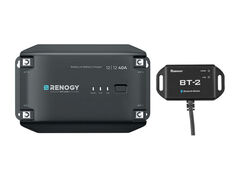
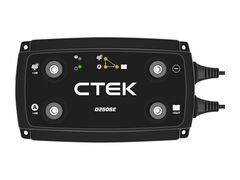
That is the biggest difference with the other three alternator chargers in this comparison. The CTEK D250SE manages six distinct lead-acid profiles (WET, EFB, Ca/Ca, MF, AGM, GEL) plus a dedicated lithium LiFePO4 profile at 14.2V; the Renogy RBC40D1U-BT2 distinguishes lead-acid (AGM, Gel, flooded) from lithium LiFePO4 with a fine adjustment range; the Victron Orion-Tr Smart likewise applies charge profiles specific to the connected service battery. The FAC580 never charges a service battery directly: it outputs a fixed 45 to 80V toward a power station's solar input, and that station applies its own charging algorithm to its own internal battery. "Chemistry compatibility" on the FAC580 therefore comes down to a matter of voltage and connector, not a charge curve.
On the input side, the FAC580 accepts both a 12V (12 to 18V) and a 24V (24 to 33V) electrical system, with no manual setting required: a genuine point in common with the other products in this comparison, all of which handle 12V and 24V.
No screen, no app: a switch and a fault light
The FAC580's interface is limited to an on/off switch and a single indicator light. According to the manufacturer's documentation, that light only comes on to flag a fault: it flashes red once a second for an input under-voltage or over-voltage event, together with a buzzer, and turns solid red once the temperature drops below -20 °C. Nothing indicates a normal charge in progress: the only way to know whether the FAC580 is actually recharging the power station is to look at that station's own display.
That simplicity has an upside: there is strictly nothing to configure at installation, so no risk of picking the wrong profile the way a manual selector charger allows. But for anyone wanting to monitor charging remotely, check a history, or get an alert, the FAC580 is the least equipped of the five products in this comparison.
A comprehensive protection list, but no fuse included
The FAC580 claims a broad set of protections: short-circuit, overcurrent, overheating, over-voltage, under-voltage and reverse polarity. On that last point, it stands apart from the CTEK D250SE, which explicitly states it is not protected against reverse polarity at the point of connection: a real advantage for the FAC580 if that protection works as claimed.
The automatic cutoff below 12V protects the starter battery from a deep discharge if the unit stays wired with the engine off. On the other hand, its stated standby draw (under 3W continuous) is a real weak point: translated to a 12V system left permanently wired, that works out to roughly 180 Ah a month, far above the under 1 Ah a month claimed by the CTEK D250SE on this same segment. A unit left wired all winter on a starter battery will therefore draw noticeably more with the FAC580 than with its CTEK rival.
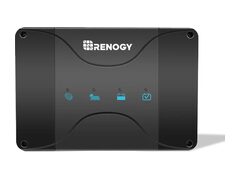
Another gap: no IP rating (dust and splash protection) is published on the manufacturer's official stores, even though the unit is designed to be bolted to the vehicle's bodywork, exposed to road spray and vibration. The CTEK D250SE, on this same point, states a full IP65 rating, and the Renogy RBC40D1U-BT2 an IP32 rating.
Finally, the box contents (FAC580 unit, 5 m 6 AWG input cable, 0.5 m output cable, six screws and four terminal caps, screwdriver, manual) include no fuse or fuse holder, even though the input cable connects straight to the starter battery's positive terminal. As with any automotive electrical add-on, it is up to the installer to add one near the battery.
A newer brand in this segment, a two-year warranty
Fossibot covers the FAC580 with a two-year warranty, matching the CTEK D250SE and the Renogy RBC40D1U-BT2 in this same comparison. The casing, ribbed and vented in the official photos, houses an active cooling fan and side vent; its 0.8 kg weight and 182 x 162 x 47 mm footprint make it the most compact of the five products compared here.
Fossibot nonetheless remains a newer brand in the specific segment of alternator chargers than CTEK, Renogy or Victron, all of which have been present for longer in this type of vehicle accessory. No outside teardown or longevity testing has turned up for the FAC580 so far, and no product recall has turned up for this model either: a picture that fits a still-young, thinly covered product rather than a proven problem.
Installation: a 5-metre input cable, MC4 output, fuse left to the installer
The FAC580 mounts directly onto the vehicle's bodywork or chassis using its built-in mounting brackets, near the starter battery or engine bay. The box includes the unit itself, a 5-metre 6 AWG input cable (long enough to reach most starter batteries from a mounting spot away from engine heat), a 0.5-metre output cable, six screws, four connector caps, a screwdriver and the manual.
On the output side, the FAC580 connects to the solar input (MC4 connector) of the power station being charged. Fossibot explicitly names its own range (F800, F1200, F2400, F3600 Pro, F7200) as compatible, alongside third-party stations that meet the required input voltage range (45V or more). Since no fuse is supplied, it is recommended to fit one on the positive cable, as close as possible to the starter battery, as with any added electrical branch on a vehicle.
Against the CTEK D250SE, the Renogy DCC50S, the Renogy RBC40D1U-BT2 and the Victron Orion-Tr Smart
How does the Fossibot FAC580 stack up against the other alternator chargers already reviewed on this site?
| Criterion | Fossibot FAC580 | CTEK D250SE | Renogy DCC50S | Renogy RBC40D1U-BT2 | Victron Orion-Tr Smart Isolated |
|---|---|---|---|---|---|
| Output | 45 to 80V toward a power station input | 12/24V toward a service battery | 12/24V toward a service battery | 12/24V toward a service battery | 12V isolated toward a service battery |
| Power / max. current | 580W (15A across 45 to 80V) | 20A | 50A (500W claimed) | 40A adjustable (40/30/20/10A) | 30A |
| Built-in solar input | No (it is the reverse: it feeds a station's own solar input) | Yes, 300W max | Yes, 660W max | No | No |
| Chemistry-specific charge profile | None, left to the power station | 6 lead-acid profiles + 1 lithium | Lead-acid and lithium profiles | Lead-acid (AGM/Gel/flooded) and lithium LiFePO4 | Lead-acid and lithium profiles |
| Control | Switch only, no settings | 3-position selector cable | Optional Bluetooth (BT-2) | Bluetooth BT-2 included | Built-in Bluetooth + app |
| IP rating | Not published | IP65 | Not stated | IP32 | Not stated |
| Weight | 0.8 kg | 0.7 kg | Not stated | Not stated | 1.6 kg |
| Observed price | £179.00 | £244.46 | £199.99 | £109.99 | £179.19 |
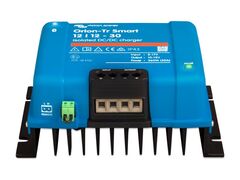
The FAC580 claims the highest output of the group and the lowest observed price, but it is also the only one of the five that does not charge a service battery directly: comparing it with the other four only makes sense if the intended use is really recharging a power station through its solar input, not maintaining a set of hardwired lead-acid or lithium batteries. The Renogy RBC40D1U-BT2 remains the group's reference for equipment-per-pound value (Bluetooth included, IP32 stated, cheaper than the FAC580), and the Victron Orion-Tr Smart Isolated for anyone wanting full galvanic isolation with built-in control.
Who the Fossibot FAC580 is for
The FAC580 is aimed above all at anyone who already owns a compatible power station (from Fossibot's own range or another brand with a suitable MC4 solar input) and wants to recharge it faster while driving, on a tight budget. Its claimed 580W and £179 price make it, on paper, the most powerful and cheapest option in this comparison for that specific use.
It is not, however, a fit for anyone looking to recharge a hardwired lead-acid or lithium service battery in the vehicle: none of the FAC580's ports are designed for that. For that use, the Renogy RBC40D1U-BT2 offers better equipment for a lower price, and the Victron Orion-Tr Smart Isolated remains the reference for full galvanic isolation. Anyone wanting remote monitoring or a charge history will also find both of those better equipped than the FAC580, which offers no connectivity at all.