
A UPS built for one router, one modem or a small NAS, not more
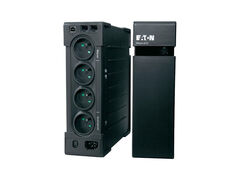
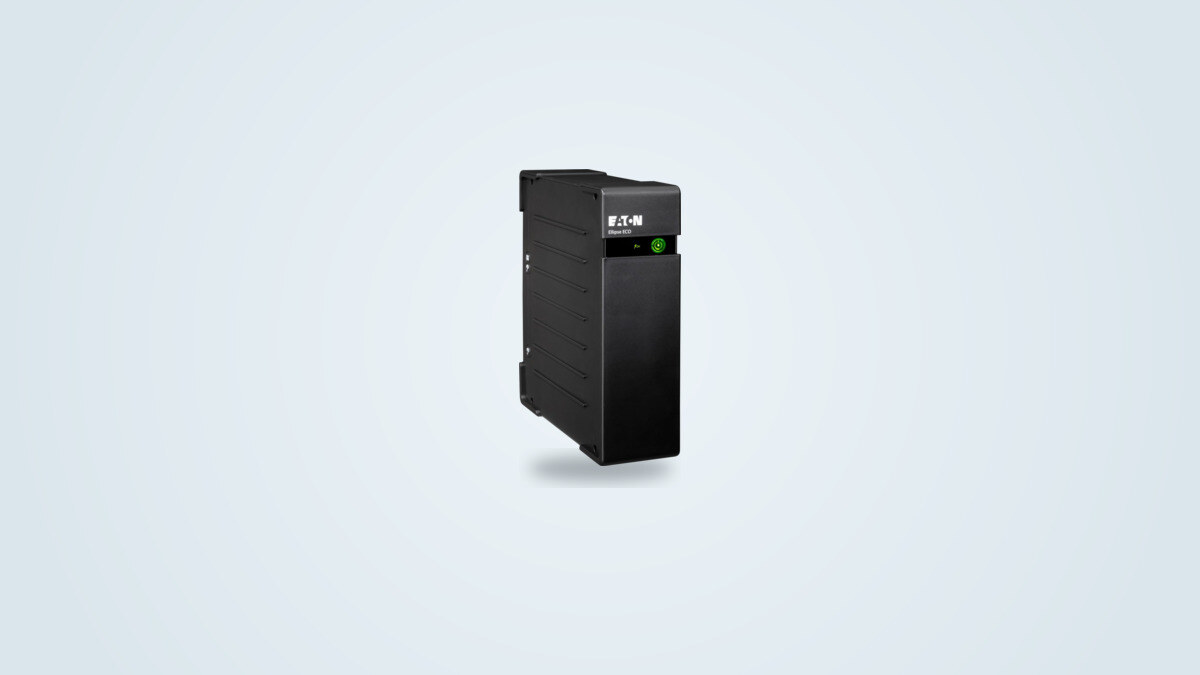
The Eaton Ellipse ECO 650 USB IEC is the entry point of Eaton's Ellipse range: an off-line UPS rated at 650 VA and 400 W of continuous power, fitted with 4 IEC C13 outlets, 3 of which are genuinely battery-backed. Its size and price position it very precisely: protecting one fixed piece of electronics that cannot tolerate even a brief outage, a router, a modem or a small backup NAS, not several at once.
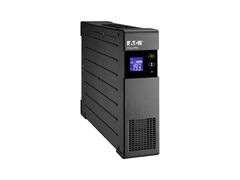
Against the Eaton Ellipse PRO 1200 already in our catalogue (1200 VA / 750 W, 8 outlets, LCD display), the ECO 650 clearly plays its entry-level role: no display, fewer outlets, power sized for a single isolated device. It remains Eaton's most widely available reference in this segment, even though the manufacturer now flags it as nearing the end of its production run, a point covered later in this review. The 81 x 263 x 235 mm tower case tucks away easily under a desk, behind a modem or next to a router, with no particular ventilation clearance needed.
What the rated 5 minutes of runtime are actually worth
Eaton rates about 5 minutes of runtime at full load (400 W) and 9 minutes at half load (200 W) for the Ellipse ECO 650. Converted to watt-hours from these two official points, those minutes represent roughly 33 Wh and 30 Wh of usable energy from the sealed 12 V / 7 Ah lead-acid battery. The consistency between both points confirms they come from one and the same energy reserve, not from unrelated figures.
The figure makes real sense once set against Back-UPS units of comparable power already reviewed on this site. The Back-UPS 850VA (BE850G2-FR) rates about 2 minutes at its own full load of 520 W, or roughly 17 Wh returned. The Back-UPS Pro 650VA (BR650MI) rates about 3 minutes at 390 W, or roughly 19.5 Wh. At comparable load, the Ellipse ECO 650 therefore returns nearly double the usable energy of these two direct rivals.
For a router or a modem that rarely draws more than 20 to 30 W, this reserve is plenty to ride out an outage, or to give the monitoring software time to trigger a clean shutdown of the NAS before the battery is fully drained.
An off-line switch faster than some supposedly smarter line-interactive rivals
The Ellipse ECO 650 runs on an off-line (standby) topology: in normal operation, mains power feeds the connected devices directly, and the UPS only switches to its battery the instant it detects an outage or a voltage sag. Eaton rates that switch at between 4 and 8 milliseconds, an official figure worth taking at face value: fast, even against rivals marketed as more sophisticated.
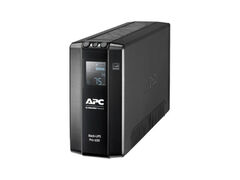
The Back-UPS Pro 650VA (BR650MI), despite its line-interactive topology with automatic voltage regulation (AVR), rates a switch time of 10 to 12 milliseconds: slower than the Ellipse ECO 650, despite an architecture marketed as more advanced. The Back-UPS 850VA (BE850G2-FR), also off-line, sits in between at 6 to 10 milliseconds.
For a router, a modem or a standalone NAS plugged into a home installation that is already protected upstream, that nuance matters less than the switch speed itself: it is what decides whether the protected device reboots or not during a hard outage.
4 IEC C13 outlets, one reserved for surge and phone-line protection only
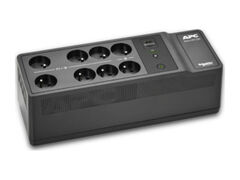
The 4 outlets on the Ellipse ECO 650 USB IEC split into 3 battery-backed and surge-protected outputs, plus a fourth surge-protection-only outlet paired with phone-line/RJ45 protection. That split is more modest than its two direct rivals already reviewed on this site: the Back-UPS 850VA (BE850G2-FR) offers 8 outlets with 6 battery-backed, the Back-UPS Pro 650VA (BR650MI) offers 6, all battery-backed.
In practice, 3 battery-backed outlets are enough to cover this product's intended scenario: a router, its modem, and a small backup NAS. The moment a fourth device joins in, a network switch, a Wi-Fi repeater, it either goes on the surge-only outlet with no battery backup, or you move up to a better-equipped unit like the Back-UPS 850VA or the Eaton Ellipse PRO 1200. The built-in phone-line/RJ45 protection, on the other hand, is a genuine plus for anyone running an ADSL or fibre modem behind the UPS.
Eaton rates the output power factor at 0.6, worth keeping in mind for loads that draw a lot of reactive power (certain monitor or PoE switch power supplies): it caps the real active power available before the UPS flags an overload, even below the 400 W apparent-power ceiling.
Eaton UPS Companion: the only software of the four that covers Mac and Linux
The Ellipse ECO 650's USB port (HID standard) pairs with the free Eaton UPS Companion software, which lets you schedule an automatic, clean shutdown of the NAS or connected computer if an outage runs long, track live power consumption, and configure the UPS's settings. Its stated compatibility spans Windows, Mac and Linux.
That is a genuine difference against the three APC Back-UPS units already reviewed on this site: their PowerChute Personal Edition software stays limited to Windows in all three cases, with macOS left to a native system shutdown with no monitoring or configuration features. For a NAS running Linux or a vendor-specific OS (Synology, QNAP, TrueNAS), that breadth of compatibility counts for more than a marketing line.
In exchange, the Ellipse ECO 650 has no control display at all: just two LEDs (mains/battery status and charge) report on operation, where the Back-UPS Pro 650VA shows live battery charge and power draw on an LCD screen. It also lacks any dedicated USB port for charging a phone or tablet, present on both the Back-UPS 850VA and the Back-UPS Pro 650VA.
Completely silent, compact case, user-replaceable battery
The Ellipse ECO 650's fully passive design, with no fan at all, translates into a noise level officially under 25 dB at one metre, genuinely silent operation only noticeable in an already very quiet room. That is a real selling point for a home office or a lived-in living room, where the more powerful Eaton Ellipse PRO 1200 fits an audible fan.
The sealed 12 V / 7 Ah lead-acid battery is user-replaceable, no small thing on a unit whose battery is its most wear-exposed part. Eaton rates a regular automatic battery test, protection against deep discharge, and cold-start capability. The manufacturer's standard warranty is 2 years, optionally extendable to 3 or 5 years, in line with the segment: also 2 years for the Back-UPS Pro 650VA, 3 years as standard for the Back-UPS 850VA.
The 3.6 kg case stays CE-certified and compliant with the IEC/EN 62040-1 and 62040-2 standards, the industry references for UPS safety and electromagnetic compatibility. Eaton rates it usable up to 2000 metres of altitude, a detail that matters for a mountain cabin running on solar power.
FR, DIN, IEC, 5S550: four different products under one commercial name
The « IEC » suffix on this model is not a marketing label: it denotes a version fitted with 4 IEC C13 outlets, the connector used on computer power cords, distinct from other versions of the same Eaton Ellipse ECO 650 range sold in other markets. The version built for France, sold as the « USB FR », instead carries 4 genuine French type E sockets: identical electrical ratings, the same 650 VA / 400 W, but a different connector, physically incompatible with either of the other two.
The German and Spanish markets get a third version in turn, sold as the « USB DIN »: 4 Schuko type F sockets in place of the IEC C13 outlets. This approach, common on network- and IT-oriented UPS units like the IEC version reviewed here, explains why one single Eaton product carries three different commercial names (FR, DIN, IEC) for one and the same internal electronics.
In the United States, Eaton simply does not sell the Ellipse ECO range at all: it sells its 5S range there instead, whose 5S550 model (550 VA / 330 W, 8 NEMA 5-15R outlets, line-interactive topology) occupies an equivalent entry-level spot, with noticeably different specifications from the ones described in this review, covered in detail in the version published for the US market.
Against three APC Back-UPS units and its own bigger sibling, the PRO 1200
How does the Ellipse ECO 650 USB IEC stack up against the three APC Back-UPS units already reviewed on this site, and against its own bigger sibling, the Eaton Ellipse PRO 1200?
| Criterion | Ellipse ECO 650 USB IEC | Back-UPS 500VA (BX500MI) | Back-UPS 850VA (BE850G2-FR) | Back-UPS Pro 650VA (BR650MI) |
|---|---|---|---|---|
| Power | 650 VA / 400 W | 500 VA | 850 VA / 520 W at full load | 650 VA / 390 W |
| Topology | Off-line | Line-interactive (AVR) | Off-line (standby) | Line-interactive (AVR) |
| Switching | 4 to 8 ms | Not stated | 6 to 10 ms | 10 to 12 ms |
| Outlets | 4 (3 battery-backed) | 3 (IEC C13) | 8 (6 battery-backed) | 6 (all battery-backed) |
| Software | Windows / Mac / Linux | Windows (native macOS) | Windows (native macOS) | Windows (native macOS) |
| Display | No, LEDs only | No | No | Yes, LCD |
| Observed price | £138.74 | £82.65 | £145.50 | £167.97 |
Against the cheaper but less capable, phone-protection-free Back-UPS 500VA, the Ellipse ECO 650 justifies its higher price with power and software versatility. Against the better-equipped, cheaper Back-UPS 850VA, the Ellipse ECO 650 answers with a faster switch and broader software, but stays behind on how many devices it can protect. Against the most complete of the three, the LCD-equipped Back-UPS Pro 650VA, the Ellipse ECO 650 keeps the edge on switching speed and complete silence. Against its own bigger sibling, the twice-as-powerful, 8-outlet Eaton Ellipse PRO 1200, the ECO 650 remains the logical choice for a single isolated device rather than a full network setup.
An announced end of production: what that means for buyers
Eaton now flags this reference as nearing the end of its production run on its official product page. In practice, the unit stays in distribution and in stock at several retailers as of this review's publication date, but that flag is worth keeping in mind ahead of a long-term purchase: spare-part availability, replacing the battery a few years down the line, or simple restocking at your usual retailer.
On underlying reliability, Eaton remains an established player in the UPS field, with an Ellipse range sold for many years and a standard 2-year warranty extendable to 3 or 5 years, a sign of the manufacturer's confidence in the unit's longevity beyond the battery alone. No recurring manufacturing fault or product recall turned up for this reference at the time of writing.
For a purchase with no very-long-term ambitions, the announced end of production changes nothing about day-to-day use; it is mainly worth weighing at the point of purchase if the future availability of a compatible replacement battery matters to you.
Who the Ellipse ECO 650 genuinely suits, and who it does not
The Eaton Ellipse ECO 650 USB IEC is aimed first at anyone protecting one fixed piece of electronics that cannot tolerate even a brief outage: a router, a modem, a Starlink dish tied to a residential solar setup, or a standalone entry-level NAS. Its complete silence also makes it a good fit for a home office or a lived-in living room, where a fan-cooled unit would be a nuisance day to day.
It suits less well anyone protecting several pieces of network gear at once (a multi-bay NAS, a switch, several workstations): the count of battery-backed outlets, capped at 3, quickly becomes a constraint, and the Eaton Ellipse PRO 1200 or the better-equipped Back-UPS 850VA take over for a similar budget. It also does not suit anyone after live visual monitoring with no computer attached: with no display, only the Eaton UPS Companion software, installed on a machine connected over USB, gives access to charge and consumption detail.
For its intended job, protecting one isolated device from a mains outage with maximum acoustic discretion, the Ellipse ECO 650 USB IEC remains a sensible, well-equipped pick with a genuinely fast reaction time.