
What the claimed 3014 Wh are really worth
The Bluetti Elite 300 claims 3014.4 Wh of usable capacity, a nominal figure tied to its LiFePO4 (LFP) chemistry and its claimed 6000 cycles before dropping to 80% of original capacity, a threshold well above the 3000 to 4000 cycles typical of the category. As with any inverter-based station, the energy actually delivered at the output depends heavily on the power drawn and the path the current takes.
Under a light mains load (around 200 W), the return sits around 88% of the claimed 3014 Wh, or just under 2700 Wh usable. That rate climbs as the load increases: at high AC power (around 2400 W), the return reaches 92 to 93%. The direct DC output, through the 12 V port, proves even more efficient, around 94%, because it skips the inverter's conversion stage, whose own overhead weighs proportionally heavier at low power.
The most compact station in its class
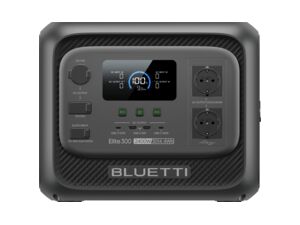
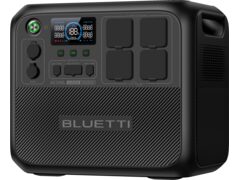
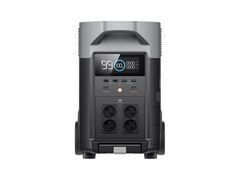
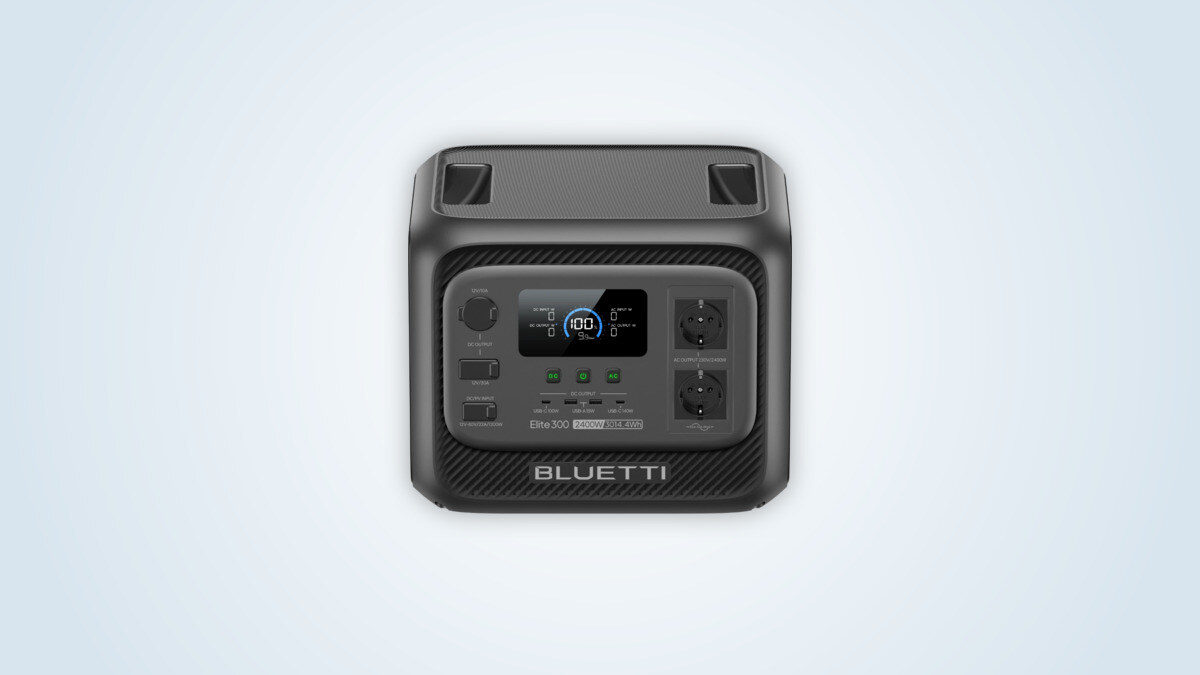
This is the Elite 300's central argument: genuine 3 kWh capacity in a 26.3 kg case measuring 36.6 x 30.5 x 29.75 cm, certified by Frost & Sullivan as the most compact 3 kWh station on the market. Per kilogram carried, the Elite 300 returns around 115 Wh, a ratio that holds up against close references in the same catalogue: the EcoFlow Delta Pro, with 3600 Wh for 45 kg, caps out at 80 Wh/kg, and the Bluetti AC200L, with 2048 Wh for 28.3 kg, drops even further to 72 Wh/kg despite a lower capacity.
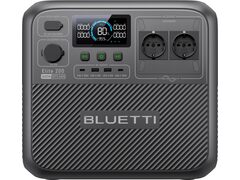
Against its own closest relative, the Elite 200 V2 (2074 Wh for 24.2 kg, or around 86 Wh/kg), the Elite 300 gains 45% more capacity for just 2.1 kg extra. That ratio is what makes the station suit nomadic use (van, motorhome) just as well as compact home backup, small enough to stay in a cupboard rather than take up a corner of the garage.
This record stays relative to its category, though: 26.3 kg is still 26.3 kg. The format carries with two hands over a short distance, but does not move around as easily one-handed as a 1 kWh station would. That is the accepted trade-off of genuine 3 kWh capacity, however much care goes into the compactness.
Does the claimed power hold under real load?
The Elite 300 claims 2400 W of continuous output and a 4800 W surge for the inrush current of motor-driven or resistive appliances. Running a kettle and an iron at the same time generated a current draw close to 3050 W, absorbed without a cutout, a comfortable margin above the claimed continuous power. A microwave, a small space heater or a high-power toaster oven start and run without particular reserve, within the 2400 W continuous limit.
No thermal throttling or power degradation over time affects this model. The station delivers what it claims, without the hidden conditions that other models sometimes impose (an unreachable surge figure in practice, power shared between outlets).
Recharging: three modes, a genuine speed/efficiency trade-off
On mains power, the Elite 300 offers three charging modes: fast (up to 2300-2400 W), standard (1200 W) and quiet (800 W), with the BMS adjusting the power actually accepted based on battery temperature and state of charge. In fast mode, the station reaches 80% in around 1h36 and a full charge in just over 1h40. Standard mode stretches that to around 2h50, and quiet mode to around 4h20.
That choice of speed carries an energy cost: charging efficiency (the mains energy drawn to actually store the 3014 Wh) reaches around 87% in standard mode (1200 W) but drops to around 85% in fast mode (2300 W). This drop, the opposite of the trend described for output efficiency above, comes from conversion losses that increase with charging current. Charging fast therefore costs a little more electricity than charging slowly.
The solar input accepts up to 1200 W (12 to 60 V, 22 A maximum) and can combine with mains charging in fast mode, for a combined total of up to 2400 W (1200 W mains + 1200 W solar).
| Mode | Power | Full charge | Approximate noise level |
|---|---|---|---|
| Fast | 2300-2400 W | ~1h40 (80% in ~1h36) | 50-54 dB |
| Standard | 1200 W | ~2h50 | ~45 dB |
| Quiet | 800 W | ~4h20 | ~40 dB |
The main friction point: the fan
This is the most consistent reservation on the Elite 300: the fan makes itself heard as soon as fast charging starts. Noise levels reach 50 to 54 dB at 1 metre during fast charging or at full output power, comparable to a sustained conversation. In everyday use or quiet charging mode, it drops to 40 to 45 dB, noticeably more discreet. The gap between the two situations is clear: the noise tracks the charging mode and the power drawn directly, not a permanent fault in the cooling system.
In practice, this noise is mostly felt during fast recharging or at high output power, two situational moments rather than a constant. For overnight home backup use, where the station idles on small loads, the noise level stays close to quiet mode. It is in a motorhome or a tent, in a confined space, that the annoyance is felt most.
Ports: a tight allowance in Europe
The Elite 300's European mains output is limited to two 230 V sockets. That is also true of its Elite 200 V2 relative, but it is a genuine gap against direct rivals in the same capacity class: the Bluetti AC200L (same brand, lower capacity) and the EcoFlow Delta Pro each offer four. Running several bulky appliances at once then calls for a power strip.
The rest of the port selection is more generous: two USB-C ports up to 140 W each (enough to charge a demanding laptop without a separate mains adapter), a 15 W USB-A port, a standard 12 V output, and notably a new XT90 12 V/30 A (360 W) output, which powers certain 12 V equipment directly on DC, without going through the inverter or its conversion losses. Control runs through a built-in LCD screen and a mobile app, with Bluetooth and Wi-Fi.
Home backup: the UPS mode
The Elite 300 includes a backup inverter (UPS) mode that switches to battery within a stated 10 ms during a mains outage, a delay short enough to avoid interrupting a router, a home hub or a desktop computer without its own battery. This figure comes from the manufacturer's documentation.
For home backup use, the combination of capacity (3014 Wh), 2400 W continuous output and UPS switchover covers a common scenario: keeping a fridge, lighting and home internet running through a multi-hour outage, without the installation constraints of a hard-wired home UPS. The limit stays the same one noted above: only two mains sockets, which can call for a power strip if several backup devices need power at the same time.
Reliability, warranty and industry recognition
The manufacturer covers the Elite 300 with a 5-year warranty and claims 6000 charge cycles before dropping to 80% of original capacity, two figures above the usual standards of the category (often 2 to 3 years of warranty and 3000 to 4000 cycles among several rivals). No product recall or safety incident affects this model since its launch in March 2026.
Build quality is solid, though the LCD screen remains hard to read in direct sunlight, a minor but real flaw for outdoor use. The station has also picked up several industry recognitions since launch, including a Frost & Sullivan certification for its compactness and an editorial distinction at CES 2026; these accolades reflect the product's design and do not replace years of real-world track record, still too short at this stage for such a recent model.
Against close references in the catalogue
Within the catalogue itself, the Elite 300 sits between two families: compact stations around 2 kWh (Elite 200 V2, AC200L) and heavier high-capacity stations like the EcoFlow Delta Pro. It borrows the best of both worlds on one specific point, the capacity-to-weight ratio, without claiming to match the Delta Pro on output power or socket count.
| Criterion | Elite 300 | Elite 200 V2 | AC200L | Delta Pro |
|---|---|---|---|---|
| Capacity | 3014 Wh | 2074 Wh | 2048 Wh | 3600 Wh |
| Weight | 26.3 kg | 24.2 kg | 28.3 kg | 45 kg |
| Capacity/weight ratio | ~115 Wh/kg | ~86 Wh/kg | ~72 Wh/kg | ~80 Wh/kg |
| Continuous AC power | 2400 W | 2600 W | 2400 W | 3600 W |
| Mains sockets | 2 | 2 | 4 | 4 |
| Observed price | £1599 | £1110.90 | £1281.94 | £2499 |
The Delta Pro remains the reference for anyone wanting maximum sockets and power without worrying about weight. The Elite 300 targets a different crowd: those who actually want to carry their station, without compromising on capacity.
Who the Elite 300 suits, and who it does not
The Elite 300 suits, above all, regular nomadic use (a converted van, a motorhome) where every kilogram carried counts, and where genuine 3 kWh capacity avoids overly frequent recharges. It suits compact home backup just as well: its size lets it stay in a cupboard rather than take up a corner of the garage, unlike stations of comparable capacity that are far heavier.
It suits less well anyone needing to power several large mains appliances at once (the AC200L or the Delta Pro, better equipped with sockets, fit that better), anyone after continuous power above 2400 W, or anyone planning to expand capacity with an add-on battery: the Elite range is not expandable. Users particularly sensitive to noise for overnight indoor use should also favour the quiet charging mode, at the cost of a noticeably longer recharge time.