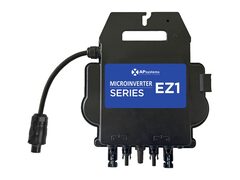

Two genuinely independent MPPT inputs, up to 1460 W input
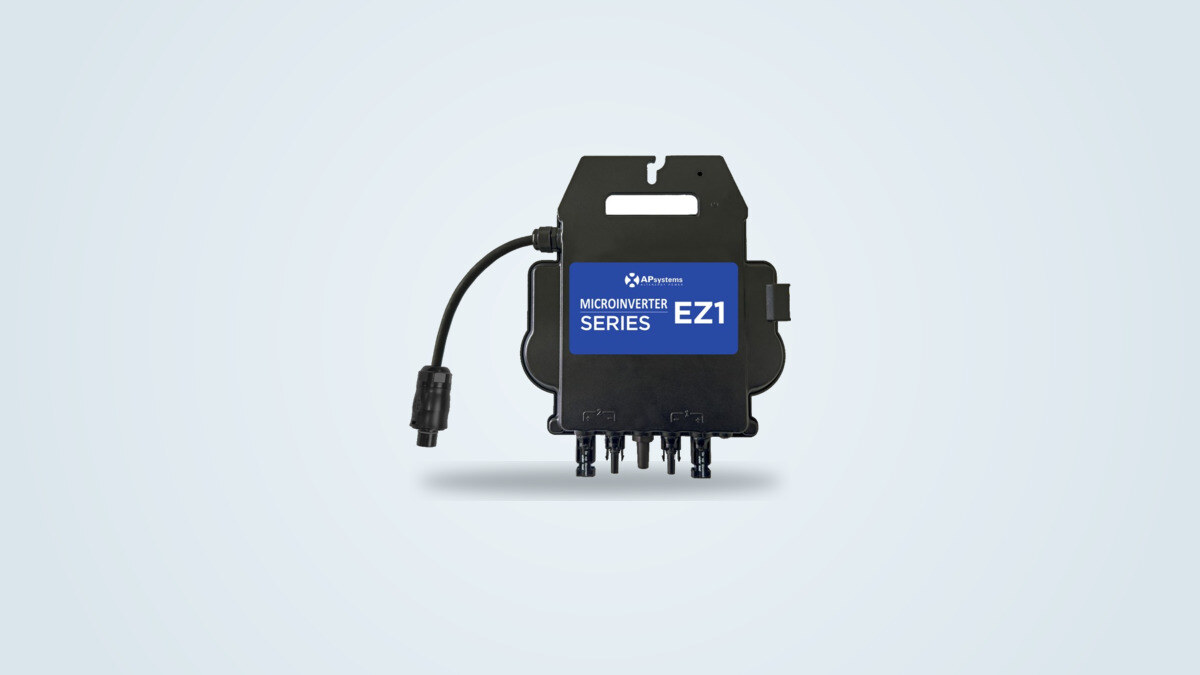
Each panel connected to the EZ1-M gets its own maximum power point tracking (MPPT), with no dependency between the two inputs. A panel that is partly shaded in the afternoon or faces a different direction from the other keeps producing whatever it can, without dragging down the other panel's output: exactly the situation most balconies and facades create, since the two panels almost never face precisely the same way. Each input accepts a panel from 300 to 730 Wp, for a combined input rating of 1460 Wp, higher than the 1200 W typical of its two closest rivals in the storage-free segment.
This independence goes beyond theory: regulation per input stays asymmetric, with up to 500 W allowed on a single line, which supports overpaneling (wiring more peak wattage than the AC output can ever return) with up to four panels split across the two physical inputs via Y-splitters. Useful for anyone who wants to spread production across the day rather than chase a narrow midday peak, for instance with two panels facing east and two facing west on a single input.
The stated efficiency, and what can actually be checked
APsystems states a peak efficiency of between 96.7% and 97.3% depending on the datasheet version, plus an MPPT tracking efficiency of 99.5%. In full sun, total output from both channels commonly reaches 810 to 825 W, at or slightly above the nominal 799 VA: the unit holds to its power promise.
One honest caveat is worth flagging: there is no externally checkable comparison figure for the EZ1-M's actual conversion efficiency at this point, unlike two direct rivals in the same segment, the Hoymiles HMS-800W-2T (real-world efficiency between 93% and 94%, against a stated 96.7%) and the EcoFlow Stream microinverter (90% to 96% depending on the power drawn). The EZ1-M's manufacturer figure therefore remains a consistent factory value across several datasheet revisions, without external cross-checking so far: neither a mark against it, nor a confirmation.
The grid-injection limit: one number that means something different in every market
The EZ1-M feeds any electricity the household is not using at that moment straight into the domestic grid. That act, grid injection, is regulated differently in every market, with one recent point in common: most European countries are now converging on a technical ceiling close to 800 W AC, while keeping very different paperwork on top of it. For a unit that plugs into a household socket rather than going through a professional installer, that paperwork is not a footnote: it decides whether the install stays a weekend project or turns into a multi-week administrative process.
| Market | AC limit | Process |
|---|---|---|
| Germany | 800 VA (up to 2000 Wp of panels) | Free self-registration in the Marktstammdatenregister, no separate notice to the grid operator needed |
| France | 800 W per delivery point | Declaration to Enedis before commissioning, regardless of power; a Consuel certificate is only needed beyond a dedicated circuit |
| Italy | Up to 799 W (the « mini-FV » tier) | A mandatory Comunicazione Unica to the local distributor, plus a compliance declaration above 350 W |
| Spain | 800 W (the ITC-BT-40 technical threshold) | A technical threshold, not an automatic exemption: self-consumption still has to be registered with the regional authority |
| United Kingdom | G98/G99 approved (ENA reference) | The datasheet is compliant, but the supplied Schuko plug does not fit UK sockets; the cleaner route runs through a registered electrician |
| United States | Varies by state, no single federal framework | Legal only in a handful of pioneer states; the EZ1-M itself, built for a 230V grid, is not the model sold on that market |
The United Kingdom sits in an odd middle ground here. The EZ1-M has passed G98/G99 type approval and is listed on the ENA's database (reference ALTEN/12127/V1/A1), so the unit itself is approved for DNO-side compliance. In practice, though, it ships with a Schuko mains plug, which does not fit a UK socket: fitting a UK plug or wiring it directly into the consumer unit through a registered electrician is the cleaner route, rather than the simple wall-plug approach that has become routine in Germany. A new BSI product standard meant to settle the plug-socket question for this category was expected around mid-2026; it is worth checking whether it has since taken effect before assuming a straightforward plug-in install.
Installing it, without an electrician
Mounting follows the same pattern as most balcony microinverters: the unit fixed under the panels or under a railing, MC4 connectors (Stäubli-made on the EZ1-M, a real mark of quality on this specific part) clipped between panels and inverter, an optional 5m mains cable plugged into a standard socket. No work on the fuse board is needed.
Pairing with the AP EasyPower app happens via QR code, first over Bluetooth then WiFi, within a few minutes in most cases. Two real points deserve attention at first startup: some units arrive factory-set to a 600 W output ceiling rather than the limit actually allowed in the destination country, a setting worth checking and adjusting in the app; and at least one case exists where a firmware update was needed before Bluetooth or WiFi pairing worked at all, on kit resold as a bundle. Neither point is a dealbreaker, but both are easier to plan for on the ground than halfway up a ladder.
App control: real strengths, one real friction point
The AP EasyPower app shows live output, history by panel, day, week, month and year, and handles firmware updates. The most clearly identified weak point concerns the connection itself: the module only runs on 2.4 GHz WiFi (no 5 GHz), with a practical range of around ten metres before a repeater becomes necessary, and dropped connections come up repeatedly. One important point: those drops only affect monitoring and history inside the app, not the energy conversion itself, which keeps working normally even when the app stops showing anything.
In exchange, the EZ1-M offers an advantage rare on this segment: a local HTTP API, switched on directly from the app with no account or subscription required, plus native Home Assistant support. Local data refreshes roughly every ten seconds, far quicker than a cloud-only feed. Enough to build a home dashboard without depending on a remote server, an option neither the Hoymiles HMS-800W-2T (which leans mainly on unofficial community tools for local use) nor the EcoFlow ecosystem offer quite as simply.
Without a battery, surplus goes straight to the grid
The EZ1-M stores nothing on its own: it is a pure microinverter, not a hybrid system. Any electricity generated and not used by the household at that moment goes back to the public grid, with no way of recovering it in the evening. For a household empty during the day, a good share of production ends up on the grid rather than cutting the evening bill, a point worth building into any savings expectations.
That is not a hidden flaw, it is simply how a storage-free microinverter works, identical to a Hoymiles HMS-800W-2T. What actually matters is the household's own daily pattern: a home occupied all day (remote work, retirement, constant presence) puts most solar output to use straight away, while a flat empty from 9 to 6 loses most of it to the grid, regardless of any setting on the unit itself. A rough estimate of daily household consumption before buying counts for more here than any debate over the inverter's own efficiency figure.
Compatible batteries: a short list, not an ecosystem
Three third-party batteries appear on APsystems' official direct-DC compatibility list: the Anker E1600 (1.6kWh), the APstorage River1600 (1.6kWh, technically very close to the Anker), and the Sunlit BK215 (2.15kWh).
The difference with Zendure or EcoFlow is structural, not just a matter of capacity: both brands offer a modular ecosystem, where extra batteries get added over time, up to 11.52kWh with Zendure. The EZ1-M, by contrast, sticks to a direct connection with just one of the three listed batteries, with no further expansion. That is a deliberate choice for simplicity, not an oversight: anyone wanting expandable storage from day one is in the wrong place; anyone wanting to bolt on a single fixed battery later is well served by the list. Before buying any of the three, it is worth checking current firmware compatibility with APsystems directly, since approval for a given battery model was not always granted from day one.
Build quality, longevity and warranty
The IP67 housing packs a high-frequency transformer for galvanic isolation, a built-in safety relay and rapid shutdown, all inside a compact 263 x 218 x 36.5mm footprint weighing 2.8kg. The stated operating range, -40 °C to +65 °C, comfortably exceeds what a European home ever demands. The standard warranty runs 12 years, among the longest in the consumer microinverter segment. Rapid shutdown isolates both inputs from the grid automatically when needed, a safety feature that matters more on a unit mounted outdoors permanently than on one kept indoors.
On sale since 2023, the EZ1-M is one of the most widely used balcony microinverters in Europe, with several full outdoor seasons behind it, longer than newer rivals such as the EcoFlow Stream or the Zendure SolarFlow 800 Pro 2. Isolated full failures do turn up, both channels dead at once on one unit, a single input losing power on another, with no sign pointing to an elevated failure rate: these read as isolated cases, not a widespread problem, and the Stäubli-made MC4 connectors add confidence on the mechanical side of things.
Against the direct competition: Hoymiles and Zendure SolarFlow
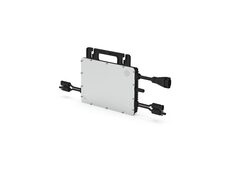
In the storage-free microinverter segment, the closest direct rival is the Hoymiles HMS-800W-2T. Both units share the same philosophy and an almost identical stated efficiency; the EZ1-M comes out ahead on solar input headroom (1460 Wp against a tighter setup on the Hoymiles) and on free local control, while the Hoymiles leans mainly on its S-Miles cloud app.
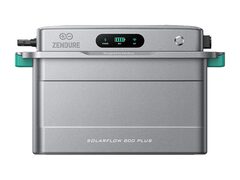
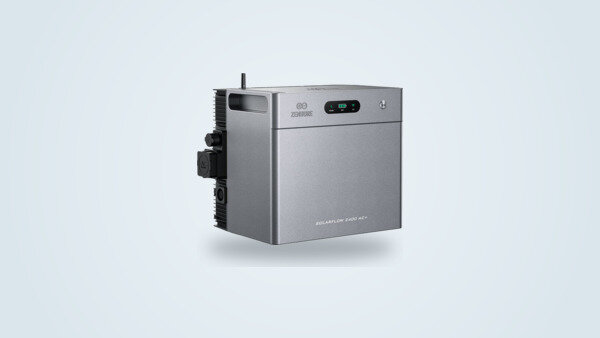
The Zendure SolarFlow 800 (Plus or Pro 2) plays a different game: a 1.92kWh battery or a modular extension built directly into the housing, with a round-trip efficiency of 83 to 86% on the Plus, well below a plain microinverter since conversion, storage and reconversion all have to be counted. The EZ1-M stays simpler and cheaper to buy, at the cost of having no built-in storage.
The choice between the two approaches mostly comes down to priorities: anyone wanting to get going quickly and simply with technology that has been proven since 2023 is well served by the EZ1-M, with the option of bolting on a compatible battery later; anyone wanting storage from the first purchase, even at the cost of lower overall efficiency and a higher upfront outlay, is better served by a SolarFlow. Neither choice is wrong, they are two answers to different expectations. On price, the EZ1-M usually comes in below a SolarFlow with storage attached, a gap that deserves at least as much weight in the decision as the datasheet comparison alone.
Who the EZ1-M suits, and who it does not
The EZ1-M suits anyone who wants a simple start in balcony solar with panels that are not perfectly aligned with each other, without signing up to a proprietary ecosystem or a subscription, and who likes the idea of controlling production locally rather than through a cloud. Anyone running Home Assistant gets native support that is rare at this price point.
It suits fewer people who want storage from day one, or a capacity expansion planned over several years: the list of compatible batteries stays short and closed. And depending on the target market, the regulatory side carries very different weight in the decision: straightforward in Germany, correct in France, heavier going in Italy and Spain, still unsettled in the UK, and out of direct reach in the United States for this exact version of the unit.