
24W on the label, a real margin beyond the spec sheet
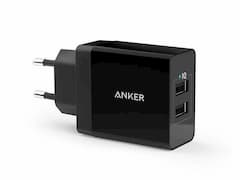
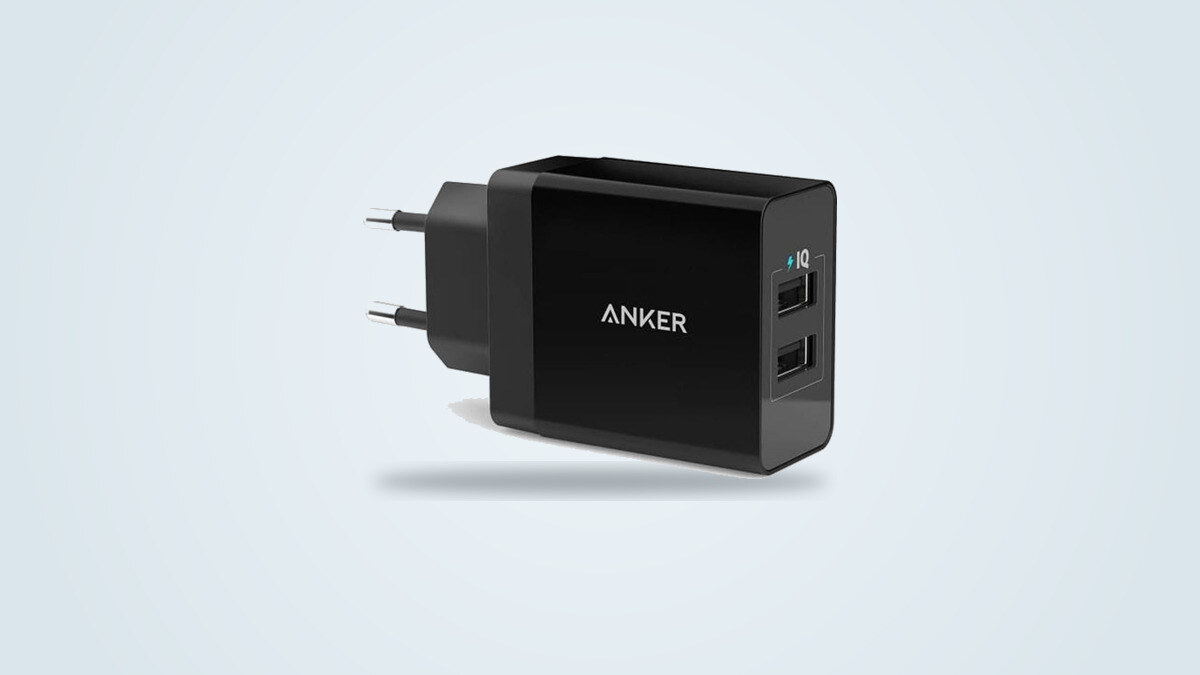
This Anker charger packs two USB-A ports for a total output of 24W. The manufacturer rates its output at 5V and 4.8A combined, meaning 2.4A (12W) available on each port. The input accepts 100 to 240V at 50 or 60Hz, which covers nearly every electrical grid in the world.
That 24W figure is not a theoretical ceiling never reached in practice. A single port can supply up to 3A, a bit beyond its individual 2.4A cap. Both ports combined can climb to 6A during a full hour of continuous operation, without the internal temperature becoming a problem: the hottest point on the circuit, at the rectifier, tops out around 83.1 °C under these extreme conditions, with no protection tripping and no cutoff. Over that same hour at full load, the coolest points on the circuit stay above 63.5 °C.
Output electrical noise stays very low regardless of the load applied: from 8 to 14 millivolts RMS depending on the current drawn, with peaks never exceeding 330 millivolts. For charging a smartphone or a tablet, this figure has no visible effect; it mainly reflects clean output electronics, a point that matters for the most noise-sensitive devices plugged in over USB.
Two ports at full power at once, a rare kind of sharing
Many entry-level dual chargers split a single pool of power between their two ports: as soon as a second device is plugged in, the first one slows down. That is not the case here. The manufacturer's spec sheet is explicit: each individual port can supply 2.4A, and both ports together can each supply 2.4A, for a combined 4.8A. Nothing suggests a shared pool that would drain once a second device is plugged in.
| Configuration | Port 1 | Port 2 | Total |
|---|---|---|---|
| 1 port in use | 2.4A | idle | 2.4A (12W) |
| 2 ports in use | 2.4A | 2.4A | 4.8A (24W) |
This principle goes beyond its own spec sheet once both ports are pushed continuously: the total can climb to 6A for a full hour without any protection tripping. For two smartphones or two small accessories charging at the same time, each one gets its full share with no compromise, a result that is far from automatic at this price point.
The trade-off is simple to state: this full sharing only applies to two USB-A ports capped at 2.4A each. Nothing here benefits from a finer voltage negotiation, Power Delivery or Quick Charge, that could push a compatible device beyond this ceiling, a point covered in the next section.
PowerIQ and VoltageBoost: automatic current recognition
PowerIQ is Anker's in-house technology that identifies the type of device plugged into each port and sends it the fastest current it can accept, up to the port's 2.4A ceiling. VoltageBoost then compensates for voltage drop in the cable, so the device still receives the rated power even with a slightly longer or thinner cable. The table below comes from older devices, contemporary with this charger's original launch, but the mechanism it illustrates stays identical with any USB-A device plugged in today: a current that adapts to the device, based on its actual needs rather than a single fixed figure.
| Device | Current delivered |
|---|---|
| iPhone 6 Plus | 1.74A |
| iPad 4 | 2.24A |
| Sony Xperia Z5 | 1.49A |
| Nexus 6 | 1.44A |
| Samsung Galaxy Note 3 | 1.67A |
| Generic power bank | 2.64A |
The power bank case shows the available margin well: 2.64A goes past the individual 2.4A rated per port, in the same vein as the 3A mentioned earlier on a single port. PowerIQ does not apply a strict ceiling right at the spec-sheet figure, it treats that figure more as a safety floor.
What it does not do: no Power Delivery, no Quick Charge, no PPS
This charger only offers two USB-A ports, with no USB-C port at all. No modern fast-charging protocol is part of the deal: no USB Power Delivery (PD), no PPS, no Quick Charge. Anker states this itself on its own product page, pointing to another model in its lineup for anyone after Quick Charge 2.0 compatibility. PowerIQ remains a proprietary technology for adjusting current at a fixed 5V, not a voltage-negotiation protocol the way PD or QC are.
This absence is not a manufacturing flaw, it is a deliberate lineup choice: this model sits in the entry segment, while Anker also offers much newer USB-C chargers with PD and PPS elsewhere in its range. For a use case built purely around standard charging (older smartphones, e-readers, earbuds, cameras, small USB-A accessories), the 2.4A per-port ceiling is plenty. For a recent phone or tablet that promises a 65% charge in 30 minutes with its original charger, this ceiling changes everything: the same charge will take noticeably longer here.
A compact shape inherited from before GaN
Anker markets this charger as very compact, one of the smallest dual-port models in its category according to the manufacturer. Its own spec sheet lists a weight of 96g, but its real weight is closer to 82g once placed on a scale, about 15% under the official figure. A gap running this direction is unusual: most spec sheets round up or stick close to the real figure, rarely landing below the real weight.
On exact dimensions, however, available figures diverge noticeably depending on whether the unfolded prongs are included, a common blur for this kind of small accessory built around folding prongs. There is no way to pin down one single reliable figure.
This compact shape owes nothing to GaN (gallium nitride) technology, which is absent here: at just 24W, a classic silicon-based charger is already small by design, far too little power for GaN to radically change the footprint the way it does on a 65W or 140W model. This model's compactness is mostly a side effect of its low power, not a recent technological feat.
Safety: MultiProtect and solid electrical isolation
Anker builds its MultiProtect system into this charger: protection against surges, overheating and short circuits, a standard baseline across the brand's whole range. Beyond this list of stated protections, the electrical isolation between the mains and the low-voltage output withstands 2830V then 4242V without the slightest issue, a very wide margin over the 230V household grid.
On the recall front, Anker's known safety recalls concern exclusively batteries with built-in cells, such as power banks, a fire risk specific to onboard lithium. This wall charger has no internal cell: it only converts and passes through mains power, it stores nothing. No recall applies to this family of products to date.
On extended operation, a full hour at full load (4.8A across both ports) brings the hottest point on the internal circuit, at the rectifier, to 83.1 °C, with no protection tripping and no cutoff. This figure concerns an internal component, not the outer shell a user actually touches, which stays noticeably cooler in normal use.
Glossy finish, no screen, an 18-month warranty
The charger's glossy shell makes a flattering first impression out of the box, but that same finish scuffs and scratches visibly after a few weeks of everyday use, more noticeable on the black finish than on white, where micro-scratches show less. This is not a functional flaw, only cosmetic wear.
On features, this model sticks to the bare essentials: two USB-A ports, foldable prongs for storage, and nothing else. Neither a control screen showing live output nor even a simple status light is present, unlike several newer, pricier multi-port chargers in our catalogue. The charging cable is not included in the box, nor is a carrying pouch: both need to be bought separately.
This model has stayed on sale under closely related names for well over a decade (PowerPort 2, then PowerPort 2 Elite), always with the same electrical specifications. That kind of commercial longevity, with no major design change, would be unlikely for a product plagued by a recurring problem within a lineup that otherwise spans dozens of other models.
Against other chargers in our catalogue
Within the same product family, several chargers in our catalogue target a very different use case: a single USB-C port, higher power, full fast-charging protocols. The table below places this model against three of them.
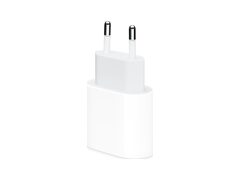
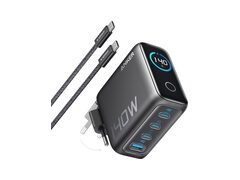
| Criterion | This 24W charger | Apple 20W USB-C | Belkin BoostCharge 30W | Anker 140W GaN |
|---|---|---|---|---|
| Ports | 2x USB-A | 1x USB-C | 1x USB-C | 4x USB-C |
| Total power | 24W | 20W | 30W | 140W |
| Protocols | PowerIQ (proprietary) | USB PD, no PPS | USB PD and PPS | USB PD and PPS |
| Sharing between ports | 2.4A + 2.4A, no compromise | single port | single port | 134W combined at 4 active ports |
| Real weight | about 82g | about 55-58g | not disclosed | about 290-295g |
This charger holds a spot of its own on this list: it is the only one of the four to split its power across two USB-A ports with no compromise when both are used at once, but also the only one with no standard fast-charging protocol at all. Against the Apple 20W or the Belkin 30W, which at least negotiate PD, it falls behind as soon as the connected device could take advantage of a higher voltage. Against the Anker 140W GaN, the comparison barely makes sense: two completely different use cases, one for a single very power-hungry device, the other for two simple devices at once.
Who it suits, and who should look elsewhere
This charger makes the most sense for anyone who needs to charge two simple devices at once, day to day or while traveling: an older smartphone alongside a pair of earbuds, an e-reader, a smartwatch, or a second phone for a companion. Its universal input voltage (100 to 240V) and foldable prongs make it a credible travel companion, and the total lack of compromise between its two ports guarantees full-power charging on both sides, even at the same time.
It suits less well anyone with a recent smartphone or tablet capable of fast charging: the 2.4A per-port ceiling completely ignores USB Power Delivery, PPS or Quick Charge, and the speed gap against a modern USB-C charger adds up to tens of minutes over a full charge. It is not a fit for charging a laptop either, whatever its power draw, nor for anyone after a control screen or even a simple status light, both absent from either port.
For a backup charger, a nightstand charger, or a travel kit where speed matters less than reliability and universal compatibility, this charger remains a reasonable pick, provided its generation-appropriate limits are accepted from the start.