

Anker Nano A1653: which exact version, and who it suits
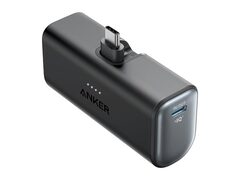
The Anker Nano A1653 is specifically the version with a built-in, folding USB-C connector in the Nano line-up, launched in August 2023: 5000 mAh, 22.5 W, 100 g. The "Nano" name covers several distinct Anker products that are easy to mix up when comparing figures: the Nano 621 MagGo 5K adds a magnetic ring and slower wireless charging, the Nano 10K/45W and the Nano 533/30W use a retractable cable rather than a direct connector, and a newer version again uses the magnetic Qi2 format. The A1653 is unmistakable thanks to its connector, which folds out of the shell to clip straight onto the phone's USB-C port, with no cable and no magnet involved at any point.
The positioning is deliberately narrow: a pocket rescue charge, not a multi-day energy reserve. The shell fits in the palm of a hand, slips into a jeans pocket without reshaping the fabric, and comes out faster than a regular power bank simply because there is nothing to untangle or fumble for in a bag. That narrow brief, more than raw capacity, is what this review measures throughout: how closely the execution matches that promise, and exactly where it runs out of road.
What the advertised 5000 mAh is really worth
The internal cell of the Nano A1653 is rated at 5000 mAh, around 18 Wh of nominal energy at a lithium-polymer cell's own voltage. That figure is the energy stored inside the shell, not what actually comes out of the USB-C port once the voltage has been converted up to the 5, 9 or 20 V a smartphone expects.
In practical terms, that usable energy covers a near-complete charge for an iPhone 15 (over 95% of its battery), but noticeably less for an Android phone with a bigger cell: around 58% for a Xiaomi 14T, around 66% for a Sony Xperia 1 VI, both fitted with a battery close to 5000 mAh. The gap has nothing to do with a fault in the product: the energy the Nano A1653 delivers stays fixed regardless of the phone on the other end, only the percentage that energy represents changes once it is measured against a bigger battery. Either way, the promise stays the same: one smartphone charge per cycle, never one and a half.
22.5 W in practice: fast on a phone, symbolic beyond it
The Nano A1653 puts out up to 22.5 W through its built-in connector, using USB Power Delivery. On an iPhone 15, that translates into a 42% charge gain in 30 minutes: a clear step up from the 5 W or 10 W chargers still common a few years ago, and in line with what the PD standard allows on a cell of this size.
A second USB-C port, separate from the built-in connector, lets you recharge a second device at the same time: both phones then gain charge together. No exact split of the total power between the two ports is published for when both are in use at once, a gap this review cannot put a number on. On an 11-inch iPad Pro, the charge gained in 30 minutes tops out at 20%, a slower pace than rivals better suited to larger tablet batteries; on a MacBook Air M1, the gain drops to 12 percentage points over the same time, enough to buy a nearly dead laptop a few extra minutes, not to recharge it. Neither of those last two uses is what the Nano A1653 was built for, and the gap in results makes that plain enough.
100 g and a cube shape: the product's central argument
The shell weighs 100 g for dimensions of around 7.7 x 3.68 x 2.5 cm, a cube shape that fits entirely in a closed hand. Against the three most sought-after direct rivals at the same capacity, the Nano A1653 stays the lightest: the Belkin BoostCharge 5K sits around 130 g, the Baseus 5000 with a built-in cable around 120 g, and the Anker 621 MagGo 5K, weighed down by its magnetic ring, around 130 g as well.
The product still works with most phone cases on the market, up to around 4.9 mm thick, with no need to remove them before clipping the connector on. That is a small but useful detail in daily use: plenty of rival built-in-connector power banks require peeling the phone out of its case first.
The trade-off of this ultra-compact shape sits in the connector itself: once unfolded and clipped onto the phone, the assembly can pick up a slight mechanical wobble, and the small cube sticks out noticeably below the handset while it charges. Nothing that affects the charge itself, but a genuine handling trade-off when held in the hand, less of an issue in a pocket or resting on a table where the overhang does not get in the way.
Betting on cable-free charging: ports and controls
The connectivity comes down to two elements: the built-in, folding USB-C connector, which acts as the sole interface for charging a phone with no cable at all, and a second, standard USB-C port that either charges a second device or recharges the pack itself. Both support USB Power Delivery. Four LEDs on the front show the remaining charge level in steps, with no precise percentage and no screen.
This deliberate bare-bones approach is the whole point of the product: no cable to hunt for, no magnet to line up, no wireless charging at a reduced speed. Flip the connector out, clip it on, charging starts. That is also the system's limit: with no cable, the Nano A1653 can only charge a phone on direct contact, never at a distance or lying flat on a table while the phone stays in a pocket. The second USB-C port does accept a standard cable and regains that flexibility for a second device, but only through that port.
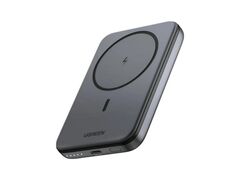
There is no USB-A port at all, in keeping with a product launched in 2023 into a catalogue of accessories that had already largely moved to USB-C. There is no wireless charging either: that need is covered by the 621 MagGo version in Anker's range, at lower power and generally for a higher price.
Recharging the pack itself: 18 W real against 22.5 W claimed
Anker lists a symmetrical 22.5 W, both for output and for input. In practice, the input caps at 18 W: a real gap between the spec sheet and the product's actual behaviour, even if it stays modest and carries no safety implications.
The direct consequence is on charging time: a full recharge of the pack itself takes around 90 minutes with a charger that genuinely delivers the necessary 18 W, and can stretch to close to two hours with a weaker or less well-matched charger. It is not the worst in its class: that is a clear step up from the 5 W or 10 W chargers still bundled with some entry-level models, but it stays well short of the 45 W to 65 W chargers now common on rival compact power banks, even if the small cell inside the Nano A1653 limits how much a much higher input current would actually help anyway.
The second USB-C port, the one that is not the built-in connector, handles this recharging of the pack. A standard USB-C cable, not included in the box, is needed for this.
Build, materials and reliability
The shell is largely made from recycled plastic, an approach now standard across Anker's recent accessory ranges. The matte finish, sold in several colours depending on the market, avoids the fingerprint marks that glossy surfaces leave on many rival products.
On safety, the product includes Anker's ActiveShield technology, a thermal-monitoring circuit that cuts or reduces charging if it detects abnormal heat. That is a feature the manufacturer states outright, consistent with the rest of its range, and it raises no particular concern given the absence of any safety notice or recall affecting this exact model.
The main wear point to watch is mechanical rather than electrical: the folding connector, flexed on every single charge, is by design more exposed than a plain, fixed port. No independent data on how it holds up over a given number of cycles could be gathered for this exact model at this stage; that is a reservation worth keeping in mind rather than an established flaw, in either direction.
Against the direct competition
At the same 5000 mAh capacity, three alternatives help place the Nano A1653: the Belkin BoostCharge 5K, the Baseus 5000 with a built-in USB-C cable, and the magnetic, wireless Anker 621 MagGo 5K.
| Criterion | Anker Nano A1653 | Belkin BoostCharge 5K | Baseus 5000 (built-in cable) | Anker 621 MagGo 5K |
|---|---|---|---|---|
| Connectivity | Built-in USB-C connector + USB-C | USB-C + USB-A | Built-in USB-C cable + USB-C | Magnetic + USB-C |
| Power | 22.5 W | ≈ 12 W | ≈ 20 W | 7.5 W wireless / 12 W USB-C |
| Weight | ≈ 100 g | ≈ 130 g | ≈ 120 g | ≈ 130 g |
| Observed price | ≈ £22 | ≈ £21 | ≈ £26 | ≈ £30 |
The Nano A1653 remains the fastest of the four on a phone and the only one to do away with the cable entirely for its main use, a genuine advantage for anyone who wants to grab it and go. The Belkin plays the dual USB-C and USB-A card at a lower price but with noticeably less power; the Baseus, with its built-in cable, regains a reach the direct connector does not have, useful for topping up a phone left inside a bag; the Anker 621 MagGo adds slower magnetic wireless charging, generally for a higher price. In the end, the Nano A1653 suits anyone who wants the fastest, most direct rescue charge for a single phone at a time; anyone who needs to charge from a distance, charge two devices without a power squeeze, or get more than one charge out of a single unit will find a better fit elsewhere in the same Anker range.