
A charger that repeats the same 52.5W formula, in a smaller case
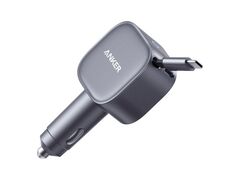
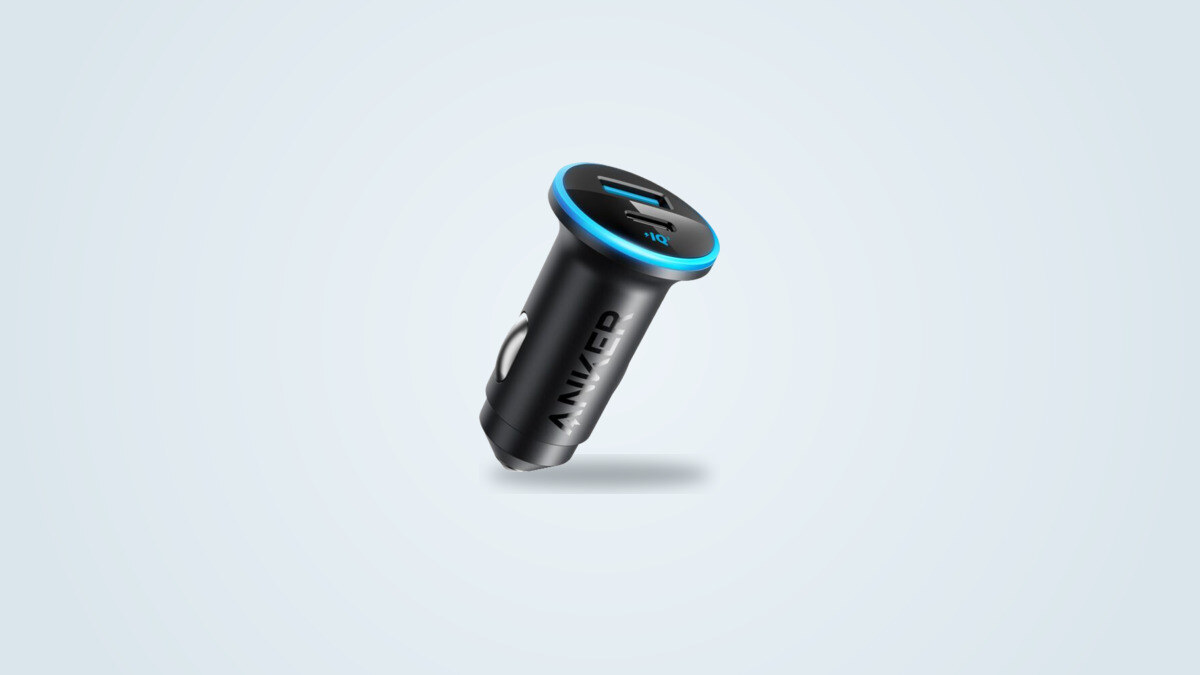
The Anker 323 car charger (official reference A2735) sits in a precise spot in Anker's car charger lineup: more powerful than the small Anker 30W, which is limited to one port of each type at lower power, but simpler than the Anker 75W with its built-in retractable USB-C cable, or the three-port Anker 167.5W that can power a laptop. It sticks to a classic two-port layout, one USB-C and one USB-A, for fast charging of two devices at once.
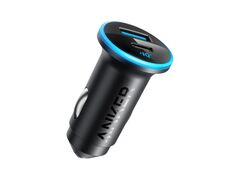
The unit plugs straight into the vehicle's 12V or 24V socket, with no cable in between, and carries the lineup's usual look: black body, blue light ring around the ports for finding them at night, Anker logo etched on the side. Within its own range, the 323 lands as the most versatile format for two-person use, between the simpler 30W and the 75W and 167.5W models built for higher power needs.
30W with Power Delivery and PPS on the USB-C port
The 323's USB-C port lists a fixed Power Delivery voltage ladder, from 5V/3A up to 20V/1.5A, topped off by the PPS (Programmable Power Supply) protocol for finer adjustment in smaller steps, up to a 30W ceiling. That is exactly the same cap as the USB-C port on the Anker 75W and on its own smaller sibling the Anker 30W, and half of the main port on the Anker 167.5W (100W).
Anker states an iPhone reaching 50% charge in about 25 minutes on this port, and a Galaxy S23 in a similar 27-minute range: manufacturer figures, to be taken as ballpark numbers that vary with battery state and cable quality. For the vast majority of USB-C phones and tablets on the market, this 30W ceiling is more than enough for a full fast charge; the limit becomes real as soon as a laptop enters the picture, even a light one, a use case this model is not built for.
22.5W more on the USB-A port, the exact same arithmetic
The second port, a USB-A, rounds out the package with Anker's own PowerIQ 3.0 technology: up to 22.5W spread over three steps (5V/3A, 9V/2A, 10V/2.25A), a fast charge that covers an Android phone just as well as an older USB-A accessory, earbuds or a GPS unit.
The notable point is the spec sheet's arithmetic, strictly identical to that of its direct rival: 30W (USB-C) plus 22.5W (USB-A) equals exactly 52.5W, the stated total. No grey area of degraded sharing shows up on paper between the two ports, each one able in theory to reach its own maximum without eating into the other. Anker states that both ports stay active at the same time with neither one shut off in favour of the other, a manufacturer figure that no independent measurement currently confirms in detail.
PD, PPS and PowerIQ 3.0: broad compatibility, with two acknowledged blind spots
The combination of Power Delivery, PPS and PowerIQ 3.0 covers a good share of the devices in circulation: recent iPhone and iPad models via Power Delivery on the USB-C port, a large part of mainstream Android phones and tablets via PD/PPS or PowerIQ depending on the port used. That is a solid base for everyday use.
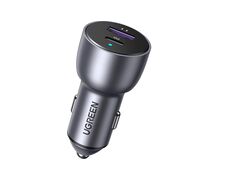
Two specific limits are worth knowing before buying. The first concerns Samsung: the USB-C port does not support Super Fast Charging 2.0 (25W), a proprietary protocol separate from standard PD/PPS, even though standard PD fast charging remains available for the vast majority of Galaxy phones. The second concerns the Huawei and Honor ecosystem: unlike its direct rival the Ugreen 52.5W, which builds in the SCP (Super Charge Protocol) on its USB-A port, the 323 lists no support for this specific protocol.
| Protocol | Anker 323 | Ugreen 52.5W |
|---|---|---|
| USB PD | Yes | Yes |
| PPS | Yes | Yes |
| PowerIQ 3.0 / Quick Charge | PowerIQ 3.0 | Quick Charge 3.0 |
| SCP (Huawei/Honor) | No | Yes |
| Samsung Super Fast Charging 2.0 | No | Not stated |
For anyone with a recent Huawei or Honor phone, this gap is worth weighing; for the vast majority of mainstream Apple and Android buyers, it changes nothing day to day.
The lightest and most compact at this power level: 23g against 57.2g for its direct rival
At 23g for roughly 56 x 30 x 30mm, the Anker 323 has the smallest footprint of the whole comparison at equal or greater power. The most telling comparison is with the Ugreen 52.5W, a direct rival that is strictly identical on paper in total power and port split: its spec sheet lists 57.2g for 65 x 30 x 30mm, more than double the weight and 9mm more in length for an equivalent charging promise.
| Model | Power | Stated weight | Stated dimensions |
|---|---|---|---|
| Anker 323 | 52.5W | 23 g | 56 x 30 x 30 mm |
| Ugreen 52.5W | 52.5W | 57.2 g | 65 x 30 x 30 mm |
| Anker 167.5W | 167.5W | 50 g | 80 x 36 x 36 mm |
| Anker 75W | 75W | 77 g | 100 x 50 x 29 mm |
This weight gap obviously does not measure a charger's quality on its own, but it matters in daily use: a shorter, lighter body sticks out less from the 12V socket, gets in the way of the gearstick less in a tight cabin, and is easier to forget about once plugged in.
ActiveShield 2.0, one generation behind the newest Anker chargers
Anker fits this model with its ActiveShield 2.0 technology: active temperature monitoring that adjusts delivered power in real time to protect the connected device's battery from overheating, on top of standard protection against overvoltage, overcurrent and short circuits.
That is a solid base for an accessory left plugged into the vehicle's 12V socket around the clock, often unwatched. One nuance is worth flagging for anyone comparing within Anker's own range: the Anker 75W, newer and pricier, already ships with ActiveShield 3.0, a more advanced generation of the same system. That does not point to a safety shortfall on the 323: it is an earlier version of the same technology, not the absence of it.
An unambiguous 18-month warranty, and a useful note on Anker's recalls
Anker states an 18-month warranty on this charger, a duration that is identical and consistent across all of its official channels. That is a point in its favour against its direct rival the Ugreen 52.5W, whose warranty length varies from 12 to 24 months depending on the retailer, with no single reference on its own product page.
On popularity, the 323 enjoys very wide commercial reach for this price bracket, a sign of a mature product in a highly competitive segment where many models look alike on paper. No recurring build issue turns up beyond the compatibility and power limits already detailed above.
Against the Ugreen 52.5W and the rest of the Anker lineup
How does the 323 stack up against its closest rival on paper and against the other power levels in its own lineup?
| Criterion | Anker 323 | Ugreen 52.5W | Anker 75W | Anker 167.5W |
|---|---|---|---|---|
| Total power | 52.5W | 52.5W | 75W | 167.5W |
| Ports | USB-C 30W + USB-A 22.5W | USB-C 30W + USB-A 22.5W | Cable USB-C 45W + USB-C 30W | 2x USB-C (100W+45W) + USB-A 22.5W |
| Built-in cable | No | No | Yes, retractable | No (included separately) |
| Stated weight | 23 g | 57.2 g | 77 g | 50 g |
| Warranty | 18 months | 12 to 24 months by retailer | 18 months | 18 months |
| Catalogue price | £19.99 | £10.79 | £24.99 | £24.99 |
Against the Ugreen 52.5W, the 323 is on level terms for power and port split, with a clear edge on weight, size and warranty clarity, though at a noticeably higher catalogue price on this market. The Ugreen stays the cheaper pick here and keeps a real, narrow edge on Huawei/Honor compatibility through SCP. Against the Anker 75W, the 323 gives up the convenience of a built-in cable and some total power, but stays noticeably lighter and cheaper; against the 167.5W, it simply is not built for the same job, that of powering a laptop alongside phones.
Who the Anker 323 is for, and when to look bigger
This charger suits anyone who wants to equip a car with a modern USB-C port and a USB-A port for a second device, with no need to power a laptop, and who places real value on stated weight and warranty. For a noticeably lower price but a bulkier case, the Ugreen 52.5W remains a direct alternative, with the added benefit of SCP for Huawei and Honor phones.
For anyone who wants a cable always on hand, the Anker 75W and its built-in retractable cable are a better fit; to power a USB-C laptop alongside phones, the three-port Anker 167.5W remains the logical choice in the lineup.