
140 W, but on a single port and not continuously
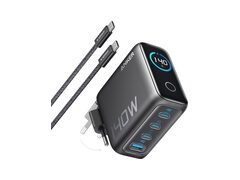
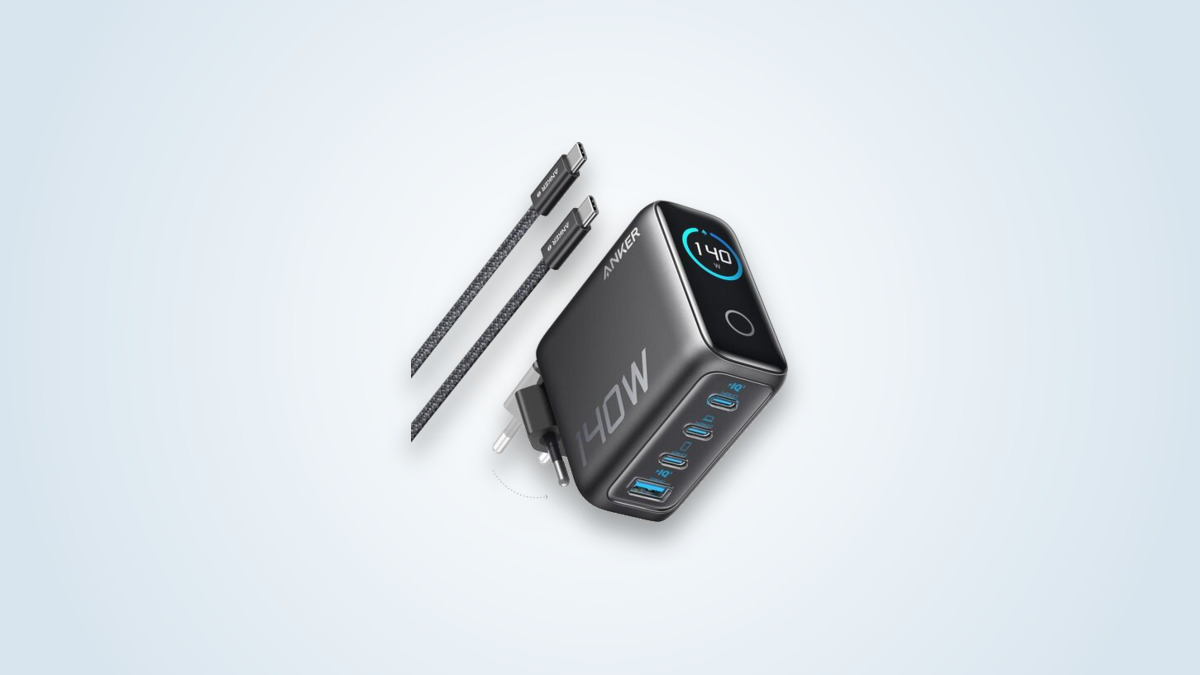
The 140 W figure that gives the product its name corresponds to the maximum power available on one of the two main USB-C ports (C1 or C2), used on its own. It is a genuine peak power figure, not an inflated one: with a recent 16-inch MacBook Pro and the cable supplied, that ceiling is indeed reached.
Two nuances still shape the practical scope of that figure. The first concerns the computer on the other end: only 16-inch MacBook Pros with an M3 Pro or M3 Max chip (late 2023 or newer) can genuinely draw 140 W on their USB-C port. The M1 and M2 generations cap out around 96 to 100 W regardless of the charger's power, since the limit comes from the computer's own Thunderbolt 4 port, not the charger. The second nuance concerns the cable: above 100 W, a certified 240 W USB-C cable (known as e-marked) is mandatory, and the one supplied in the box is one.
Over time, this 140 W ceiling does not hold indefinitely. Under continuous full-power load, output falls back to 120 W after about half an hour, a thermal protection behaviour that the manufacturer itself describes in its official documentation as normal operation, not a fault. In practice, the charger does deliver its advertised peak power, but that peak behaves as a short-lived spike rather than a sustained rating, a nuance the bare figure "140 W" does not convey.
With 4 ports in use, never more than 134 W total
Power sharing between the four ports follows a table set by the manufacturer, and it has a direct consequence for the product's commercial promise: the sum of available power never totals 140 W once more than one port is active.
| Configuration | Split | Total |
|---|---|---|
| 1 port (C1 or C2 alone) | 140 W | 140 W |
| 2 ports (C1 + C2) | 70 W + 70 W | 140 W |
| 3 ports (C1 + C2 + C3) | 65 W + 45 W + 30 W | 140 W |
| 4 ports (all active) | 65 W + 45 W + 12 W + 12 W | 134 W |
It is only at 4 ports that the total drops below 140 W, by 6 W, a modest but real gap on the figure that gives the product its name. In practice, the split is not a simple equal share: the first two ports plugged in (C1 and C2) stay prioritised, and a device plugged in last on the lowest-priority port can end up with as little as 2 to 12 W depending on what the other ports already draw. With a laptop, a lighter second laptop, and a smartphone on three ports at once, for example, the ports delivered around 64 W, 43 W, and 21 W, a split consistent with priority logic rather than an arithmetic share.
In the most common use case, charging a phone even when all four ports are occupied, the algorithm does not seem to excessively penalise the least power-hungry device: a Samsung Galaxy S24 FE plugged in last on all 4 active ports charged from 0 to 100 % in under 80 minutes, a result close to what that same phone would achieve alone on a dedicated charger.
The GaN promise, more nuanced under sustained use
GaN (gallium nitride) technology is put forward to justify a compact housing despite the high power, and on this specific point, the promise holds: at 69 × 69 × 36 mm folded, the charger stays within the usual size for its category. The implicit promise of minimal heat, on the other hand, deserves a more nuanced look.
Under sustained full-power load, the housing's temperature climbs and the charger applies thermal protection that reduces delivered power after about 30 minutes, from 140 to 120 W. The manufacturer confirms this mechanism in its official documentation and explicitly presents it as normal operation, not a fault to be fixed. In practice, the heat stays noticeable, especially around the control display, after a prolonged charge, noticeable but not a nuisance in daily use.
The manufacturer itself places the sector norm for acceptable surface temperature at up to 77 °C at a 25 °C ambient temperature, a threshold it cites to justify that the heat felt to the touch stays within bounds. That is a useful nuance: the GaN charger remains noticeably more compact than a conventional model of the same power, but "compact" and "never gets hot" are not quite the same promise.
Two real compatibility limits, but narrow ones
The charger supports the PPS (Programmable Power Supply) protocol, which enables fine-grained fast charging on most recent Android smartphones. On this point, one precise technical limit reduces performance for certain models: this charger's PPS rail caps at 20 V, while the protocol allows up to 21 V. On a device that uses that last volt, such as a Google Pixel 9 Pro XL, the consequence shows up as a charge at around 27 W instead of the 34 W accessible with a charger that goes up to 21 V, a real gap but one that only affects devices sitting right at the top of this specific voltage range. Most other smartphones in this comparison (Samsung Galaxy S24, Xiaomi 14T Pro, OnePlus 12, Nothing Phone 2) reach their maximum charging speed with no restriction observed.
Second limit, rarer in its consequences: the charger offers no fixed 12 V output step. This absence has no impact for the vast majority of uses (smartphones, tablets, laptops, which all negotiate their voltage over USB PD or PPS), but it rules out certain older DJI drone models whose original charger specifically requires that step.
One additional, more minor reservation concerns the Apple Watch: its charge can stop mid-cycle, probably because the charger's protection mechanism judges the power drawn too low for this particular accessory.
295 g or 395 g? The manufacturer's own spec sheet contradicts itself
This charger's advertised weight illustrates a rare case where the manufacturer's own official documentation contradicts itself. On the same official European product page, the FAQ states around 295 g, while the technical specifications table further down that same page shows 395 g for the same model, a 100 g gap that does not match any known variant of the product.
Several cross-checks support the lower figure: the manufacturer's US spec sheet lists 295 g, and a second available figure sits at 287 g. The 395 g figure therefore looks like a data-entry error on the European page, perhaps a full packaging weight mislabelled as the product weight alone, rather than a distinct reality. The most likely weight therefore sits around 290 to 295 g, consistent with the compact size advertised for this power class.
A useful control display, underside ports to get used to
The built-in display shows the power delivered by each active port in real time, concrete information for checking that a device is charging at the expected speed rather than having to guess. On comparable products fitted with the same type of display, the gap between the on-screen reading and the power actually delivered typically stays within 1 to 2 W, a level of precision sufficient for everyday use.
This choice of a display has a direct trade-off for ergonomics: to keep it visible at all times, the manufacturer placed the four charging ports on the underside of the housing rather than on the edge. In practice, this means lifting or turning the charger over to plug in a cable, a habit to pick up rather than a design flaw, but a less convenient layout in daily use than the classic arrangement of ports on the edge.
18-month warranty, short of the 24-month standard
No safety recall has been logged for this charger to date, and over 250 hours of extended use has shown no failure, only a brief voltage dip noticeable when an extra device is plugged in, with no lasting effect. The manufacturer also maintains two documentation pages dedicated specifically to this model, one on heat and the other on the power drop under prolonged use, an indirect sign that these two topics come up often enough to warrant an official explanation, rather than a sign of a hidden fault.
One point is worth noting for anyone comparing it with the rest of the manufacturer's range: this model's commercial warranty is 18 months, shorter than the 24 months usually offered on other chargers from the same brand. That is not a manufacturing defect in itself, but a factor to weigh into the cost-effectiveness calculation over time.
Who it suits, and who it does not
This charger makes the most sense for anyone travelling with several devices to recharge, a demanding laptop plus at least one smartphone or tablet, who wants to carry fewer adapters. The main port covers a recent 16-inch MacBook Pro at full speed, the other three ports cover everything else with no particular setup, and the control display gives reassurance about what is actually being delivered.
It suits less well anyone chasing a continuously sustained 140 W on a single, very demanding device over long sessions: the throttling to 120 W after half an hour of continuous charging reduces the value of the peak figure in that specific case, and a dedicated single-port charger with greater thermal dissipation would do better. Owners of a high-end Google Pixel or older DJI drones requiring a 12 V step will also find better options elsewhere for those specific uses.