
Fossibot FDC300
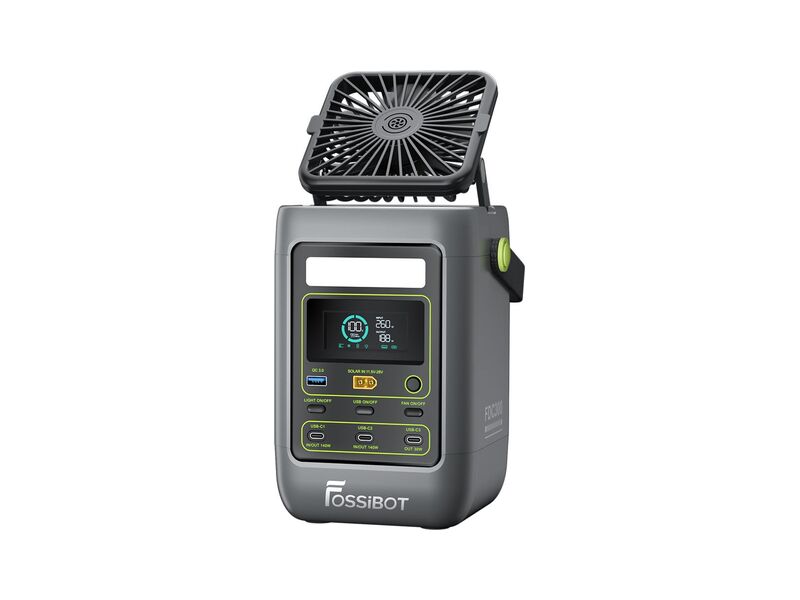
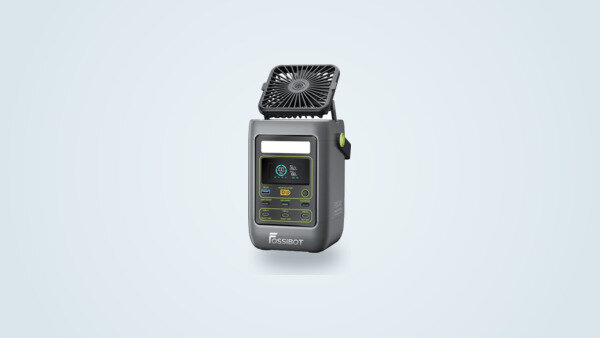
The Fossibot FDC300 (288 Wh) bets everything on USB-C: no AC outlet, but up to 140W bidirectional per port, plus a built-in folding fan to cool the campsite as much as your gear.
Characteristics
- Capacity: 288 Wh (LiFePO4, 3000+ cycles)
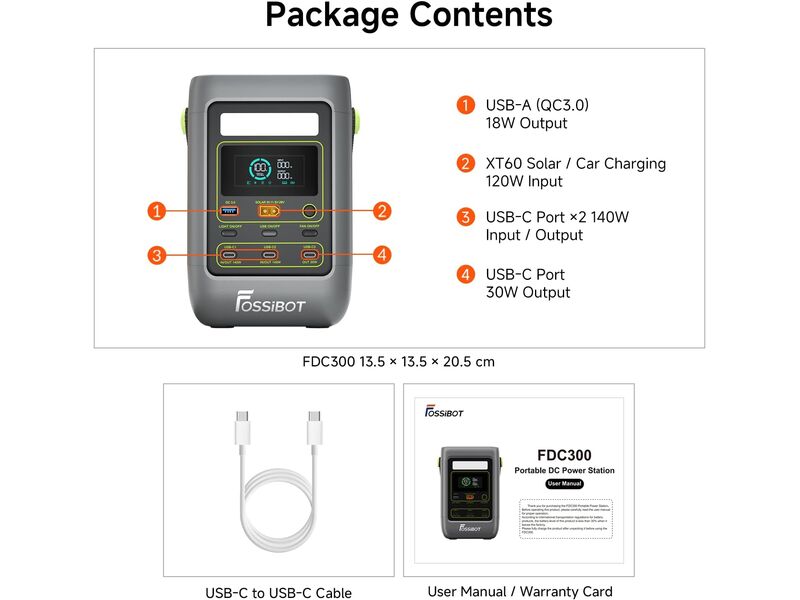
- Output: 3x USB-C (2x140W + 1x30W) + USB-A 18W, no AC outlet
- Weight: 2.7 kg (135 x 135 x 205 mm)
- Features: 3-speed folding fan, built-in light and screen
- Bidirectional 140W USB-C and built-in fan, no AC outlet
Detailed overview: Fossibot DC mini power station with fan
Unveiled by Fossibot at IFA 2026 (Berlin, 4-8 September), the FDC300 takes an unusual approach for a portable power station: no 230V/120V AC outlet at all. All its power runs through USB, making it more of a supersized power bank than a classic power station, built for nomadic electronics rather than appliances.
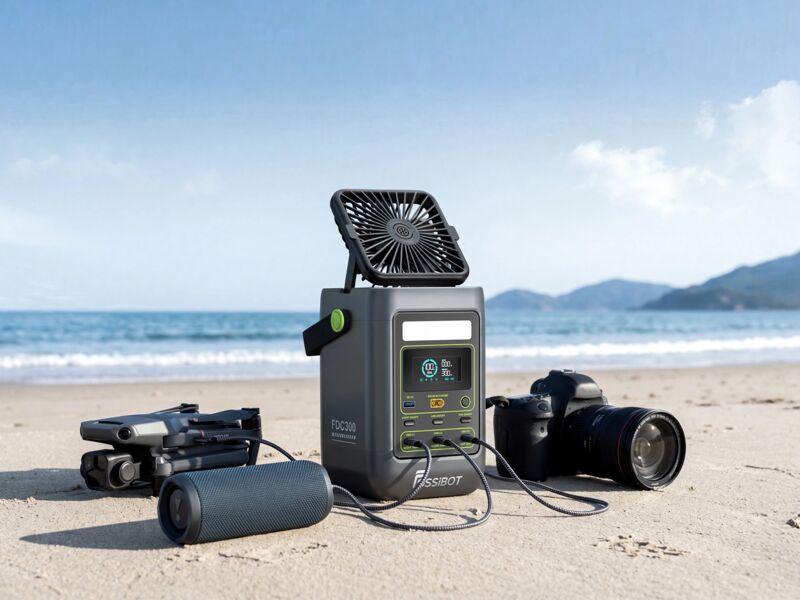
Its 288 Wh LiFePO4 battery can power up to four devices at once: two USB-C ports deliver up to 140W each (200W combined), support Power Delivery 3.0, and are bidirectional, so they can charge a laptop or recharge the FDC300 itself from a powerful USB-C adapter. A third USB-C port tops out at 30W, and one Quick Charge 3.0 USB-A port adds 18W. On the input side, an XT60 connector accepts up to 120W from solar panels or a 12V vehicle socket, for a full charge in about 2h40 that way, or as fast as 1h14 combining both 140W USB-C ports. A built-in screen constantly shows charge status and current power draw.
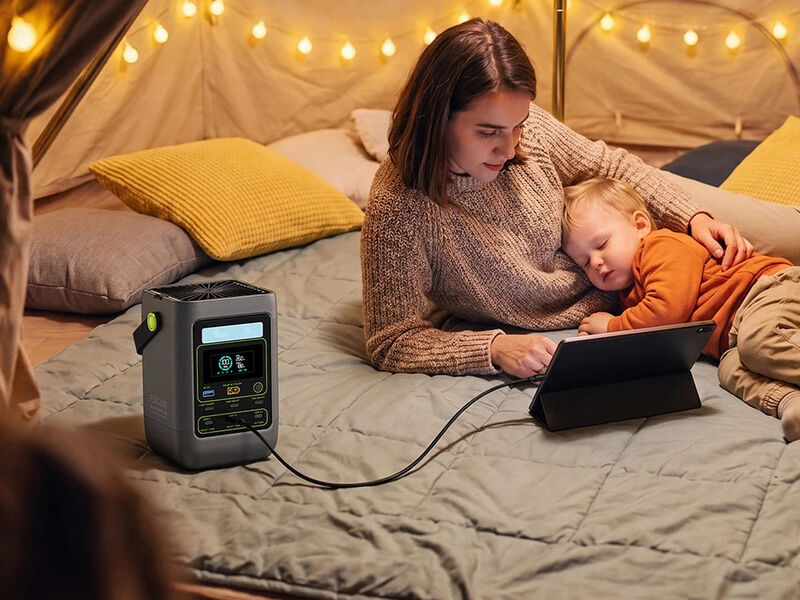
Its most visible feature remains the built-in folding personal fan, with three speeds and a "natural wind" mode, able to run for up to 100 hours on that function alone on a full battery. A built-in light and a hidden phone stand under the housing round things out, handy for watching a video while charging your phone. It all fits into a compact 135 x 135 x 205 mm footprint at 2.7 kg, with a rated discharge temperature range of -10 °C to 40 °C.
The FDC300 is a lightweight companion rather than a home backup station: with no AC outlet, it can't power a fridge or small appliances. It targets a much narrower niche, somewhere between a light mobile office, a bivouac companion, and a cooling boost, where its fan, light, and powerful USB-C ports set it apart from a regular power bank.
Full specifications
Detailed characteristics
Battery and capacity
| Rated capacity?Total stored energy in watt-hours. The higher the figure, the longer the runtime. | 288 Wh |
|---|---|
| Expandable capacity?Whether capacity can be increased with add-on batteries. | No |
| Removable battery?The main battery can be removed or replaced by the user. | No |
| Battery chemistry?LiFePO4 (LFP) lasts far longer and is safer than NMC. | LFP (LiFePO4) |
| Charge cycles?Number of full charges before capacity drops to the stated threshold. | 3000 cycles |
AC output
| Continuous AC power?Power the unit can sustain continuously on its 230 V outlets. | 200 W |
|---|---|
| Number of 230 V AC outlets?Number of mains outlets available on the unit. | 0 |
| RV / TT-30 outlet?Dedicated 30 A outlet for North-American style RVs. | No |
Recharging
| Max solar input?Maximum solar power accepted at the input (PV panels). | 120 W |
|---|---|
| Vehicle charging (12/24 V)?Can be charged from a vehicle's cigarette-lighter socket. | Yes |
Ports and connectors
| USB-C ports?Number of USB-C ports and the fastest port's power (laptops, phones). | 3 × 140 W |
|---|---|
| USB-A ports?Number of USB-A ports and maximum power (small devices). | 1 × 18 W |
| 12 V output (car socket)?12 V cigarette-lighter output and its power (coolers, pumps…). | No |
Portability
| Weight?Net weight of the unit, battery included. | 2.66 kg |
|---|---|
| Dimensions (L × W × H)?Overall size of the unit in millimetres. | 135 × 135 × 205 mm |
| Form factor?Portable (hand-carried), transportable (heavy), or wheeled. | Portable |
| Wheels?Built-in wheels for moving the unit. | No |
| Telescopic handle?Retractable handle like a wheeled suitcase. | No |
Safety and environment
| Discharge temperature?Temperature range in which the unit can deliver power. | -10 to 40 °C |
|---|
Backup / UPS
| UPS / EPS mode?Automatic switch to battery on a mains outage (backup). | No |
|---|
Display and connectivity
| Display?Type of screen showing power, runtime and alerts. | LCD |
|---|---|
| Solar connector?Connector type of the solar input (XT60, Anderson, MC4…). | XT60 |
Availability and warranty
| Market launch?Date the model first became available on the European market. Useful to place its generation: technology moves fast in this segment, and a device several years old may be at the end of its commercial life. | September 2026 |
|---|---|
| Warranty?Length of the manufacturer's warranty. | 3 years |
⚡ How long will this power station run a device?
With 288 Wh, the Fossibot FDC300 external battery runs a fridge (50 W) for ~4h55 or an LED TV (90 W) for ~2h45.
| Home | Runtime |
|---|---|
| Mini fridge (45 W) | ~5h25 |
| Refrigerator (50 W) | ~4h55 |
| Freezer (60 W) | ~4h05 |
| American fridge (150 W) | ~1h40 |
| Outdoor & workshop | Runtime |
|---|---|
| Wi-Fi router (15 W) | ~16h |
| Electric cooler (45 W) | ~5h25 |
| Laptop (60 W) | ~4h05 |
| Nebulizer (100 W) | ~2h25 |
Rough estimate: real consumption varies, and very power-hungry appliances (heating elements) must stay below the output power.
Comparison
Around £136, the Fossibot FDC300 sits in an unusual niche between a premium power bank and a mini power station, searched for as "USB-C power station no AC" or "power bank with fan". Here's how it compares to three close profiles: Fossibot's own F1200, a proper station with an AC outlet; the Anker Prime 27,650mAh, a premium power bank with no fan; and the Baseus Blade2, a compact, fast-charging USB-C power bank.
| Criterion | Fossibot FDC300 | Fossibot F1200 | Anker Prime 27,650mAh | Baseus Blade2 |
|---|---|---|---|---|
| Capacity | 288 Wh | 1024 Wh | ≈ 99.5 Wh | ≈ 96 Wh |
| AC outlet | No | Yes (2 sockets, 1200W) | No | No |
| Fastest port | USB-C 140W | USB-C 100W | USB-C 140W | USB-C 100W |
| Built-in fan | Yes, 3 speeds | No | No | No |
| Weight | 2.7 kg | 11.5 kg | ≈ 0.74 kg | ≈ 0.62 kg |
| Price observed | £136 | ≈ £471 | ≈ £189 | ≈ £111 |
In short, the FDC300 sits in a category of its own: it comfortably outdoes a regular power bank on capacity and versatility (fan, light, phone stand), without rivalling a proper station like the F1200, which remains essential whenever an AC outlet is required. Against premium power banks like the Anker Prime, it offers more runtime but weighs noticeably more.
Our tester's review: Christophe Delpuech
The Fossibot FDC300 reuses an architecture already seen here, a 100% USB-C housing with no inverter and no AC outlet, and adds a genuine signature feature: a folding personal fan rated for up to 100 hours on its own battery, missing from both its direct rivals of the same capacity. Its two bidirectional USB-C ports, rated 140W each, cover a lot of ground in charge or output, and the built-in screen keeps constant tabs on charge status. Two honest caveats: unlike its rivals, it has no 12V output at all, and total power caps at 200W, so the two main USB-C ports can't both run at full power together. Unveiled at IFA 2026, it's too new for any independent data yet on real efficiency or fan noise, every figure here comes straight from the manufacturer. An original, versatile pick, provided you accept that total lack of track record.
In-depth review Fossibot FDC300: our full review 4.0/5 Read our full review → Capacity and efficiency 4.0 Delivered power 4.0 Recharging 4.1 Ports and control 3.8 Build and endurance 4.0 Noise not measuredFrequently asked questions: Fossibot DC mini power station with fan
No, it's a 100% DC station: all its power comes out through its USB-C and USB-A ports. It can't power a device that plugs into a standard AC socket, unlike other Fossibot stations such as the F1200.
Up to 100 hours using only that function on a full battery, with 3 adjustable speeds and a "natural wind" mode that varies intensity for a more pleasant airflow.
Around 1h14 to 1h36 combining both 140W USB-C ports, 2h17 through a single USB-C port, or 2h40 via solar or a 12V vehicle socket through the XT60 connector (120W max).
Yes, as long as the laptop charges over USB-C Power Delivery: the two main ports deliver up to 140W each, enough for the vast majority of USB-C laptops on the market.
Yes, it has just launched (unveiled at IFA 2026) and is in stock, priced at £136, with a 3-year manufacturer warranty.
Yes, alongside the folding fan, the housing includes a built-in light and a screen that constantly shows charge status and power draw.
Need help choosing?
Related articles
Other products in the "Compact power stations" category
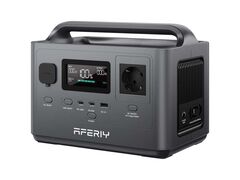
Aferiy P040
£162.12 (11)
With 256Wh, a full mains recharge in just over an hour and a UPS mode under 10ms, the Aferiy P040 protects sensitive devices without breaking the bank.
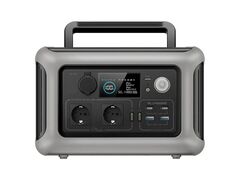
Allpowers R600
See price (7)
Affordable and backed by a 5-year warranty, the Allpowers R600 delivers 299 Wh, 600 W and a one-hour recharge, plus a built-in wireless charger.
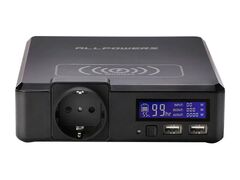
Allpowers S200
See price (6)
154Wh and 200W in an ultra-compact, book-sized station with built-in wireless charging: the mini power station that goes everywhere without weighing you down.
Allpowers S300 Plus
See price (5)
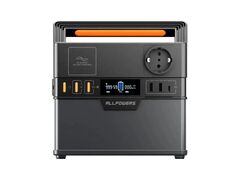
Compact and clever, the Allpowers S300 Plus (288 Wh) combines USB-C 100 W, a wireless charger, an LED torch and app control.
Published on 01/09/2026