
How we chose
Magnetic wireless charging used to be a bit of a gimmick: slow, easy to misalign, barely faster than doing nothing at all. That changed with Qi2, the standard that borrows MagSafe's magnet ring and opens it up beyond Apple's own ecosystem. Some power banks now hit 25 W wirelessly, nearly as fast as a standard USB-C cable.
To build this selection, we compared the market on five concrete criteria:
- Wireless charging speed: 7.5 W on classic models, up to 25 W on certified Qi2.
- Magnetic grip quality: the number and strength of the magnets, so the pack never slides off.
- A built-in or included USB-C cable, so you're never caught without one.
- Usable capacity relative to weight and thickness.
- Value for money, since this segment still costs more than a plain wired power bank.
Here is our pick, with the type of user each model suits best.
| Model | Capacity | Wireless | Wired | Weight | Price |
|---|---|---|---|---|---|
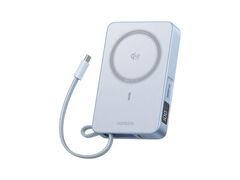
| Ugreen MagFlow 10000 | 10,000 mAh | Qi2 25 W | 30 W (built-in cable) | 254 g | ≈ $60 |
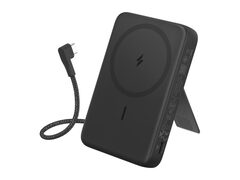
| Anker Zolo Magnetic | 10,000 mAh | 7.5 W | 30 W (built-in cable) | 240 g | ≈ $50 |
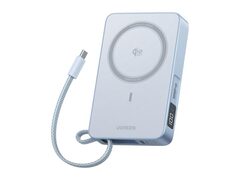
| Ugreen MagFlow 20000 | 20,000 mAh | Qi2 25 W | 45 W (built-in cable) | 480 g | ≈ $100 |
| Ugreen Nexode Mini | 5,000 mAh | 7.5 W | 15 W (60 W cable included) | 145 g | ≈ $40 |
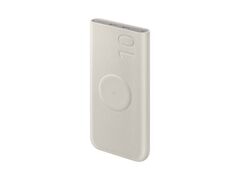
| Samsung 10000 Induction | 10,000 mAh | Qi 7.5 W | 25 W (2x USB-C) | 222 g | ≈ $40 |
1. Best overall: Ugreen MagFlow 10000mAh
If one power bank had to sum up the state of the art in magnetic wireless charging in 2026, this would be it. The Ugreen MagFlow 10000mAh is one of the few that fully exploits certified Qi2, with wireless charging climbing to 25 W, versus 7.5 W on most magnetic packs. On an iPhone 17 Pro Max, it tops up to 50% in about 38 minutes, with no cable at all.
Its seventeen magnets provide a firm grip, so you can keep using the phone one-handed without the pack sliding off. A built-in USB-C cable, which doubles as a wrist strap, takes over for wired charging up to 30 W, and a digital screen shows the remaining charge in real time. At 10,000 mAh (37 Wh), it charges a recent iPhone about 1.7 times, and stays well under the 100 Wh cabin limit.
The one catch: the full 25 W is only available on recent iPhone 16 and 17 models (iOS 26); older models cap at 15 W, already well above the classic standard. For anyone chasing the fastest, most complete wireless charging on the market, this is currently the one to beat.
2. Best value for money: Anker Zolo Magnetic 10000
Cheaper than a fast Qi2 charger, the Anker Zolo Magnetic 10000 banks on something else: versatility. Its magnet grips firmly onto a MagSafe-compatible iPhone, wireless charging stays at a classic 7.5 W, but it makes up for that with two well-executed ideas.
First, a built-in kickstand that unfolds to turn the phone into a small tilted screen, handy on a plane or at a desk. Second, a USB-C cable built directly into the case, delivering up to 30 W wired, more than enough to fast-charge a phone without hunting for a cord. At 10,000 mAh, it delivers roughly two full phone charges in a pocket-friendly shape (240 g).
It's the logical pick for anyone who wants a complete accessory, magnet, video stand and built-in cable, without paying the premium for 25 W Qi2.
3. For never running out of power: Ugreen MagFlow 20000
Most MagSafe power banks cap out at 10,000 mAh to stay thin. The Ugreen MagFlow 20000 doubles that while still holding onto certified 25 W Qi2, and climbs to 45 W wired thanks to its built-in USB-C cable.
Its seventeen N52 magnets deliver roughly 9 newtons of holding force, and the pack can power up to four devices at once: two USB-C ports, one USB-A, and the induction surface. Enough to cover an entire long weekend, with margin to bail out friends, without ever hunting for an outlet.
The trade-off is predictable: at 480 g and 33 mm thick, this is a bag battery, not a pocket one. For light daily use, a 10,000 mAh model is more comfortable; for a real anti-outage shield while travelling, this one doesn't disappoint.
4. The thinnest: Ugreen Nexode Mini 5000mAh
At the opposite end, the Ugreen Nexode Mini 5000mAh plays the discretion card to the max. At just 1.31 cm thick and 145 g, it practically disappears on the back of an iPhone without throwing off the balance in hand.
Magnetic charging stays at 7.5 W, the norm for this ultra-thin format, backed up by a USB-C port up to 15 W. The real bonus: Ugreen includes a 60 W-capable USB-C cable in the box, a rare inclusion for this kind of product. At 5,000 mAh, it delivers roughly one full iPhone charge, exactly enough to bail out a day or an evening.
This is the power bank to slip into a jacket pocket and forget about, for anyone who values lightness over maximum runtime.
5. Most versatile, Android included: Samsung 10,000 mAh Wireless
Every model above mainly targets the iPhone. The Samsung 10,000 mAh Wireless pack (EB-U2510) takes the opposite approach: its standard, non-magnetic Qi charging surface works just as well with an iPhone as with a compatible Android phone, a Galaxy Watch, or earbuds.
It makes up for the lack of a magnet with real wired versatility: two USB-C ports up to 25 W, capable of powering three devices at once (two cables plus induction). A USB-C cable is included, and the beige finish, partly made from recycled plastics, is a nice change from the usual black casing.
For anyone without a MagSafe case, or with a Qi-compatible Android phone, this is the most versatile way to combine wireless and fast wired charging.
MagSafe, Qi and Qi2: what's the difference?
These three names describe related but distinct technologies, and the confusion is common.
Qi (pronounced "chee") is the oldest and most widespread inductive wireless charging standard, developed by the Wireless Power Consortium. It typically caps at 7.5 or 10 W and has no magnet system at all: the phone must be carefully aligned on the coil.
MagSafe is Apple's proprietary system, launched with the iPhone 12. It adds a ring of magnets that automatically aligns the phone on the charging coil, with power reaching 15 W on Apple-certified accessories.
Qi2 is the open standard that borrows MagSafe's magnet approach (dubbed the "Magnetic Power Profile") and opens it up to third-party accessories, with charging climbing to 25 W in its Qi2.2 revision on compatible devices. A Qi2 accessory works with any smartphone fitted with the same magnet system, not just recent iPhones, as long as the phone supports it.
The practical takeaway: the more a power bank is certified Qi2 (rather than simply "magnetic" or "MagSafe-compatible"), the more likely it is to deliver a genuinely fast charge rather than a mere trickle.
Getting the most out of a MagSafe power bank
A few simple habits help you get the most out of this format:
- Remove thick cases, or ones containing a bank card (magnetic stripe), before attaching the pack: both the magnetic grip and charging efficiency suffer otherwise.
- If the phone gets noticeably warm during wireless charging, switch to the built-in USB-C cable for a while: heat slows the charge and, over time, wears the phone's own battery down a little faster.
- For extended use (train, plane), the kickstand or built-in stand on some models is more comfortable than a pack lying flat.
For more on choosing a power bank in general, see our guide to the best travel power banks, or browse our power banks section for the full catalogue.