
How we chose
Replacing a lead-acid battery with LiFePO4 lithium on a van, a boat or a solar setup changes everything, but the mains charger has to keep up too, or it will undercharge the battery or, worse, damage it. This comparison deliberately focuses on mains chargers (plugged into the wall) that are genuinely compatible with LiFePO4 lithium, in both 12V and 24V, as distinct from our comparison of lead-acid, AGM and gel chargers for winter, which covers winter maintenance of traditional batteries. Our selection criteria:
- A genuine lithium charge profile, not just one that is merely tolerated: charge voltage tuned for LiFePO4, with no desulfation or equalisation stage that could exceed the BMS's upper cut-off.
- Charging power matched to the actual capacity of the battery being maintained, from a small leisure cell to a large van or boat pack.
- 12V compatibility, and more rarely 24V: many consumer mains chargers stop at 12V.
- Protections: reverse-polarity and short-circuit protection, built to survive a van's or boat's technical compartment.
Four picks, from a tight budget to professional high-end.
Why a lead-acid charger doesn't suit a LiFePO4 battery
A lead-acid, AGM or gel battery charges on a well-established profile: constant-current charge, then absorption, then float maintenance, sometimes preceded by a higher-voltage desulfation pulse to break down sulfate crystals. A LiFePO4 lithium battery needs none of these lead-acid-specific stages, and some of them can flat-out damage it.
A single LiFePO4 cell has a nominal voltage of 3.2V: a 12V pack wires four in series (12.8V nominal), a 24V pack wires eight (25.6V nominal). Victron Energy, which makes its own 12V and 24V LiFePO4 batteries, recommends a charge voltage between 14V and 14.4V for a 12V pack (28V to 28.8V for a 24V pack), with 14.2V (28.4V) as the optimal figure, and a float voltage of 13.5V (27V) (source). A lead-acid charger that climbs above that during a desulfation or equalisation stage can exceed the BMS's upper cut-off voltage: the BMS then trips the charge as a safety measure, and repeated trips wear the battery out prematurely.
Mains charger, DC-DC charger or solar controller: don't mix them up
Three different devices can charge a LiFePO4 lithium battery, but they don't serve the same purpose, and confusing them leads to the wrong purchase. The mains charger, the subject of this comparison, plugs into a wall socket, at home, on a marina shore-power post or via a generator: it's the equivalent of a shore charger. The DC-DC charger, by contrast, charges from the vehicle's alternator while driving, regulating a current that the alternator alone doesn't limit finely enough for a lithium battery wired in directly; we cover this in our comparison of dual-battery DC-DC kits for vans and 4x4s. The solar charge controller (MPPT or PWM), finally, charges from solar panels and has nothing to do with mains power. A single van or boat often combines all three, each one covering a different energy source.
If the question is about the battery itself rather than its charger, our comparison of 12V LiFePO4 lithium batteries to replace lead-acid covers how to pick a pack, BMS included.
12V or 24V: what changes for the mains charger
12V dominates the consumer market by far: leisure vehicles, pleasure boats, light residential solar setups. 24V stays more niche for private users, but is standard on heavier vans, trucks and some boats, partly because at equal power a 24V system carries half the current of a 12V system, meaning fewer losses over long cable runs.
On the consumer mains-charger side, lithium-compatible 24V options stay rare: most models sold in DIY stores stop at 12V, even when they advertise lithium compatibility. A 24V mains charger does exist from some specialist manufacturers, but always check two things before buying: the stated output voltage must match the pack's nominal voltage exactly (24V, not 12V), and the lithium mode must be explicitly listed, not just an AGM or gel mode. Never wire two 12V chargers in series to get 24V: without electronic synchronisation between them, the risk of imbalance between the two halves of the pack is real.
Current, voltage, capacity: how to compare specs
Beyond the lithium profile, a few benchmarks to compare spec sheets against each other:
| Model | Current | Voltage(s) | Lithium | Max capacity |
|---|---|---|---|---|
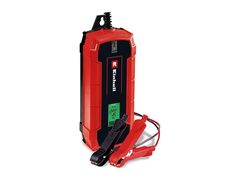
| Einhell CE-BC 5 M LiFePO4 | 5A | 12V | Auto-detect, dedicated LiFePO4 | Common leisure batteries |
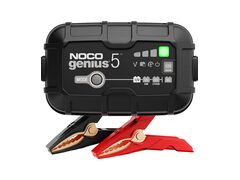
| NOCO GENIUS5 | 5A | 6V / 12V | 12V Lithium mode | Up to 120Ah |
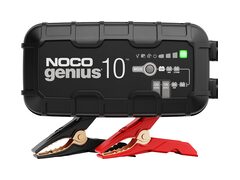
| NOCO GENIUS10 | 10A | 6V / 12V | 12V Lithium mode | Up to 230Ah |
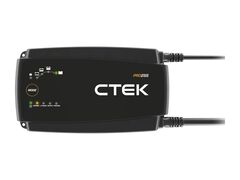
| CTEK PRO25S | 25A | 12V | Lithium 30 to 450Ah | Up to 450Ah |
The charge current should match the pack's capacity and the time you have available: aim for roughly 0.2 to 0.5C for a reasonable full charge without stressing the BMS (a 100Ah battery charges comfortably at 20 to 50A). A lower current suits simple maintenance, left plugged in for days at a time, very well.
Our picks: 4 mains chargers genuinely compatible with LiFePO4 lithium
Budget lithium: Einhell CE-BC 5 M LiFePO4
At around fifty euros, the Einhell CE-BC 5 M LiFePO4 automatically detects the type of battery connected (LiFePO4, gel, AGM or lead-acid) and applies the matching profile, up to 5A. It's the cheapest option on the market to cover both the car's lead-acid starter battery and the motorhome's lithium pack with a single unit.
The compact all-rounder: NOCO GENIUS5
The NOCO GENIUS5 adds a genuine « 12V LITHIUM » mode at 5A, alongside 6V and the usual lead-acid profiles, for batteries up to 120Ah. Its thermal sensor and Force mode (waking batteries that have dropped as low as 1V) make it a reliable companion for wintering a motorbike, boat or rarely-used van.
The powerful all-rounder: NOCO GENIUS10
Twice as powerful as the GENIUS5, the NOCO GENIUS10 delivers 10A and goes up to 230Ah in 12V Lithium mode, enough to quickly recharge a large van, boat or motorhome pack. Its Supply mode (a stabilised 13.6V power supply) also helps preserve the vehicle's memory during a battery swap.
The high-power professional: CTEK PRO25S
With 25A and lithium compatibility from 30 to 450Ah, the CTEK PRO25S targets heavy use: a workshop, several vehicles, or a large pack in a converted van. Its dedicated wake-up function can even revive a lithium battery that has dropped into low-voltage protection, a case many consumer chargers simply give up on.