
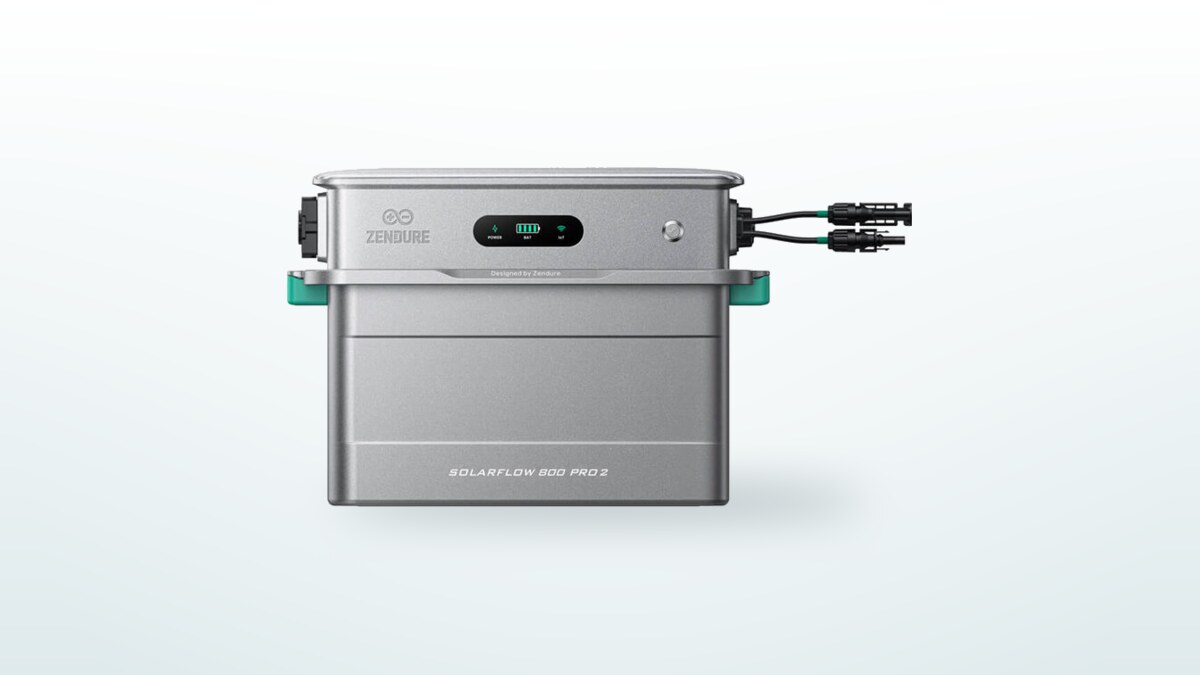
1000 W bidirectional: a figure that has nothing to do with grid export
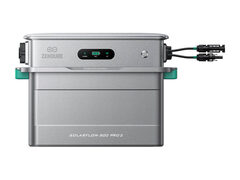
The product page highlights a 1000 W bidirectional AC output, a figure repeated across most spec summaries. That value actually applies exclusively to off-grid back-up mode, a separate function meant to power essential appliances during a power cut, through a dedicated circuit not connected to the home's electrical panel.
For the most common use case, a kit permanently connected to the home's grid, the figure that actually applies is 800 W, the same as the rest of the SolarFlow lineup. That is also the value consistent with the regulatory caps in force in France and Germany for simplified plug-in solar setups. The 1000 W back-up mode only takes over during a power cut, on a dedicated circuit, with no connection to the power sent into the home day to day.
3840 Wh maximum: expansion that lags behind the rest of the lineup
The built-in 1920 Wh battery accepts a single expansion, the Zendure AB2000L, to reach 3840 Wh in total. That is the only configuration offered by the manufacturer's official configurator: no option with several additional batteries appears for this specific model.
That ceiling stands in contrast with the rest of the SolarFlow lineup, where the same architecture accepts up to five additional batteries to reach 11.52 kWh. On this particular point, the Pro 2 marks a clear step back in flexibility compared with the models it complements in the brand's catalogue, rather than outdoing them across the board. The trade-off makes sense on its own terms, though, since this model's priority clearly goes to allowable solar input rather than maximum storage capacity.
For anyone mainly after energy storage across several days, another model in the lineup, more geared toward storage, will suit the need better than this Pro 2, built first and foremost to cope with panels that are hard to angle perfectly.
Four MPPT controllers: the strongest argument, not a new feature
The most convincing technical point of the Pro 2 remains its four independent MPPT controllers at 660 W each, for a total solar input of 2640 W. Each panel then works at its own maximum power point: a module partially shaded or facing a different direction no longer drags down the other three, unlike a one- or two-tracker architecture where the inverter has to strike a compromise between mismatched inputs.
This mechanism matters especially on an apartment balcony, where panels are often split between a railing and a perpendicular wall, with very different orientations and sun hours. It is a genuine physical advantage, well established and consistent with how multi-MPPT architectures are known to work.
One nuance is worth knowing, though: this four-tracker setup is not a feature new to the Pro 2, it already equipped the previous generation of this model. The four-MPPT argument therefore still holds against the other current members of the lineup, which are less well equipped, but it does not set this Pro 2 apart from its immediate predecessor on this particular point.
AI energy management: connected to hourly rates, never measured independently
The built-in energy management system connects to more than 840 European electricity suppliers across 32 markets, to automatically adjust battery charge and discharge according to the hourly rates in force: it charges when electricity is cheap, and favours discharge when it costs more. A winter protection setting also limits discharge below a threshold that is unfavourable for the cell in cold weather.
This principle, common on larger home systems, shows up here at balcony scale. The savings the manufacturer announces remain declarative figures, though, without a detailed calculation method or an independent measurement to confirm them: best treated as a plausible potential rather than a guaranteed result, especially since the real gain depends heavily on the electricity supplier, the household's consumption profile and the local tariff structure.
French regulations: a grey area wider than this one product
The 800 W threshold widely repeated for balcony solar kits in France is often presented as based on a 2017 ministerial order. A direct reading of that text shows it actually deals with electricity buy-back tariff conditions for much larger installations, unrelated to a wattage cap for balcony kits, and that the text has since been replaced. This confusion about the 800 W threshold for balcony kits in France remains widespread.
The 800 W threshold in France is better described as a market convention, widely adopted by manufacturers including Zendure, than a single explicit legal text setting that figure for this product category. The recognised administrative step remains the no-export self-consumption agreement filed with the grid operator, free and fully digital for installations up to 36 kVA. A new electrical connection standard has also applied in full since September 2025, without banning balcony kits, which are treated as unpluggable mobile generators rather than a fixed installation.
This grey area is not specific to this product: it touches the entire category of balcony solar kits sold in France. The SolarFlow 800 Pro 2, natively calibrated to 800 W of export, fits in any case within the market practice currently accepted.
In Germany, a much clearer legal framework
The German balcony solar market has had a noticeably clearer framework since the Solarpaket I took effect in mid-2024: an explicit legal cap of 800 VA in export, with up to 2000 W peak of installed modules. The only administrative step required is registration with the federal market data register, within a month of commissioning, with no separate filing needed with the grid operator.
The SolarFlow 800 Pro 2, calibrated to 800 W of grid export, natively complies with this German limit, which today remains the clearest and most precise legal framework across the entire European balcony solar market.
Real efficiency: what is known, and what is not yet
The manufacturer claims a conversion efficiency of up to 96 %, an improvement of roughly three points over the previous generation thanks to a new generation of power components. That figure remains a manufacturer's own data, with no independent measurement specific to this exact model available to confirm or qualify it to date.
The previous generation of this model showed a more modest efficiency figure when charging from the grid, with a different generation of components. That figure applies to a distinct product: it does not automatically carry over to the Pro 2, and should therefore not be attributed to it without its own confirmation.
Smart metre and app: day-to-day control
The SolarFlow 800 Pro 2 pairs with the Zendure 3CT smart metre, which measures the home's consumption in real time to fine-tune battery control and target zero export when desired. The system's low-voltage start-up, from as little as 14 V versus 18 V for a more conventional design, lets it start producing earlier in the morning or under hazy skies.
Full control, including the connection to dynamic hourly rates, goes through the manufacturer's app and an internet connection, local or mobile: basic regulation keeps working without a permanent connection, but the advanced functions depend on it. That is a common dependency on this type of connected product, worth keeping in mind for anyone after a setup that runs fully independent of the network and the cloud.
The zero-export principle consists of adjusting the power sent out by the battery so that it matches the home's instantaneous consumption as closely as possible, with no surplus sent back to the public grid. The 3CT metre plays a central role here by feeding the system real consumption data in real time rather than an estimate. The responsiveness of this mechanism, in other words the delay between a change in consumption and the battery's adjustment, has not been measured independently for this specific model to date.
Size and installation: more compact than the previous generation
At around 22.6 kg for 392.7 × 236.3 × 276 mm, the Pro 2 is smaller and lighter than the previous generation of this model, which came in close to 26 kg. Installation is still designed to be done without an electrician, between the panels and a household socket, with IP65 weatherproofing suited to outdoor mounting.
The stated operating temperature range, 0 to 55 °C while charging and -20 to 55 °C while discharging, is a wide one. No account of a real installation in actual operating conditions, over several weeks or months, exists yet for this specific model, the product being too new for that kind of extended use.
A price that varies sharply depending on the configuration chosen
The unit alone, without panels or an additional battery, sits at around 779 € directly from the manufacturer. The official configurator then offers many combinations with bifacial solar panels (two or four modules at 450 or 500 W), with the AB2000L additional battery, or with the 3CT smart metre, pushing the total price up to around 2100 € for the fullest configuration.
On the German market, more mature for this type of product, several price comparison sites already list the unit alone noticeably cheaper than the official catalogue price, a sign of competition between resellers rather than a disagreement over the reference price. That same discount pattern could well repeat in France as the product spreads to other resellers, but no such trend is measurable yet on a French market where the product has only just arrived.
A product too new for a real track record
This Pro 2 joined the European market during the summer of 2026, and its rollout in France is even more recent. No full laboratory test, with a detailed protocol and measured figures, exists yet for this specific model, the product being too new for extended actual use.
This lack of track record is not specific to this product: it applies to any recent launch. It is still worth knowing before buying, though: the efficiency figures, battery longevity and tariff-management effectiveness currently rest solely on the manufacturer's own statements, with no independent confirmation available to cross-check them.
Up against the Anker Solix Solarbank 3 E2700 Pro and the EcoFlow Stream Ultra X
In the high-end balcony solar kit segment, two references already reviewed on this site help place the Pro 2: the Anker Solix Solarbank 3 E2700 Pro and the EcoFlow Stream Ultra X.
| Criterion | Zendure SolarFlow 800 Pro 2 | Anker Solix Solarbank 3 E2700 Pro | EcoFlow Stream Ultra X |
|---|---|---|---|
| Base capacity | 1920 Wh | 2688 Wh | 1920 Wh |
| Maximum expansion | 3840 Wh | 8064 Wh | 3072 Wh delivered |
| MPPT controllers | 4 | 2 | 2 |
| AC grid export output | 800 W | 800 W | 800 W by default |
| Price observed | ≈ 779 € | ≈ 1300 € | ≈ 1199 € |
The Pro 2 sits clearly below the other two on price and capacity, but stands out for its number of MPPT controllers, double that of the other two references. It therefore suits a different buying profile: a tighter budget and a priority on tolerating difficult panel orientations, rather than the largest possible energy reserve.
Who it suits, and who it does not
It suits anyone with a balcony that has difficult orientations or partial shading, where several panels cannot all face the same way, and who favours a contained entry budget on this segment over the largest possible capacity.
It does not suit anyone looking to build up a large energy reserve over several days, since expansion tops out at 3840 Wh, nor anyone who wants to rely on an established usage track record before buying: the product being very recent, that track record simply does not exist yet.