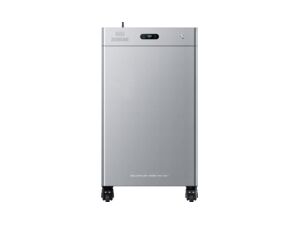

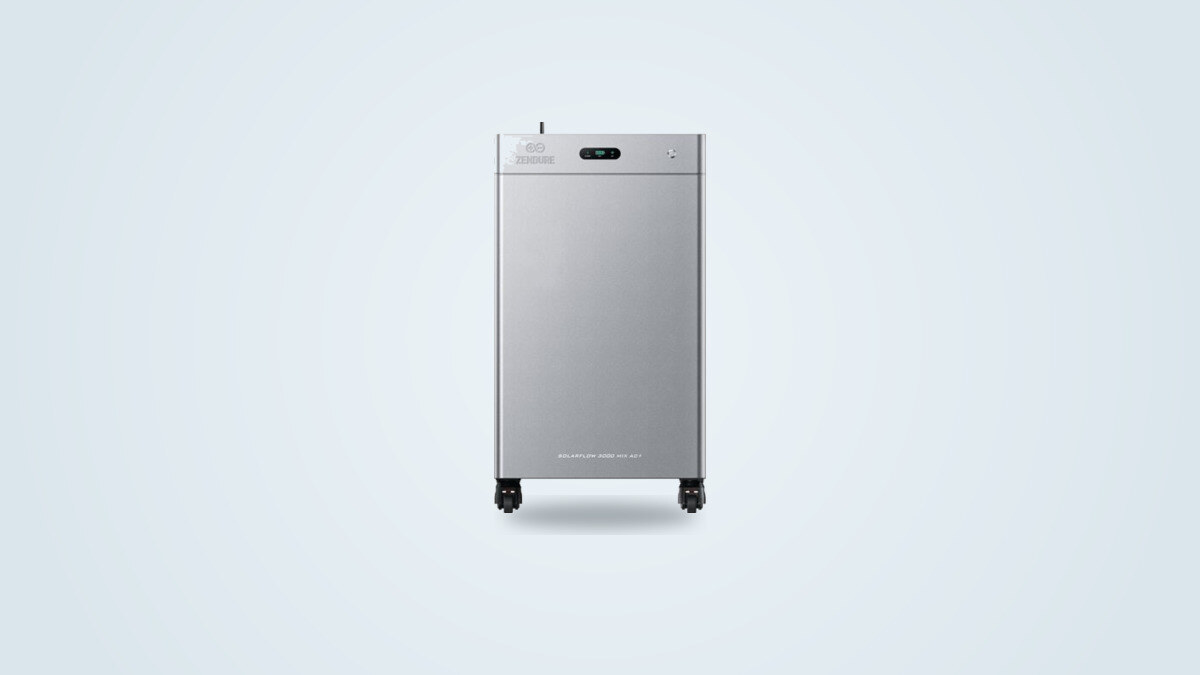
The entry-level model in the SolarFlow Mix line
The Zendure SolarFlow 3000 Mix AC+ opens the new SolarFlow Mix line, which combines home storage, balcony-system simplicity, and a degree of mobility. It targets a roughly two-person household, with annual consumption around 3000kWh.
Unlike the SolarFlow 4000 Mix AC+ and Mix Pro, its 8000Wh capacity is fixed, with no expansion option. That's a deliberate simplicity choice, not an oversight: the product targets stable use rather than a growing setup.
A round-trip efficiency claimed at 90%
Zendure states a round-trip efficiency of 90% for the SolarFlow 3000 Mix AC+. No independent measurement of that figure is available to date. It's a decent efficiency for an AC-coupled home battery, without being the highest on the market.
On durability, the unit is rated for 10,000 cycles at 70% remaining capacity, for a lifespan estimated at around 15 years on the basis of two full cycles a day, covered by a 10-year manufacturer warranty.
A fixed 8000Wh: simplicity comes at the cost of growth
This is the product's most defining limitation. Where the SolarFlow 4000 Mix AC+ and the Mix Pro accept expansion modules up to 50kWh, the 3000 Mix AC+ stays locked at its original 8000Wh, with no add-on option at all.
In exchange for that rigidity, the 3000 Mix AC+ stays around £400 cheaper than its bigger sibling, a coherent trade-off for anyone who doesn't need room to grow.
A dedicated input for an already-installed solar inverter, with no MPPT of its own
The SolarFlow 3000 Mix AC+ has no MPPT built in and doesn't manage any solar panels directly. Its logic is different: a dedicated input takes the AC output from an already-installed solar inverter, up to 3000W, with compatibility Zendure states across most major brands on the market (Huawei, SMA, Fronius, Enphase, SolarEdge, Sungrow).
This design assumes you already have a working solar installation with an inverter in place: this product adds storage to existing production, it doesn't replace a full solar setup.
A generous backup output for this segment
During a grid outage, the off-grid output delivers 3680W continuous and up to 7200W peak, with an automatic transfer switch stated at 10 to 15 milliseconds, fast enough not to disrupt most sensitive electronics.
This backup power comfortably exceeds what most plug-and-play balcony batteries offer, and covers the essential needs of a small household during an outage with room to spare.
On casters, but mobility is mostly theoretical at 80kg
The IP65-rated metal casing operates from -20 to +55 °C and stays mounted on casters to ease repositioning. At around 80kg for dimensions of 461 x 234 x 825mm, though, this isn't a daily nomadic setup: the casters mainly help reposition the unit during a semi-fixed installation (utility room, workshop, cabin), not frequent transport.
Noise level is stated by Zendure at around 25dB at half load, with no independent measurement available to date.
HEMS 2.0 and the ZenKi 2.0 AI: control among the most capable in this segment
Control runs on HEMS 2.0 and the ZenKi 2.0 artificial intelligence, with LAN, RS485, Wi-Fi, and Bluetooth connectivity. That mix of wired and wireless protocols gives more smart-home integration flexibility than most plug-and-play balcony batteries, which often stick to Wi-Fi or Bluetooth alone.
This is a genuine strength of the product, consistent with Zendure's more upmarket positioning on smart control compared to simpler rivals.
"Plug and play" doesn't mean paperwork-free past 800W
This is the most important point to understand before buying. Standard balcony batteries stay under 800W of inverter power, a threshold that in France allows a simplified declaration (CACSI) without certified compliance sign-off. The SolarFlow 3000 Mix AC+ accepts up to 3000W of input, well past that threshold.
In practice, this mostly weighs on a brand-new installation. For a household simply adding storage to a solar inverter that's already connected and declared, that administrative step was already handled beforehand.
Against the SolarFlow 4000 Mix AC+ and the Growatt NOAH 2000
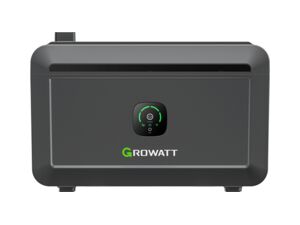
Within Zendure's own range, the 3000 Mix AC+ positions itself as the affordable, fixed-capacity version of the 4000 Mix AC+. Against a more modest balcony battery like the Growatt NOAH 2000, the comparison changes in nature.
| Criterion | SolarFlow 3000 Mix AC+ | SolarFlow 4000 Mix AC+ | Growatt NOAH 2000 |
|---|---|---|---|
| Capacity | 8000Wh (fixed) | 8000Wh, expandable to 50kWh | 2048Wh, expandable to 8192Wh |
| Bidirectional power | 3000W | 4000W (5000W bypass) | Separate micro-inverter required |
| Solar input | 3000W (third-party inverter) | 5000W (third-party inverter) | 1800W (2 MPPT) |
| Mobility | Yes, on casters | No, fixed | No, fixed |
| Observed price | £1999 | £2399 | ≈ £333 |
The 3000 Mix AC+ occupies a niche of its own: a large 8kWh capacity in one unit, with relative mobility thanks to its casters, a profile the far cheaper but much smaller-capacity NOAH 2000 doesn't cover at all. Against its own bigger sibling, it loses on power and expandability but gains on price accessibility.
Who the SolarFlow 3000 Mix AC+ is for
This model suits a two-person household with stable consumption that already owns a working solar inverter and wants to add a large storage capacity without having to manage expansion later.
For a household whose needs might grow (an extension, an EV), the SolarFlow 4000 Mix AC+ offers much better headroom for a roughly £400 premium. And for a brand-new installation with no existing inverter, the compliance process to expect is worth planning for before buying.