
Pure AC coupling: the promise and its verification
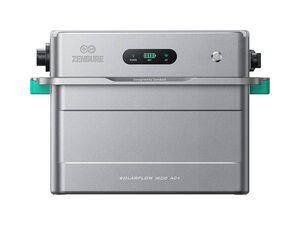
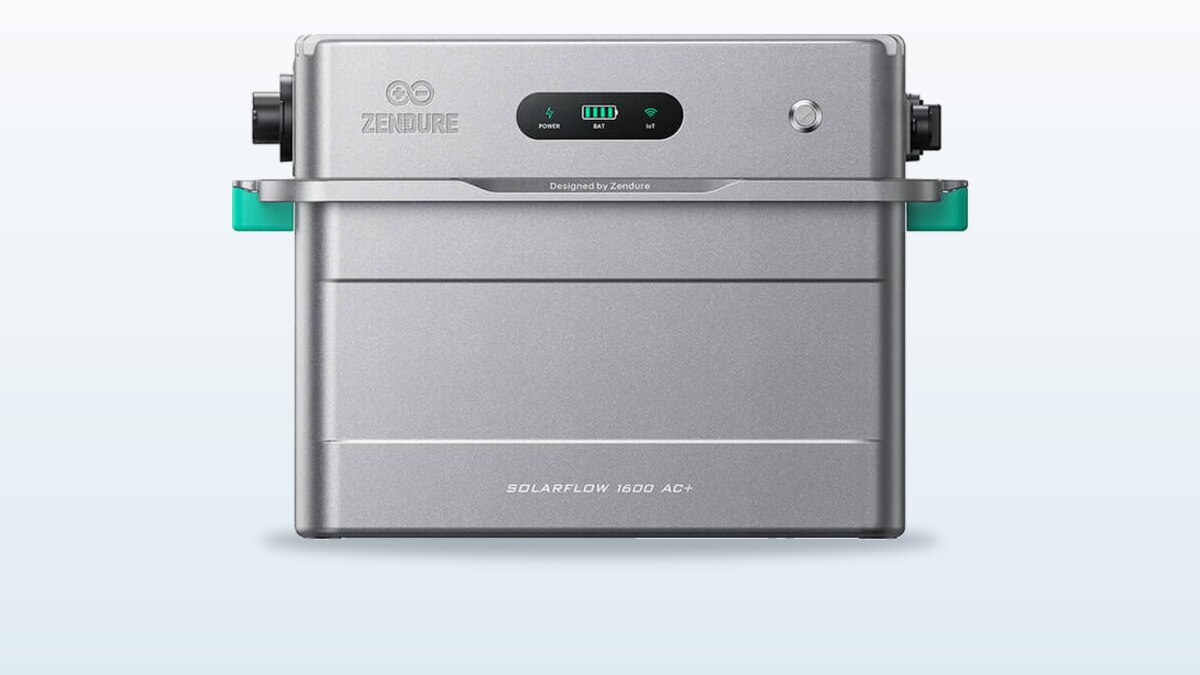
The SolarFlow 1600 AC+ sets itself apart from the rest of the SolarFlow lineup through the total absence of MPPT: it connects purely over AC, to a solar setup already fitted with an inverter, with no DC wiring to manage at all. This simplified architecture is also what carries the product's central sales pitch, compatibility with 100% of rooftop photovoltaic inverters on the market, regardless of brand.
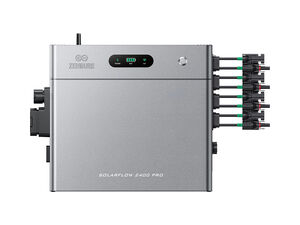
The technical reasoning behind this promise is solid: a purely AC coupling does not interact with the inverter's DC electronics, which mechanically reduces the risk surface compared with a DC-coupled system like the SolarFlow 2400 Pro and its 4 MPPT trackers. But the claim itself, taken literally, benefits from no independent verification to date crossing several inverter brands: it rests on the manufacturer's argument, not on a published cross-test.
Round-trip efficiency: a good number, a partial confirmation
Round-trip efficiency comes out at 87.6% on average over four complete cycles (individual cycles between 86.9 and 88.3%): a good level for this type of product, close to that of the SolarFlow 2400 Pro. A second figure, with no detailed protocol available, comes in slightly lower at 85.5%; the gap of nearly two points between the two stays within a plausible margin, with the 87.6% figure remaining the reference to go by.
This efficiency drops noticeably as soon as the power drawn decreases: under zero-export regulation at low load, it falls back to 78-82%, with the inverter drawing an almost fixed amount of power regardless of the load passing through it. A residual feed-in gap of 30 to 60 W instead of a regulation close to 0 W also persists in at least one equipped household, without the cause being settled: incorrect positioning of the smart metre's current clamps is suggested, without confirmation.
Backup switchover during a power cut
The switchover to backup power during a mains outage is set by the manufacturer at 15 ms, a value of 20 ms also exists under comparable conditions: both stay in the same range, a fairly reassuring signal. No case of switchover failure was found for this specific model.
Track record remains limited, however: the product has been sold since February 2026, and the long-term reliability of the switchover, over several months or years of use, does not yet have a long history behind it. Occasional malfunctions of the backup output, which appeared after certain firmware updates on the AC+ lineup in general rather than on this specific model, remain a point to watch over time rather than a confirmed defect on this unit.
The real friction point: software setup
Hardware installation of the unit itself is quick, about ten minutes in general, and does not require an electrician as long as power stays under the shared 800 W threshold. It is the software setup that proves trickier than advertised, a point that comes up in several customer reviews: app documentation judged incomplete on some menus, a charge priority logic that is unintuitive once several Zendure generations coexist on the same setup, and the need, not clearly highlighted at the time of purchase, for an additional Smart Metre 3CT for full benefit of tariff optimisation.
An occasional charging lockup, with the unit staying stuck at a low level despite available solar surplus, comes up at least twice on the manufacturer's official forum, without resolution from technical support in the most detailed case. The sample remains limited, but the problem is real and dated.
Quiet operation and thermal behaviour, a genuine strength
The enclosure runs without a fan, in full passive cooling: it only produces a light click from the relay at switchover, a few times a day. Surface temperature peaks at 38 °C at the top of the enclosure after about two hours of charging at 800 W, a level judged well controlled, clearly below safety thresholds.
What extending to 11.52 kWh really costs
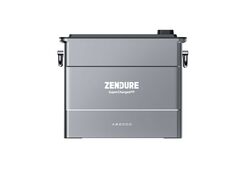
The 1920 Wh capacity extends up to 11.52 kWh by adding AB2000L batteries, in steps whose cost climbs fast: about 959 € with a first module (3.84 kWh), 1558 € with two, up to 3355 € for the full five-module configuration. Against the 719 € of the unit alone, extending capacity to the maximum works out to nearly five times the starting price, a cost to weigh before building a long-term extension plan rather than discovering it afterwards.
The observed price and availability against the direct competitor
The price of the unit alone, 719 €, is confirmed convergently across at least six independent French retailers, identical to the price already displayed on the manufacturer's page, and the unit remains available in stock at every retailer checked. The reference list price, on the other hand, varies noticeably from one source to another (979 €, 919 € or 779 € depending on the retailer): the exact discount amount is therefore something to check at the time of purchase rather than take for granted, with only the final price of 719 € staying stable.
Its closest direct competitor in pure AC coupling, the EcoFlow Stream AC Pro listed at 799 €, is for its part currently out of stock at the manufacturer: a real and verifiable availability advantage for the SolarFlow 1600 AC+ today.
Warranty and returns: what the small print reveals
The warranty covers 10 years for the battery itself, but only 1 year for the supplied accessories, cables and smart metre included: a gap worth knowing before purchase, even if it remains standard for this type of product.
A less well-known and more penalising point: outside of a proven manufacturing defect, return shipping costs remain charged to the buyer, estimated by the manufacturer itself at between 150 and 250 €, because of the safety requirements that apply to shipping batteries. A 30-day right of withdrawal remains open, but returning the unit because the setup ultimately does not suit has a real cost to factor into the purchase decision.
Who the SolarFlow 1600 AC+ is for
The SolarFlow 1600 AC+ is aimed first at anyone who already has a working balcony solar setup, with an inverter in place, and wants to add storage to it without rethinking the existing electronics or tying up a budget in superfluous MPPT. Its structural simplicity, decent efficiency and confirmed price make it a credible option for this specific use case.
It suits less well anyone starting a solar setup from zero: with no MPPT or direct solar input, it cannot capture energy from panels not connected to an existing inverter, unlike the SolarFlow 2400 Pro. And for anyone looking for fine-grained tariff optimisation from day one, it is better to anticipate the cost and complexity of adding a Smart Metre 3CT, rarely highlighted at the time of purchase.