What the claimed 38.5 Wh are really worth
The Xtorm FS5W101 packs a 10,000mAh LiPo (lithium-polymer) cell, which the maker's spec sheet converts to 38.5 Wh. The math checks out: at a nominal 3.85V, typical of this chemistry, 10,000mAh works out to exactly 38.5 Wh. That is a consistent figure, which is not always the case in this segment, where some brands quote an energy rating that does not match their own mAh number.
That 38.5 Wh figure remains a nominal value, the cell's rating before any conversion. How much of it actually reaches the phone is not known for this specific model: turning the battery's direct current into a magnetic field, then back into current inside the phone, necessarily wastes some energy as heat. A direct wired charge loses far less energy in the process than an inductive one.
As a rough reference point, a recent iPhone's battery (iPhone 15 or 16) holds around 13 to 14 Wh. Even after the usual losses of a magnetic charge, the FS5W101's 38.5 Wh cover one and a half to two full recharges, a figure in line with what Xtorm itself claims for the product. A hungrier phone, a large Pro Max model, or an Android device with a bigger battery, will push that ratio closer to a single full charge.
The case also supports pass-through charging: the FS5W101 can recharge over its USB-C port while the phone keeps charging wirelessly on top of it at the same time, with no need to wait for the power bank itself to be full first.
MagCharge Ultra 15W: a promise kept, but not the fastest on the market
The FS5W101's magnetic charging relies on Xtorm's own MagCharge Ultra technology, capped at 15W. That is enough to add roughly 20% of charge to an iPhone in 20 minutes according to Xtorm, a figure that lines up with what almost any 15W MagSafe charger on the market delivers, since Apple's own technology has been capped at that level since launch.
That figure places the FS5W101 within its segment: several recent 10,000mAh magnetic power banks top out at 7.5W, half its speed, while others, more recent, reach 25W thanks to the Qi2 standard (or its Qi2.2 revision). The FS5W101 sits in the middle: notably faster than the bottom of the market, but behind the newest models.
Xtorm does not claim any Qi2 certification for this model, unlike several rivals that display that badge on power banks in the same price range: the FS5W101 relies solely on its own MagCharge Ultra branding, a magnetic charge that is MagSafe compatible but sits outside the newest open standard.
The power bank's single port sidesteps any power-sharing issue between two wired outputs, a common limitation on dual USB-C models: here, there is only one wired output, so nothing to split between two devices plugged in at the same time.
Wired charging: the gap between the output port and the charging input
The FS5W101's USB-C port outputs up to 20W, enough to power a non-MagSafe smartphone over a cable, or any other USB-C device. That is the figure Xtorm highlights, both on the product page and on its own site.
The FS5W101's user manual sets a different value for the other direction of current flow, though: recharging the power bank itself, through that same port, tops out at 18W, not 20W. The product's marketing never distinguishes between the two directions: both the product page and the brand's site uniformly advertise 20W, in and out alike. A 2W gap between output and input is modest, but it illustrates a useful rule for this kind of product: the figure put front and center rarely describes both directions of current flow with the same precision, and the technical manual remains the most reliable reference whenever in doubt.
In practice, the FS5W101 recharges fully in around 3 hours from empty, a figure Xtorm quotes and one consistent with an 18W input rather than 20W. Compared with other magnetic power banks able to recharge their own cell through a built-in 30 to 36W cable, that 3-hour figure sits toward the slow end, without being unusually long.
Pass-through works both ways at once: plugging the FS5W101 into the mains never interrupts the wireless charge of the phone resting on it, a feature that is not a given on this kind of product.
The metal kickstand, the one real difference from the competition
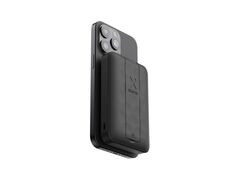
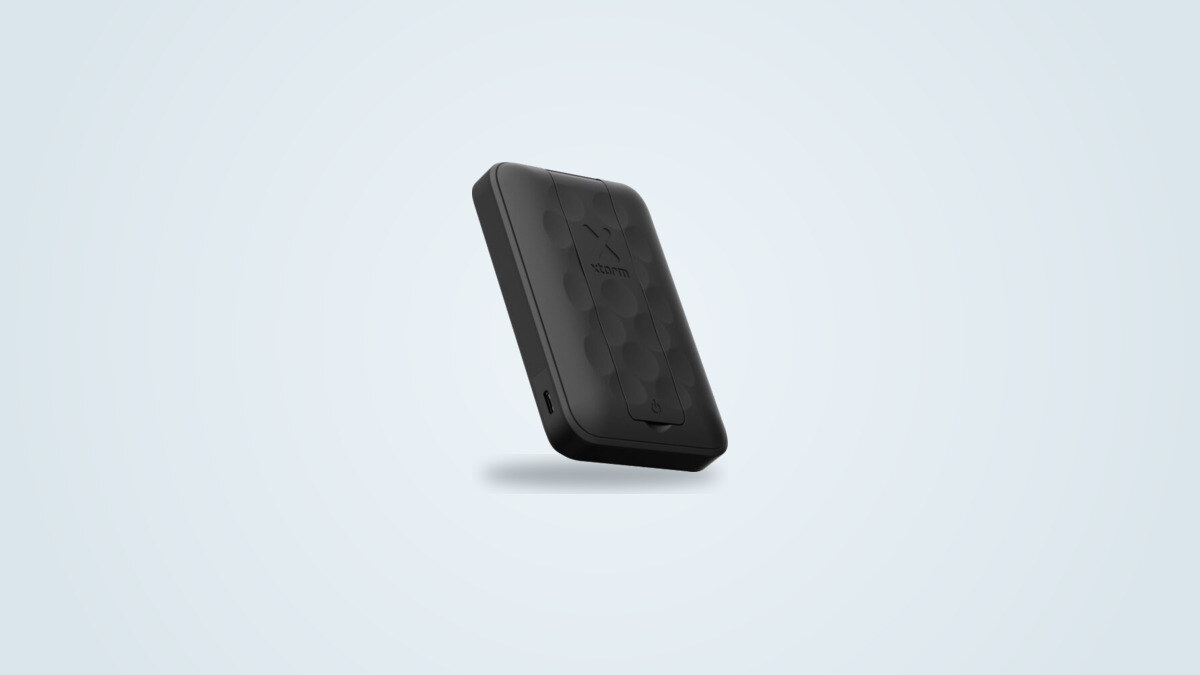
The built-in kickstand is the FS5W101's most distinctive feature. Folded away, it sits flush with the case and hides the power button underneath it: pressing the kickstand itself is enough to start charging, which avoids accidental presses in a bag or pocket. Unfolded, it turns the power bank into a desk stand, in portrait or landscape mode, handy for watching a video or taking a video call while charging.
This is the one area where Xtorm genuinely stands out from several direct rivals: the product page describes it as sturdier than a plain plastic stand, a claim that matches what the official product photos show, kickstand unfolded, in visible metal rather than the molded plastic seen on several comparable magnetic power banks in the same price bracket.
Xtorm bundles this kickstand, the press-to-start button and pass-through charging under one marketing label, three-way charging. Behind that commercial phrase, all three elements are real and work together: the kickstand for stability, the hidden button for simplicity, and pass-through so the phone's charge is never interrupted.
This is the only area where the FS5W101 clearly punches above its price bracket. On every other measurable criterion, power, screen or built-in cable, it sits at best in the middle of the segment, never at the top.
The price of that kickstand: a noticeably thicker case
At 229g, the FS5W101 lands almost exactly at the weight of the lightest model in its direct comparison set, which weighs 230g. On weight alone, Xtorm loses nothing against the best in class.
Thickness tells a different story. At 24mm, the FS5W101 is the thickest case among all the 10,000mAh magnetic power banks compared here, well ahead of the slimmest model in the segment, which does not exceed 15.95mm: close to a 50% gap between the two, for almost identical weight.
The mechanism explains the gap: fitting a foldable metal kickstand requires internal volume that a simpler plastic stand, or no stand at all, does not. The FS5W101 trades slimness for the sturdiness of its kickstand, a deliberate trade-off rather than a design flaw: there is no way to get both the thinnest case on the market and a foldable metal kickstand in the same space.
In a trouser pocket, that extra thickness is genuinely noticeable; set on a desk or slipped into a bag, it becomes largely secondary next to the comfort of a stable, durable stand.
A magnet that trails the best in the category
The built-in magnet aligns the FS5W101 correctly on the back of a MagSafe compatible iPhone from the first touch, from the iPhone 12 up to the latest compatible models according to Xtorm. Its grip, though, stays weaker than the best magnetic power banks in the category: there is a risk of it coming loose during a sudden movement, especially if the phone's case has not been removed first, which widens the gap between the two magnet arrays and weakens the hold.
This is a general trait of the whole product family, not a flaw specific to the FS5W101: the thicker the case, the greater the distance between the two magnets, and the weaker the holding force. A thin case, or removing it entirely, noticeably improves the grip of any magnetic power bank, this one included.
Xtorm does not publish a magnetic force figure, in newtons, for this model, unlike several rivals that do display that number. In its absence, only a qualitative description of the grip is possible: solid enough for everyday use, sitting on a desk or a sofa, but not the most reassuring for active use, walking, sport or transit.
The power bank also gets noticeably warm to the touch at the end of a wireless charge at full power, an expected trait of any 15W magnetic charge inside a compact case, without this calling the safety of operation into question: Xtorm's built-in safety control exists precisely to stop that kind of warmth from escalating.
Six layers of protection and a 2+1 year warranty: safety and build
The FS5W101 is built from recycled plastic (PC and ABS), with a textured honeycomb finish that improves grip and hides fingerprints, a design choice shared across the whole Fuel Series 5 lineup. Xtorm's built-in safety check covers six points: protection against short circuits, overheating and overcharging, a standard baseline for this kind of product rather than something specific to the FS5W101.
No recall targets an Xtorm product to date. That is a favorable sign, though tempered by how young the model is, launched in June 2024: the track record available is shorter than for a product sold for several years.
A detail buyers often miss: the advertised 2-year warranty is only the baseline. Registering the purchase within 3 months of receiving it, receipt in hand, extends coverage to 3 years, a policy shared across the whole Xtorm lineup rather than something specific to this model, but rarely highlighted on retailer product pages.
That extended warranty works in the FS5W101's favor against rivals whose real coverage sometimes turns out shorter than their own product page suggests.
Versus the EcoFlow Rapid Mag, the Anker MagGo and the Ugreen MagFlow
In the segment of 10,000mAh magnetic power banks with a built-in stand, three names come up regularly in comparisons: the EcoFlow Rapid Mag 10K, the Anker MagGo 10K and the Ugreen MagFlow 10000.
| Criterion | Xtorm FS5W101 | EcoFlow Rapid Mag 10K | Anker MagGo 10K | Ugreen MagFlow 10000 |
|---|---|---|---|---|
| Wireless charging | 15W | 25W (latest phones) | 15W | 25W |
| Wired port | 20W | 36W, built-in cable | 27W | 30W, built-in cable |
| Thickness | 24mm | 15.95mm | 19.8mm | 21mm |
| Weight | 229g | 230g | 250g | 254g |
| Screen | LED, percentage | LED, percentage | LCD | LCD |
| Warranty | 2 years (+1 on registration) | 24 months | 2 years | 2 years |
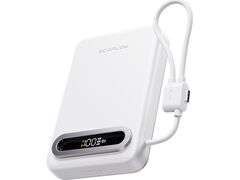
The EcoFlow Rapid Mag remains the thinnest and lightest of the comparison, with a built-in 36W cable, but its 25W wireless speed gain only fully shows up on the very latest Qi2.2 compatible phones; on everything else, it drops to 15W, exactly like the FS5W101.
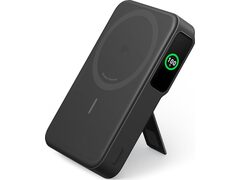
The Anker MagGo adds a status screen the FS5W101 lacks, for a very similar weight and wireless power, 15W as well: its wireless charging delivers 76.1% of its capacity at full power, a figure that gives a sense of the losses to expect from this kind of charging in general.
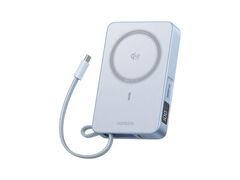
The Ugreen MagFlow climbs to 25W wireless and includes its own built-in cable, but its real total available capacity comes out behind several direct rivals of the same rated power.
Against these three names, the FS5W101 does not lead on any power or connectivity criterion. Its metal kickstand and extended 3-year warranty remain its most concrete selling points.
Android compatibility and use without MagSafe
Without built-in MagSafe magnets, an Android phone cannot clip onto the FS5W101: wireless charging is still possible by simply resting it on top, since most standard Qi receivers work without magnetic alignment, but at lower power and stability than with a properly aligned iPhone. Wired charging through the USB-C port, on the other hand, works regardless of phone brand.
For a mostly Android setup, the FS5W101 essentially becomes a 20W wired power bank with a built-in stand, since the magnetic feature loses much of its appeal without the phone's matching magnets. Xtorm itself only markets MagCharge Ultra specifically around MagSafe compatibility on iPhone, without claiming an Android equivalent.
Who the FS5W101 is for, and who should look elsewhere
It suits anyone who mainly wants a sturdy desk stand for watching videos or taking video calls while charging, without giving up standard 15W magnetic charging. It also suits anyone who values the perceived sturdiness of a metal kickstand over a plastic one, and anyone who takes advantage of the extended 3-year warranty by registering their purchase.
It does not suit anyone chasing the fastest wireless charging on the market, 25W with several direct rivals, nor anyone who prioritizes a slim case in their pocket: its 24mm of thickness make it the bulkiest in the comparison. It also does not suit anyone relying on the magnet for active use, walking or sport, since its grip lags behind the best references in the category.