
XTAR VC4: our full review

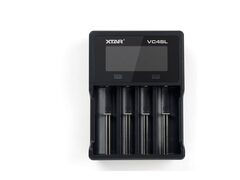
An LCD screen that shows voltage, current and capacity for each of its 4 independent slots: the XTAR VC4 charges nearly every Li-ion and Ni-MH cell format, from AAAA to 32650.

Our rating
4.0/5
Safety and protections: 3.8 out of 5 (weighting 20%)Safety3.8Build and endurance: 3.8 out of 5 (weighting 15%)Build3.8Format and chemistry compatibility: 4.4 out of 5 (weighting 25%)Compatibility4.4Charging precision: 3.6 out of 5 (weighting 25%)Precision3.6Display and control: 4.4 out of 5 (weighting 15%)Display4.4

How is this rating calculated?

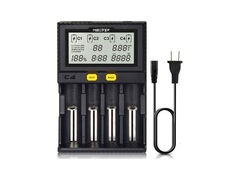
XTAR VC4 charger with its LCD screen showing 4 cells charging

The essentials

The XTAR VC4 stands out for its versatility and its LCD screen, which shows voltage, current, capacity and progress for each of its 4 independent slots. It accepts one of the widest cell format ranges on the market, from AAAA to 32650, in both Li-ion and Ni-MH, with automatic chemistry detection and auto-stop at full charge. Its recovery function can restart very deeply discharged cells that other chargers refuse. The main limit is its fixed 1000mA charge current, with no adjustment: a real constraint for anyone regularly charging large formats like the 26650, which take longer to charge with no option to raise the current. The input stays USB-A, with no backup USB output, and the product page details neither a list of protections nor a warranty duration. For anyone with a range of cell formats who wants one informative, reliable charger, the VC4 remains a safe bet.

Strengths

  • Compatible with a very wide range of formats and chemistries (AA, AAA, 18650, 21700, 26650... Li-ion, Ni-MH, Ni-Cd)
  • 4 fully independent slots, each cell charged according to its own profile
  • LCD screen showing voltage, current, capacity and progress for each slot
  • Recovery function for very deeply discharged cells
  • USB-powered, usable with a standard wall charger or a power bank

Limitations

  • Fixed 1000mA charge current, not adjustable, which extends charging time for large formats and offers no gentler option for small ones
  • USB-A input only, no USB-C
  • No USB output, cannot be used as a backup power bank unlike some rivals
  • The product page does not detail a list of protections (reverse-polarity, anti-spark) beyond the auto-stop at full charge
  • No contractual warranty duration is stated on the product page
XTAR VC4: see the full details and price →

A charger that shows everything, for almost every format

Most cell chargers make do with a few basic indicator lights. The XTAR VC4 goes further with an LCD screen that details the status of each of its 4 slots, while accepting one of the widest format ranges on the market.

4
Independent slots
23
Compatible cell formats
1000 mA
Max charge current

From AAAA to 32650, one of the widest compatibility ranges

The VC4 accepts lithium-ion cells (10440 through 32650, including the widely used 18650, 21700 and 26650) as well as Ni-MH and Ni-Cd cells in AAAA, AAA, AA, C and D formats. This versatility covers nearly every cylindrical cell in a household or workshop with a single device. The 4 slots work fully independently: two cells of different capacities charged at the same time do not affect each other, each follows its own charge profile.

Automatic detection, but a fixed 1000mA current

Each slot automatically detects the type and level of the inserted cell, adjusts its charge accordingly and stops on its own once fully charged, with no intervention needed. The VC4 also includes a recovery function that can gently restart very deeply discharged cells, which other chargers would detect as dead and refuse to charge. The real limit lies in the charge current, fixed at 1000mA with no way to adjust it: a constraint for large formats like the 26650 or D, which take longer to charge than with an adjustable-current charger, and for small formats that get no gentler current option.

The LCD screen, the VC4's main asset

Where a basic charger makes do with a two-colour LED, the VC4's screen shows for each slot the voltage, the charge current, the measured capacity and progress, in real time. It is a genuine monitoring tool for checking cell health or spotting a tired cell, rather than a simple charging-in-progress indicator. Power input stays USB-A, with no USB-C support, and the charger offers no USB output to back up an external device.

Auto-stop at full charge, but few details beyond that

The VC4 automatically cuts charging on each slot once it is full, avoiding overcharge for cells left plugged in longer than necessary. The body is properly sized for a 4-slot charger, at 210g for 149 x 115 x 35 mm.

Worth knowing: the product page does not detail a list of protections beyond this auto-stop (reverse-polarity, anti-spark), nor a contractual warranty duration.

Against the VC4SL, the Miboxer C4 and the XTAR X4

How does the VC4 compare with other 4-slot chargers with a screen?

Technical comparison: XTAR VC4 against other cell chargers (observed prices, indicative only)
CriterionXTAR VC4XTAR VC4SLMiboxer C4XTAR X4
Max current1000mA3000mA1500mA2000mA
Adjustable currentNoYesYesNo
USB outputNoNoNoYes
Observed price£34.20£29.41£29.46£26.90

The VC4SL and the Miboxer C4 both offer a higher, adjustable current, a real plus for charging large formats quickly, at a lower or similar price to the VC4. The XTAR X4 goes further with a USB output to back up an external device, for a higher budget. The VC4 stays relevant for anyone who values the most readable screen in the range and maximum format compatibility, without needing to adjust the current themselves.

Who the XTAR VC4 is for

This charger suits anyone with a range of cell formats who wants a single informative, reliable device to charge them all. To charge large formats faster with an adjustable current, the XTAR VC4SL or the Miboxer C4 are a better fit; to back up an external device via a USB output, the XTAR X4 is the natural choice.

The rating in detail

Our rating
4.0/5
Actual charging current not measured
Battery compatibility not measured
Safety and protections 3.8
Build and endurance 3.8
Cables and connectors not measured
Actually delivered power not measured
Multi-port power sharing not measured
Protocol compatibility not measured
Size and technology not measured
Format and chemistry compatibility 4.4
Charging precision 3.6
Display and control 4.4
XTAR VC4: see the full details and price →

The product and its alternatives

XTAR VC4

XTAR VC4

See price (19)

A charger that tells you everything: the XTAR VC4 charges 4 Li-ion or Ni-MH cells at once and shows voltage, current and capacity on its LCD screen. The reference for cell enthusiasts.

View product
Xtar VC4SL Charger

Xtar VC4SL Charger

£29.41 (10)

A four-bay charger with an LCD screen and USB-C: the Xtar VC4SL shows voltage, current, capacity and internal resistance, and charges at up to 3A on one bay.

View product
MiBoxer C4 Charger

MiBoxer C4 Charger

See price (27)

The MiBoxer C4 charges 4 cells at once, shows voltage, current and capacity on its LCD screen, and even handles LiFePO4: the clever universal charger.

View product
Xtar X4 Charger

Xtar X4 Charger

See price (10)

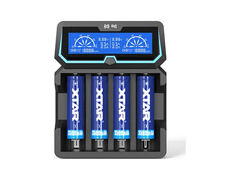
The Xtar X4 charges 4 Li-ion or NiMH cells at once, runs on mains or USB power, and turns into an emergency power bank thanks to its 5V USB output.

View product

Frequently asked questions

Lithium-ion cells from 10440 to 32650 (including the widely used 18650, 21700 and 26650) and Ni-MH and Ni-Cd cells in AAAA, AAA, AA, C and D formats. Each slot automatically detects the type and level of the inserted cell.

No, the VC4 charges at a fixed 1000mA per slot, with no adjustment possible. Other models in the range, such as the VC4SL, offer a higher, adjustable current.

No, it has no USB output to charge an external device. The XTAR X4, in the same range, offers this function.

Yes. It has a recovery function that gently restarts charging of deeply discharged cells, which many conventional chargers detect as dead and refuse to charge.

It works over USB-A: plug it into a wall charger, a computer port or a power bank. Handy to use at home and on the move, with no dedicated transformer.