What the advertised 5000 mAh figure is really worth
The internal cell of the Ultra Slim 5000, a Lishen SP654588SL soft-pack unit, carries a nominal voltage of 3.88V for a capacity of 4900 mAh (5000 mAh at maximum), or 19.1 to 19.4 Wh depending on which reference figure is used. It is this last number, 19.4 Wh, that the product's public spec sheet quotes.
That is not, however, what the USB-C port actually returns. Xiaomi itself states, in the product's regulatory documentation, a rated capacity of 2700 mAh at 5V/2.4A, or 13.5 Wh. The roughly 30% gap between the two figures signals nothing unusual: it corresponds to the voltage conversion between the cell's 3.88V and the 5, 9 or 12V delivered at the output, a routine loss for this type of circuit, made larger here by how little room a 10 mm case leaves for the conversion components.
In practice, those 13.5 Wh cover a full charge for most current smartphones, not two. A recent iPhone (roughly 12 to 13 Wh of battery) can be filled almost entirely in one go; a larger Android phone (16 to 19 Wh) will fall short. That is no surprise given the format: nobody expects a 10 mm battery to rival a 20,000 mAh pack, and Xiaomi never claims otherwise.
10 mm and 93 g: the argument that justifies everything else
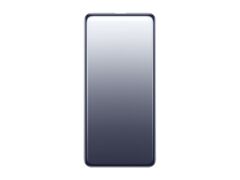
The real-world dimensions come out to 112.9 x 53.1 x 10.1 mm for 93.5 g, within a few tenths of the official figures (113 x 53 x 10 mm, 93 g): the spec sheet does not oversell the product's thinness. That is a rare level of accuracy for this type of accessory, where the gap between the claim and reality is sometimes measured in whole millimetres.
This format fits in the back pocket of a pair of jeans, in a backpack sleeve or in a slightly generous card holder, where a standard 10,000 mAh pack forces you to open the bag. The metallic NCVM-coated finish (a vacuum-deposition technique that gives a chrome-like look) reinforces the impression of a card rather than an electronic case.
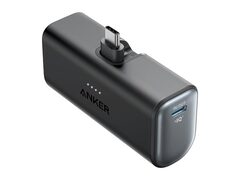
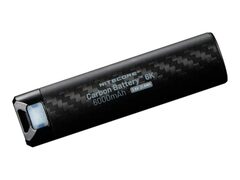
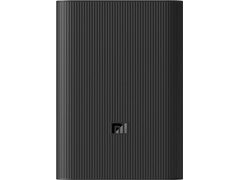
Against three references from the catalogue sold in the same pocket-battery segment, the gap is clear. The Anker Nano 5000, at the same capacity, uses a noticeably thicker body with a built-in connector. The Nitecore Carbon 6K, lighter thanks to its carbon-fibre shell, is still more than twice as thick. The Xiaomi Mi Power Bank 3, with double the capacity, also weighs more than double. None of the three targets the same use case: the Ultra Slim 5000 is built to disappear, not to maximise runtime.
20W in practice: what a single port can really do
The single USB-C port delivers up to 20W on output, split according to the connected device across three profiles: 5V/2.4A, 9V/2.22A or 12V/1.5A, all compatible with USB Power Delivery and PPS. On a recent USB Power Delivery compatible smartphone, the port delivers around 18W, close to the advertised 20W.
Xiaomi also states charging times on its own smartphones: about 39% in 30 minutes for a Xiaomi 14, around 37% for a Xiaomi 14 Ultra, figures consistent with the advertised 20W.
20W nonetheless remains modest next to the 45 or 65W offered by thicker batteries on the market, and the single port rules out charging two devices at once: that is the direct trade-off for the 10 mm thickness, which leaves no room for a second connector and its supporting electronics. A built-in recognition chip automatically adjusts the current delivered based on the device detected (phone, tablet, low-current earbuds), so there is nothing to configure before plugging in.
105 minutes and a bundled cable: recharging in practice
On input, the same USB-C port accepts up to 18W (5V/3A or 9V/2A), enough for a full recharge in 105 minutes, or 1h45, a figure repeated identically across the manufacturer's documentation and the spec sheets published in every market where the product is sold.
A 15.5 cm USB-C cable is bundled in the box, a detail that matters more than it might seem: among the three directly comparable references in the catalogue, only one (the Anker Nano 5000) offers an equivalent solution, via a built-in connector rather than a separate cable; the other two (Nitecore Carbon 6K, Xiaomi Mi Power Bank 3) ship with no cable at all. Its short length, however, limits use to charging while held in hand or set right next to a charger, not at a distance.
Since the port is bidirectional, that same cable both recharges the battery and powers a device: no extra accessory is needed to cover both uses.
Ports and display: a deliberately bare-bones choice
The connectivity comes down to the essentials: a single USB-C port, no USB-A, no wireless charging. Remaining charge is shown through four indicator lights rather than a percentage display. This gauge is necessarily coarse, with no precise indication of the percentage left: a choice consistent with the rest of the product, but worth knowing before buying for anyone used to a more detailed display.
This deliberate simplicity has a positive trade-off: fewer components mean less thickness, which is the entire point of the product. The case, which carries extensive manufacturer printing and logos, does lose a little of the restraint that the metallic finish alone might have suggested, a minor cosmetic point rather than a functional one.
Nine electronic protections cover overcharging, over-discharge, short-circuiting, overheating and overvoltage, a standard but complete list for this price segment. No Bluetooth system or companion app is tied to the product, consistent with a simple-accessory rather than a connected-device positioning.
Under the hood: real thermal engineering to fit inside 10 mm
The cell, a Lishen SP654588SL, is paired with a SouthChip SC8934 charging chip (a synchronous buck-boost controller with integrated MOSFETs), an ABOV A94P829LUN microcontroller handling charging-protocol negotiation, a JESTEK JST3050 line MOSFET (rated at 30V) and a 2.2 µH inductor. The cell's own protection relies on a dedicated chip paired with a dual 6A MOSFET.
| Function | Reference |
|---|---|
| Cell | Lishen SP654588SL, 3.88V, 4900 to 5000 mAh |
| Charging chip | SouthChip SC8934 (synchronous buck-boost) |
| Microcontroller | ABOV A94P829LUN |
| Line MOSFET | JESTEK JST3050 (30V) |
A notable point for a case only 10 mm thick: a composite foam-and-aluminium-foil layer separates the cell from the circuit board, serving both as thermal dissipation and mechanical cushioning. That attention to cooling is not superfluous on such a thin format, where heat generated during a full-power charge has very little volume to dissipate into.
The suppliers involved, SouthChip for the charging chip and ABOV for the microcontroller, are established names in charging electronics, present on many products across the market beyond this single reference: a sign of serious component sourcing, even if that guarantees nothing about the finished product's long-term durability.
A family of near-identical products, easy to mix up
Xiaomi sells its ultra-thin 5000 mAh batteries in several versions marketed under almost identical names, which creates real confusion at the point of purchase. This specific model, sold as the "Ultra Slim Power Bank 5000mAh" (internal reference PB0520MI), stands apart through the complete absence of magnets or wireless charging: a single 20W USB-C port, nothing else.
The rollout followed a familiar regional pattern for Xiaomi: availability in China from late 2024 (around 129 yuan), an official Japanese launch on 24 December 2024 (2,780 yen, 2,490 yen as a launch offer), then Hong Kong and India, ahead of a European arrival in mid-2025 (£19.99 in the UK, €29.99 in Germany and the Netherlands, €24.99 in France at launch). Prices seen today vary noticeably between markets depending on promotional periods, without straying far from that launch range.
Reliability and brand trust: a real recall, but on a different model
In 2025, Xiaomi carried out a global recall affecting close to 147,000 units of a different power bank, the 33W 20,000 mAh model (reference PB2030MI), after several overheating reports and a fire that occurred in a public place. The identified cause is a batch of cylindrical cells in the 126280 format that can overheat under certain conditions of use.
That recall does not concern the Ultra Slim 5000: the reference, the capacity and, above all, the cell format are entirely different (a single 5000 mAh soft-pack cell versus cylindrical cells assembled to total 20,000 mAh). No safety notice, recall or official alert has been identified for this specific model to date.
Two units bought by the same buyer stopped working (unable to charge) within a year of use. That is a real but isolated signal, not corroborated by another source to date: neither the volume of cases nor the nature of the fault supports concluding there is a structural problem, unlike the recall described above, which rests on tens of thousands of affected units and an identified technical cause. The two-year manufacturer warranty remains the normal safeguard in case of an early failure.
Against the direct competition
In the ultra-thin pocket-battery segment, three references from the catalogue help place the Ultra Slim 5000: the Anker Nano 5000, the Nitecore Carbon 6K and the Xiaomi Mi Power Bank 3, the latter belonging to a different and much older Xiaomi line, unrelated to the model covered here.
| Criterion | Xiaomi Ultra Slim 5000 | Anker Nano 5000 | Nitecore Carbon 6K | Xiaomi Mi Power Bank 3 |
|---|---|---|---|---|
| Capacity | 5000 mAh (19.4 Wh) | 5000 mAh | 6000 mAh | 10,000 mAh |
| Thickness | 10 mm | ≈ 25 mm | ≈ 23 mm (cylinder) | ≈ 15 mm |
| Weight | 93 g | ≈ 100 g | 88 g | ≈ 200 g |
| Maximum power | 20W | 22.5W | 10W | 22.5W |
| Cable supplied | Yes, USB-C | Built-in connector | No | No |
The Ultra Slim 5000 wins clearly on thickness, the sharpest gap in the table: its 10 mm is an edge that neither the Anker Nano (about 25 mm despite the same capacity) nor even the Nitecore Carbon 6K (about 23 mm) can match. The latter is still lighter thanks to its carbon-fibre shell and offers a bit more capacity, but costs noticeably more and ships without a cable. Against the Anker Nano, the power gap (22.5W versus 20W) stays marginal, but the Anker's built-in connector removes the need to carry a separate cable, a real practical edge offset here by the much slimmer body. The Xiaomi Mi Power Bank 3, with double the capacity for more than double the weight, answers a different need: runtime over discretion.
Who it suits, who it does not
The Ultra Slim 5000 suits anyone who wants an energy reserve on hand at all times without ever thinking about it: in a shirt pocket, a card holder, a bag's side pocket, to cover a commute, a night that runs long or an unexpected low battery at the office. Its declared usable capacity of 13.5 Wh is enough for a full charge on most current smartphones, and the bundled cable means it is ready to use straight out of the box.
It also suits frequent flyers: at up to 19.4 Wh, it stays far below the 100 Wh threshold above which airlines require approval, and travels with no paperwork at all in hand luggage.
It suits less well anyone after several days of runtime or the ability to charge two devices at once: the single port and the real 13.5 Wh do not allow for that. It also suits less well anyone after wireless charging, only available on the magnetic versions of the same Xiaomi family, sold under very similar names but technically different products. For everything else, meaning the everyday backup use it claims, the execution is accomplished and honest about its own limits.