
What the claimed 18.5 Wh are really worth
The Varta Energy 5000's spec sheet lists a 5,000 mAh lithium-polymer cell at 3.7 V, or 18.5 Wh of stored energy. That is the figure printed on the box and repeated across almost every product listing online. Varta's own technical documentation, however, also publishes a second, far less prominent figure: a rated capacity of 2,960 mAh at 5 V, meaning the realistic amount of energy available once converted to USB output voltage.
That second figure works out to 14.8 Wh, or around 80% of the cell's 18.5 Wh nominal rating. That loss is not a flaw: it reflects the electronic conversion needed to step the cell's 3.7 V up to the 5 V a smartphone actually uses, plus a small margin the management electronics reserve to avoid deep discharge. An 80% ratio sits at the higher end for a lithium-polymer battery in this price range: a number of direct rivals convert a smaller share of their rated capacity into genuinely usable energy.
In practice, 14.8 Wh is enough to give most current smartphones (whose batteries typically hold between 12 and 18 Wh) one full charge, sometimes a little more on a compact, small-battery model. That is exactly what a battery of this capacity promises, no more, no less: the Varta Energy 5000 is not trying to be a multi-day energy reserve, just a top-up to get through a day or rescue a dead device.
One last point concerns air travel. At 14.8 to 18.5 Wh depending on which figure is used, the Varta Energy 5000 stays well under the 100 Wh threshold most airlines allow in the cabin without paperwork. No prior authorization is needed to carry it in hand luggage.
15 W advertised, 12 W on the datasheet: the power that matters
On the packaging and across most online product listings, the Varta Energy 5000's USB-C port is presented as capable of up to 15 W. That figure also appears on the catalogue spec sheet. Varta's own detailed technical documentation for this exact model, however, states a different value for that same port: 5 V and 2.4 A, or 12 W, both for input and output. The same order of magnitude applies to the two USB-A ports, likewise specified at 5V/2.4A, or 12 W each.
On three recent phones (a Xiaomi Mi 10 Pro, an iPhone 12 Pro and a Samsung Galaxy S21 Ultra), charging power ranged between 7.4 W and 8.4 W on the USB-A ports, and between 7.5 W and 11.6 W on the USB-C port depending on the device plugged in. None of the three reached either the specified 12 W or, even less, the 15 W used commercially. Part of that gap comes down to each phone's own limit, but it confirms that the 15 W figure owes more to marketing than to the product's actual technical specification.
The Varta Energy 5000 also recognizes no standardized fast-charging protocol, neither USB Power Delivery nor Qualcomm Quick Charge. It outputs a fixed 5 V and lets the connected device draw whatever current is available, with no negotiation involved. For a recent smartphone rated for 20 W or more, that translates into a noticeably longer charge than with its original charger.
That limit does not undermine the product's main purpose: a backup charge is still a backup charge, whether it takes 90 minutes or a little longer. It is, however, worth knowing before buying for anyone after genuinely fast charging, a use case the Varta Energy 5000 does not address.
Recharging the battery itself: 8.5 to 9 hours
Fully recharging the Varta Energy 5000 from a wall outlet is not quick. With a standard USB-C charger (no special negotiation), the USB-C port accepts around 12 W of input. With a USB Power Delivery charger, that figure rises slightly to around 13 W, without the battery actually negotiating the PD protocol itself: it simply benefits from the higher current such a charger makes available. On the micro-USB input, a Quick Charge 3.0 charger delivers only 8 W, since the battery does not recognize that protocol either.
The direct consequence: a full recharge of the battery, from empty to full, takes between 8.5 and 9 hours over USB-C with a suitable charger. That is a long time for a mere 18.5 Wh capacity: several newer external batteries fitted with a fast-charging chip recharge an equivalent, or even larger, capacity in 2 to 3 hours. This delay comes from the lack of a dedicated fast-charging circuit, a technical choice consistent with the product's price positioning, but one worth knowing before buying for anyone planning to recharge the battery more than once in the same day.
Pass-through charging, confirmed in Varta's official documentation, lets you plug the battery into the mains while it powers a connected device: both operations run at the same time, with no need to wait for one to finish before starting the other. That is a useful function for anyone using the Varta Energy 5000 as a permanent bedside or desk battery, less critical for typical on-the-go use.
Four ports for the price: the real difference against 5,000 mAh rivals
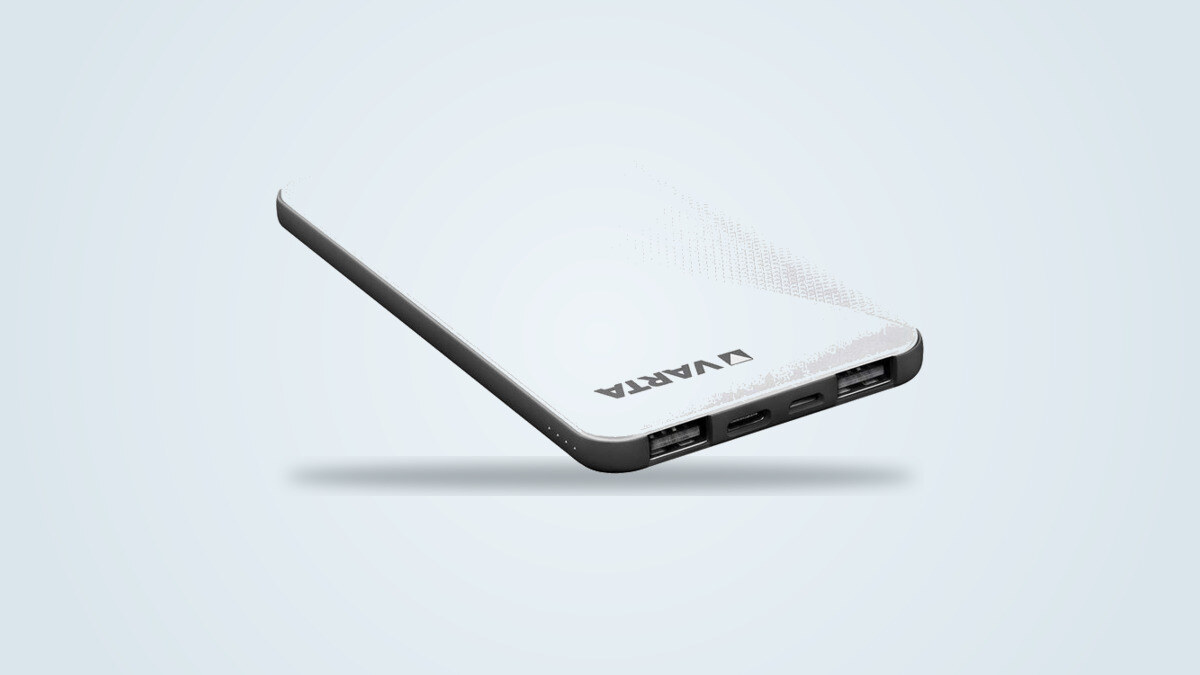
With four active ports, the Varta Energy 5000 is better equipped than most of its direct 5,000 mAh rivals. The detail: a micro-USB input (charging only), a bi-directional USB-C port that both recharges the battery and powers a device, and two USB-A output ports. Enough to plug in up to three devices at once, with total power then shared across the active ports.
Remaining charge is shown on four white LEDs, each representing 25% of capacity. That is adequate for a backup device, but less precise than a percentage display or screen, which newer or pricier batteries in the same catalogue offer. No companion app or Bluetooth feature is tied to the product, in keeping with its price positioning.
The comparison with direct rivals of the same capacity is telling: a significant share of 5,000 mAh batteries sold at a similar price offer only a single output port, usually one lone USB-A. The Varta Energy 5000 offers three on output (two USB-A plus one USB-C), a choice that genuinely widens what it can be used for, especially for anyone travelling in a group or owning devices with different connectors.
No wireless (Qi) charging is offered, and the included cable is neither built-in nor retractable: it is a plain USB-C cable, to be carried separately in the bag. Two understandable trade-offs given the price, but worth keeping in mind for anyone after those features.
150 grams, 10.5 mm thick: a card-like format
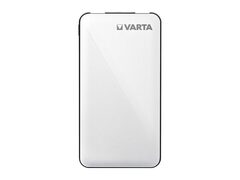
137.5 mm long, 72.5 mm wide, 10.5 mm thick, 150 g on the scale: these figures come directly from the manufacturer's spec sheet. They place the Varta Energy 5000 among the slim external batteries, closer to a thick card than a bulky brick. The format slips easily into a jacket pocket or a small bag, a real advantage for daily or travel use.
Relative to weight, the cell's nominal energy (18.5 Wh for 150 g) works out to a density of around 123 Wh per kilogram. That is a decent figure without being exceptional: the much higher-capacity external batteries in the catalogue generally reach a higher density, because the fixed weight of the shell, connectors and management electronics counts for proportionally less once the cell itself is bigger. On a format this small, that fixed overhead makes up a larger share of the total weight, a pattern that affects every small external battery on the market, not just this one.
In absolute terms, 150 g remains very light regardless: less than most current smartphones, and unobtrusive enough to live permanently at the bottom of a bag without ever weighing it down.
Build, safety and reliability
Varta advertises a protection suite for this range called Advanced Safety Technology, covering six distinct risks: overheating, overcharge, short-circuit, deep discharge, input overvoltage and overcurrent. That is a standard list for a serious lithium-polymer battery, but worth checking since not every entry-level battery publishes this level of detail.
The exterior finish pairs a white top with a charcoal-grey underside, with a diagonal textured pattern on the top face and rounded corners. The ABS plastic shell makes no claim to shock or water resistance. The manufacturer warranty runs for two years, a standard for the category rather than a differentiating argument.
Varta AG is a German company founded in 1887, historically associated with primary batteries and automotive batteries, a segment where its reputation is long-standing and well established. Its Energy line of external batteries, launched much more recently (the Energy 5000 dates from September 2020), targets a different and far more competitive market, where the brand's historical reputation on primary cells does not automatically carry over to external batteries: this is a segment where Varta remains one player among several, facing brands that have specialized in portable electronics for longer than it has.
No recall or recurring fault has been identified for this specific model. As with any electronic product sold at scale and at a tight price point, an isolated unit can always turn out faulty or run warmer than average: a generic market risk, not a trait specific to the Varta Energy 5000.
Against three direct rivals around £15
Between £10 and £17 depending on the retailer and time of year, the Varta Energy 5000 sits in the most contested segment of the external battery market: entry-level 5,000 mAh banks. Here is how it compares with three references that regularly come up in searches for this format, the Anker PowerCore 5000, the Belkin BoostCharge 5K and the Xiaomi Redmi 10000.
| Criterion | Varta Energy 5000 | Anker PowerCore 5000 | Belkin BoostCharge 5K | Xiaomi Redmi 10000 |
|---|---|---|---|---|
| Capacity | 5,000 mAh (18.5 Wh) | 5,000 mAh | 5,000 mAh | 10,000 mAh |
| Output ports | 2x USB-A + 1x USB-C | 1x USB-A | 1x USB-C + 1x USB-A | 2x USB-A + 1x USB-C |
| USB-C power | 12 W specified (15 W advertised) | No USB-C port | ≈ 12 W | ≈ 18 W |
| Simultaneous charging | 3 devices | 1 device | 2 devices | 2 devices |
| Weight | 150 g | Not stated | Not stated | Not stated |
The table sums up the Varta Energy 5000's position on this segment fairly well: it is not the most powerful on any single criterion, but it is the only one of the four to offer three active output ports at once for a 5,000 mAh capacity. Against the Anker PowerCore, limited to a single port, the gap in versatility is clear. Against the Belkin, which has a comparable USB-C port but only one extra port, the difference comes down to the third port and the ability to charge three devices. Against the Xiaomi Redmi, twice the capacity for a similar price, the trade-off is different: more stored energy, but a noticeably larger and heavier format than the Varta.
Who it suits, who it does not
The Varta Energy 5000 suits anyone after a simple, cheap, easy-to-carry backup reserve: a full smartphone charge when a charger has been forgotten, a rescue during a busy day, or a second battery kept permanently in a bag without a second thought. Its port versatility (two USB-A, a bi-directional USB-C, a micro-USB input) also makes it a practical choice for households with several devices using different connectors.
It also suits frequent flyers: at 14.8 to 18.5 Wh depending on which figure is used, it stays well under the 100 Wh threshold, with no paperwork to plan for. And on a tight budget, it offers more complete connectivity than most rivals sold at the same price.
It suits fewer buyers heading out for several days without access to a wall outlet: its capacity, roughly one smartphone charge, is not enough to cover a weekend of camping or an extended power cut. It also suits fewer buyers after genuinely fast charging: with no USB Power Delivery or Quick Charge protocol, and real-world power that falls well short of the 15 W advertised on the packaging, it charges the newest smartphones slowly. Finally, anyone wanting wireless charging or a precise on-screen readout will find neither on this model.