
A real 74Wh: what the advertised 20,000mAh are actually worth
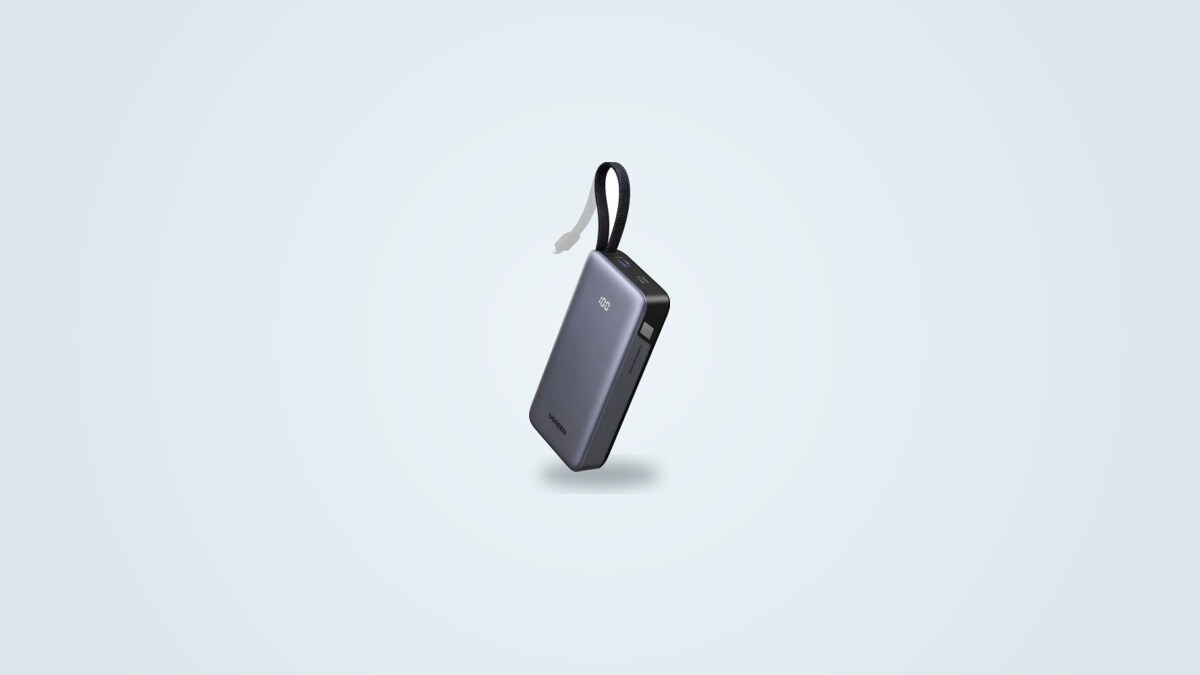
The casing advertises 20,000mAh, a figure calculated at 3.7V, the nominal voltage of a single lithium cell. Converted into usable energy, that works out to 74Wh, the figure Ugreen publishes on its spec sheet across the six markets this site covers. Inside, that 20,000mAh pack takes the form of two lithium-ion polymer cells rated at 10,000mAh (37Wh) each, wired in series, a configuration consistent with the advertised total, without the gap that sometimes exists on this market between a sold capacity and one actually fitted inside.
In practical terms, that 74Wh recharges, according to Ugreen, an iPhone 17 Pro around 3.6 times, a Galaxy S26 Ultra 3.1 times, a Xiaomi 17 Pro 2.6 times, or an iPad mini 7 2.8 times. That is a comfortable reserve for several days away from an outlet, though not enough to fully recharge a laptop from empty to full: this Nexode has no output powerful enough for that job, it stays geared towards mobile devices.
The 100Wh threshold matters most for anyone flying: beyond it, most airlines require prior approval to carry a power bank in the cabin. With 74Wh, the 26Wh margin remains comfortable. One caveat still applies: this figure is the one published by the manufacturer, consistent with the hardware inside the product, but no independent measurement of the energy this specific reference actually delivers to a connected device, once conversion losses are accounted for, could be found at the time of writing. As with any battery pack of this kind, part of the stored energy is necessarily lost in voltage conversion; the exact scale of that loss remains, here, missing data rather than an invented figure.
55W, but only for one phone brand
The power figure on the casing and in the product name, 55W, only applies to one specific situation: a Xiaomi, Redmi or Poco phone compatible with the proprietary Xiaomi Turbo Charge protocol, plugged into the built-in USB-C cable. For every other device, iPhone, Galaxy, Pixel, tablet or laptop, power tops out at 45W over USB Power Delivery 3.0. The product page and the official listing are transparent about this once you read the fine print, but the "55W" shorthand used in the product name can suggest a universal power level.
This 45W ceiling is not arbitrary: across the usual USB Power Delivery steps (5V/3A, 9V/3A, 12V/3A, 15V/3A and 20V/2.25A, or 45W at peak), the 45W version in the same range, which shares the same electronics platform, holds that level without falling short of the claim. This 55W version simply adds Xiaomi protocol recognition on top, without changing the universal ceiling for other devices. An iPhone 17 Pro Max recovers around 66% of charge in 30 minutes on the standard USB-C port, an honest result for 45W even if it falls short of the 55W in the product name.
The UFCS protocol (Universal Fast Charging Specification), also supported, deserves a mention: it is a recent Chinese standard aiming to unify the proprietary fast-charging schemes of Huawei, Xiaomi, Oppo and Vivo under one protocol recognised across several brands' hardware. Its presence widens this power bank's real-world compatibility beyond Power Delivery alone, though its usefulness depends directly on which devices are already in the traveller's pocket.
Three outputs, one shared power budget
The casing offers three simultaneous outputs: the built-in USB-C cable, a second, independent USB-C port, and a USB-A port capped at 22.5W. All three can power devices at the same time, a useful setup for a group on the move or for topping up a phone, a smartwatch and earbuds in a single stop. What the product name does not say: these three outputs share a common power budget rather than each running at its own maximum at all times.
In practice, plugging in a single device lets available power reach its individual ceiling, 55W for a compatible Xiaomi phone or 45W for anything else. As soon as 2 or 3 devices charge together, that power is split between the active ports: each then receives less than its theoretical maximum, and no combination lets the individual ceilings add up. This is a mechanism common to nearly every multi-port power bank on the market, Ugreen is no exception, but it is worth knowing before counting on fast simultaneous charging for several power-hungry devices.
A low-current mode is also available, activated by holding the power bank's button for 3 seconds. It adapts output for devices that only draw a very small current, such as wireless earbuds or a smartwatch, avoiding the automatic cut-offs these small devices often trigger on a standard power bank once the requested current drops below a minimum threshold.
CCC certification: what it really changes for China
The CCC mark (China Compulsory Certificate), printed directly on this Nexode's casing, is the real differentiator for this reference against much of the market. This certification has been mandatory for selling power banks inside China since August 2024, and since 28 June 2025 the Civil Aviation Administration of China (CAAC) has banned boarding with any power bank lacking a visible CCC mark on domestic flights within mainland China. The check specifically looks for an oval logo with three interlocking "C"s, printed directly on the shell: a removable sticker does not qualify.
One nuance matters here, and it is rarely spelled out: this requirement covers flights within mainland China, not entry into the country from abroad. A traveller taking a direct international flight into China is not, in principle, subject to this specific rule on arrival. However, as soon as an itinerary includes a domestic connecting flight, for example Paris to Shanghai followed by Shanghai to Chengdu, that second leg falls under CAAC regulation, and a power bank without a visible CCC mark can be refused or confiscated at the security check. This is exactly the situation, common for anyone visiting several Chinese cities on the same trip, that this Nexode's certification covers.
This regulatory requirement follows several onboard fire incidents attributed by Chinese authorities to non-compliant power banks. It addresses a genuine safety concern, and enforcement is now strict at domestic Chinese airports.
Recharging itself: around 4 hours, the real weak point
The power bank accepts up to 45W on input, through either its built-in cable or its independent USB-C port, and Ugreen states a full recharge of around 4 hours with a charger of that power or higher (not included in the box). That is a decent figure for an era when this type of product topped out at 18 or 20W, but it lags well behind more recent references from the same brand: the Nexode 20000 145W, which shares the same nominal 74Wh capacity, accepts up to 80W on input and recharges fully in around 90 minutes, nearly three times faster.
| Model | Nexode 20000 55W | Nexode 20000 145W |
|---|---|---|
| Maximum input | 45W | 80W |
| Full recharge time | ≈ 4h | ≈ 1h30 |
Pass-through charging (recharging the power bank while it feeds a device plugged into one of its outputs) remains available, useful at a desk or in a hotel room with only one socket free. But for anyone happy to plug this in overnight and find it full by morning without a second thought, the stated 4 hours cause no issue at all; it is mainly for a top-up during the day, between two appointments, that the gap with faster competitors starts to show.
470g for 152 x 71 x 30mm: heavier than its three-times-more-powerful cousin
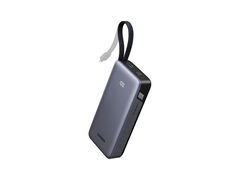
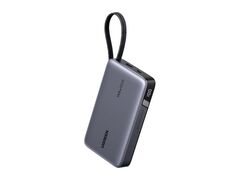
This Nexode weighs 470g for 152 x 71 x 30mm, built-in cable included. That is a bag item rather than a pocket one: its length exceeds that of a recent smartphone, and the 30mm thickness, cable folded against the casing, keeps it from sitting truly flat against other items.
The notable point lies in comparing it with the rest of the built-in-cable Nexode range: the 45W version, virtually identical physically, weighs 468g for the same dimensions, a negligible difference. But the Nexode 20000 145W, which triples total available power and pushes the built-in cable from 45W to 100W, weighs 450g, 20g less than this 55W version, inside a wider but thinner casing (139 x 80 x 27mm). In other words, on this specific range, paying for more power does not cost more weight: whatever really adds weight to a built-in-cable power bank seems to come down to other design choices rather than output power alone.
In practice, this 20g gap is too small to steer a purchase on its own. It mainly shows that the weight of a built-in-cable power bank depends on its overall design (cell size, casing structure, cable mechanism) at least as much as on its output power.
Against other 20,000mAh power banks on the market
At around £28 to £38, this Nexode competes with the most common 20,000mAh power banks on the market. Against the Anker 335 (PowerCore 20K), the Baseus Bipow Pro 20000 and the Xiaomi Power Bank 20000, it stands out through a combination none of the three rivals offer together: a built-in USB-C cable, a display and CCC certification printed on the casing.
| Criterion | Nexode 20000 55W | Anker 335 (PowerCore 20K) | Baseus Bipow Pro 20000 | Xiaomi Power Bank 20000 |
|---|---|---|---|---|
| Max power | 55W (Xiaomi), 45W PD | 20W | 25W | 33W |
| Built-in cable | Yes | No | No | No |
| Display | Yes (LED) | No | Yes | No |
| CCC certification shown | Yes | Not stated | Not stated | Not stated |
The Anker 335 remains a safe bet but tops out at 20W with no cable or display: for anyone charging just a phone with no urgency, it is plenty and typically costs less. The Baseus Bipow Pro adds a monitoring display but no built-in cable, meaning one still needs to be carried separately. The Xiaomi plays the raw-power card at 33W, ahead of the other two at 20W and 25W, but without a cable or a visible Chinese certification, ironic for a Chinese brand. Against these three references, the Nexode 20000 55W remains the only one to combine all three arguments at once, at the cost of a simpler display than the one on its own higher-end sibling.
Build quality, protections, and a newer version already for sale
The casing includes multiple protection against overvoltage, overcurrent, overcharging, overheating and short circuits, paired with UL94 V-0 certified fire-resistant materials. The built-in cable carries its own identification chip (E-Marker), a component that guarantees the cable is recognised and rated for the stated power rather than being a simple passive wire. The manufacturer's warranty runs for 2 years, a correct standard for the category without being the longest on the market.
Ugreen has built itself up over more than a decade on charging accessories, cables, GaN chargers and power banks, with distribution now broad across mainstream retailers. Nothing in the information available for this reference at the time of writing points to a structural fault or a recall, a positive sign without being a definitive guarantee over time for a model that has so far stayed fairly new on the market.
One point is worth flagging for anyone torn between generations: since late summer 2026, Ugreen has been selling a newer version of this same "55W 20000mAh" range, more compact (around 389g for 116 x 71 x 30mm against 470g here) and fitted with a fuller display showing charge cycle count and internal temperature on top of the remaining percentage. This newer version is priced noticeably higher than the one covered in this review. For anyone who does not need that detailed battery-health tracking, the version described here remains a sound and less expensive choice within the same range.
Who it suits, and who it does not
It suits, first, anyone with a recent Xiaomi, Redmi or Poco phone who wants to use its native fast charging without carrying extra cables: the built-in cable covers this at 55W with no extra accessory. It suits just as well anyone travelling regularly to China with multiple domestic legs, where the CCC certification on the casing removes any risk of confiscation at the security check. Its 74Wh, under the 100Wh threshold, also make it a safe pick for any regular air traveller, whatever the destination.
It suits less well anyone with only an iPhone, a Galaxy or a Pixel, who never gets access to the 55W tier: for that use case, an equivalent model without Xiaomi recognition, often cheaper, would deliver the same service over Power Delivery. It is also not the pick for anyone after the fastest possible recharge for the power bank itself: the stated 4 hours are noticeably longer than the 90 minutes of its own 145W cousin, a gap that matters for anyone alternating short sessions between available outlets. Finally, anyone wanting detailed tracking of battery health (cycles, temperature) should look at the newer, pricier version in the same range mentioned above, since this Nexode 55W settles for a simple percentage.