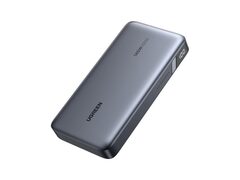

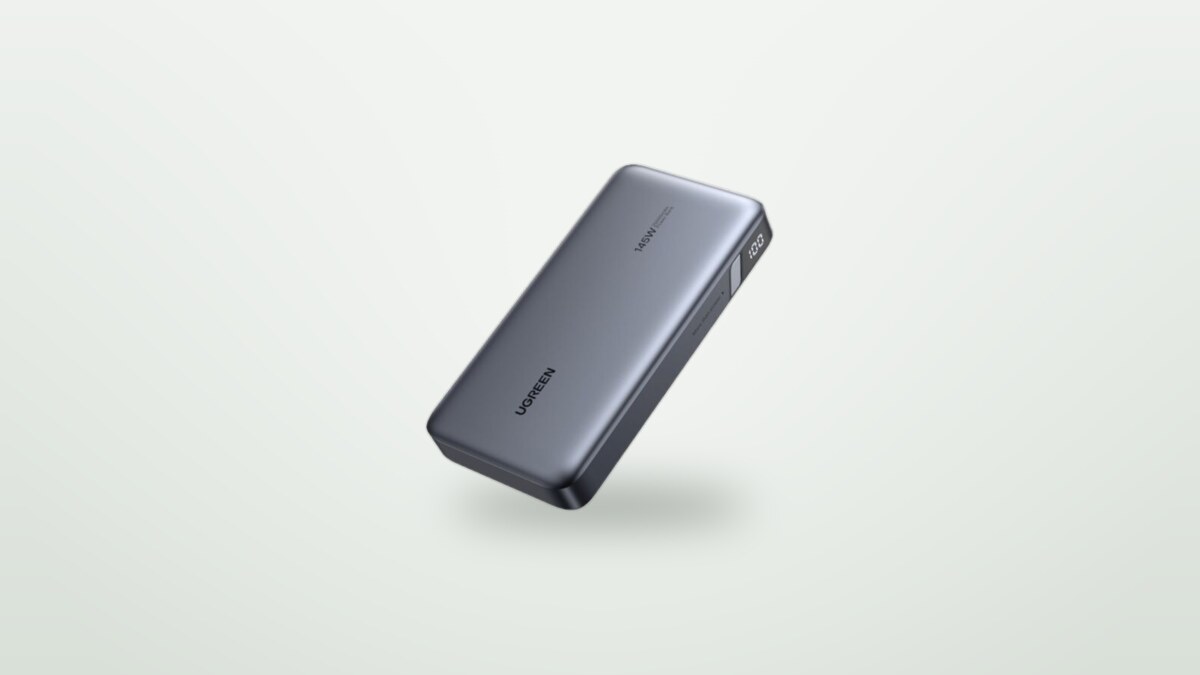
Careful: "Nexode 145W" refers to more than one different Ugreen product
Ugreen uses the name "145W" for at least two products with distinct specs: the one covered in this review (25000 mAh, 505 g, main port at 140 W) and a separate "145W power bank for laptop" in a different format (590 g, main port capped at 100 W on the spec sheet itself). Everything below concerns precisely the model in this review (Ugreen's internal reference PB205), not the other product.
94 to 100 W in practice, far short of the 140 W advertised
The 140 W peak advertised on the main port corresponds to a protocol ceiling (USB PD 3.1, extended 28 V/5 A mode), reachable only with a fully compatible device and cable. In real-world use with actual laptops, the reality is far more modest: 94 W with a 16-inch MacBook Pro, a 100 W cap (standard USB PD 3.0 protocol) on another unit, and highly variable draw depending on the laptop connected (from 30 W to over 90 W at times) on a third. No independent measurement found confirms a sustained 140 W draw.
A real throttle, but tied to the remaining charge level, not heat
The main port switches from 100 W down to 65 W once the battery's own remaining charge drops to about 29 %, a precise and reproducible behavior. This is not a thermal throttle kicking in after several minutes at full power, but a limitation tied to the device's own remaining energy level, a power-management behavior rather than a flaw.
Capacity delivered varies with the power drawn, consistent with the physics
At different output power levels, the capacity actually delivered varies but stays consistent: 80 to 87 % of the advertised 25000 mAh at one output power, only 63 % at a higher output power. The higher the draw, the greater the conversion loss: that is an expected physical phenomenon, not a suspicious shortfall. A useful comparison point: a direct rival delivers noticeably less than its own advertised figure, where this battery stays within a range consistent with the category's usual conversion losses.
2 hours at 65 W, sometimes beaten
A full recharge of the battery itself at 65 W takes about 2 hours, in line with the advertised figure, sometimes in as little as 1h40. Over a 5 V USB-A input (without a PD charger), it takes 13 hours, a clear sign that a compatible fast charger remains essential to reach the advertised speed.
The screen shows the charge level, not real-time power
The built-in screen shows only the remaining charge percentage of the battery itself, in 1 % increments, not the instantaneous power delivered to connected devices. Ugreen does offer that kind of detailed readout (voltage, current, power per port), but on newer, pricier Nexode ranges (165 W, 200 W), not on this model.
Three years on the market, but very little independent reliability data
This is the weakest point of this review: despite being on the market since May 2023, no independent, dated feedback at 12 or 24 months has been located. Inside, the cells come from an established Chinese cell manufacturer (BAK, 21700 format), alongside dedicated protection circuits, a reassuring sign for component quality, though that is not a substitute for an actual real-world lifespan measurement. This absence of data should not be read as a positive or negative signal either way: it is a genuine blind spot in the coverage available online, worth flagging as such rather than filling in with guesswork.
145 W on 2 ports, 115 W with all 3 ports at once
The advertised split is 140 W on the main USB-C port, 65 W on the second USB-C port, and 22.5 W on the USB-A port, for a total of 145 W reachable using only the two USB-C ports together. A 115 W cap applies when all three ports draw power at the same time, below the 145 W of two-port mode. In real-world use with several devices charging at once, actual combined draw generally stays well under these caps: each device negotiates its own power, and few ever ask for the maximum their port allows.
A 2.40 m drop without an immediate recharge afterward
After a controlled 2.40 m drop onto soil, this specific unit could not immediately recharge a phone: it eventually worked normally again after one charge cycle. This is an extreme-robustness case, not an everyday failure, but a real point of caution.
No official recall has been identified for this specific model, in the United States or in Europe. Ugreen states it is not affected by the 2025 controversy over decertified cells at several power bank manufacturers (Anker, Baseus, and other brands were recalled at the time), and this model does not appear on the lists of affected models the brand has made public, though an exhaustive independent check of that list was not possible.
A mature product, stable price, responsive support on late failures
The going price has stayed in a 50 to 70 € range for at least two years, with occasional deeper promotions, a profile typical of a mature product late in its cycle rather than a steady decline. No mains charger is included, a real friction point but widely treated as the norm at this end of the market, except for a buyer who does not already own a compatible fast USB-C charger.
The official warranty is 2 years. In the rare cases of failure beyond the first year, warranty replacement was handled quickly when the purchase came directly from Ugreen's official store; the most negative experiences mostly concern delivery and general customer service, not failures of the product itself.