
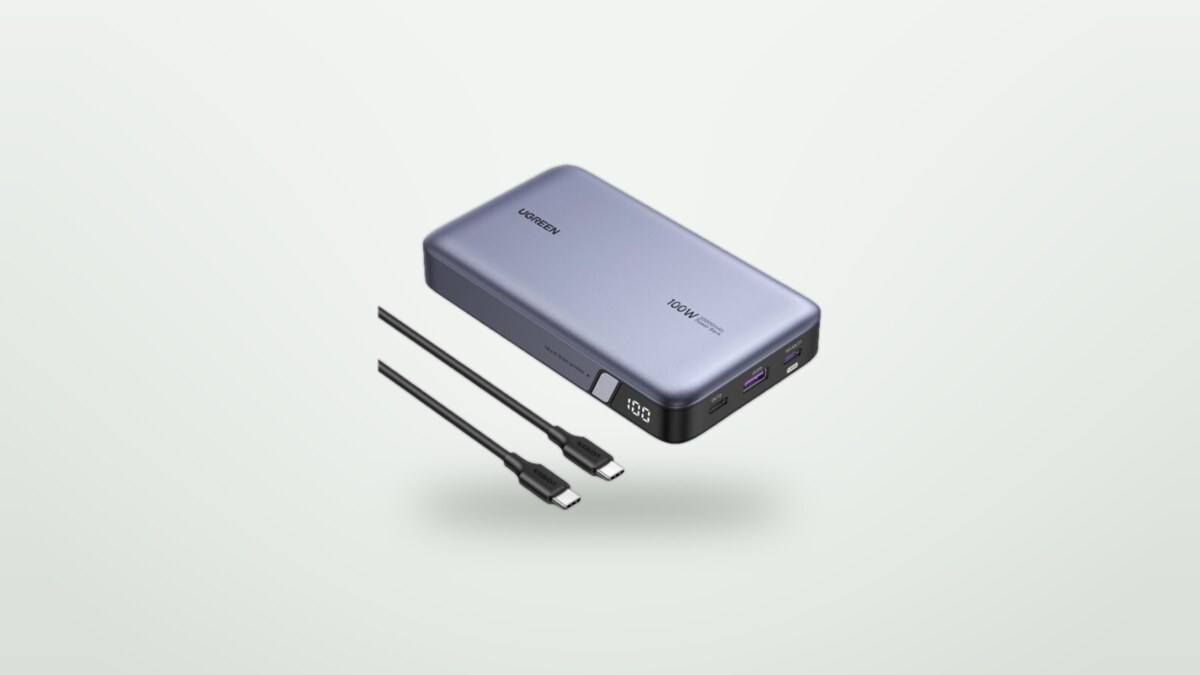
What the 20000 mAh capacity is really worth
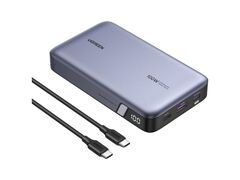
Behind the advertised 20000 mAh sits a 72 Wh nominal battery (four 21700 Li-ion cells wired in series), consistent with current manufacturer documentation. Efficiency reaches 81.4 %, a decent score for this compact, screen-equipped format.
Recharging the battery itself takes about 2 hours with a 65 W or higher charger, not included in the box.
The real catch: 100 W only on a single port used alone
This is the most important point to understand before buying. The main USB-C port does deliver 100 W, with a MacBook Pro as well as with a dedicated adapter. But that power is only available if this port is used alone. As soon as a second device is plugged into either of the other two ports, everything changes.
| Port | Used alone | Combined use (rated) | Combined use (actual) |
|---|---|---|---|
| Main USB-C | 100 W | 65 W | ~60 W |
| Secondary USB-C | 30 W | 20 W | ~14 W |
| USB-A | 22.5 W | 20 W | ~7 W |
The mechanism explains why: the main port has its own full-power conversion stage, while the other two ports share a second, much more modest stage. This is not an artificial limit, but a direct consequence of the electronic components chosen for this format and this price.
Charging a laptop: the numbers that hold up
On this point, the promise holds. A MacBook Air M3 plugged into the main port goes from 10 to 50 % charge in about 25 minutes, and reaches 100 % in about one hour. That is a real argument for anyone who wants to leave the dedicated mains charger behind while travelling.
A compatibility quirk affects a Huawei P60 Pro smartphone, which drew only 17 W of the 88 W theoretically supported by its own fast-charging protocol. This limitation appears tied to Huawei's proprietary protocol rather than a flaw in the battery itself, a pattern that also shows up with other third-party chargers on this same smartphone.
The screen shows the charge level, not real-time power
The battery has a digital LED display that shows the remaining charge percentage. Contrary to what some product descriptions imply, it does not show the real-time power delivered per port: it is a charge-level display, not a built-in wattmeter.
That is a useful distinction to know, especially next to other models from the same brand fitted with an actual colour screen showing more detailed information (see the next section on the risk of mixing up references).
The plastic finish, a real weak point
A plastic shell scuffs and scratches easily, with a surface that feels slippery in hand. It is not a dealbreaker, but it is a real reservation, alongside the weight, which feels significant for light everyday travel use.
The USB-C to USB-C cable included in the box, by contrast, stands out for good build quality (low electrical resistance, E-marker connector rated for 240 W).
The trap of multiple "Nexode 100 W" products
A serious point of caution before buying: Ugreen sells several external batteries under very similar names, with different specs. This specific review covers the 20000 mAh model with three ports (two USB-C, one USB-A) and a simple LED screen, international reference 25188.
| Product | Main difference |
|---|---|
| Nexode 100 W (GaN mains charger) | Mains charger with no battery, 4 to 5 ports, unrelated to this product despite the near-identical name |
| Nexode Power Bank 20000 mAh 130 W | TFT colour screen, about 470 to 476 g, pricier |
| Nexode Power Bank 12000 mAh 100 W | Only two ports, lower capacity, smaller format |
| Nexode Power Bank 20000 mAh 145 W | USB-C cable built into the shell, three ports |
This mix-up is real: figures found online under the name "Nexode 100 W" sometimes actually refer to the 130 W colour-screen model rather than this one. Before comparing a figure found online to this review, it is worth checking that it concerns the correct reference.
Real price and availability
The going price varies significantly depending on the channel and the timing. On the manufacturer's own official marketplace, the price stays fixed at around 80 € with no active promotion. On general marketplaces, by contrast, the price regularly drops under 50 €, with a historic low of around 47 € during a flash promotion.
| Channel | Going price |
|---|---|
| Official Ugreen store | 79.99 €, no active promotion |
| General marketplace | About 50 €, historic low near 47 € |
| One-off flash promotion | As low as 34.70 € seen once |
This wide price gap depending on the channel and the timing makes comparing before you buy especially worthwhile: the same product can cost nearly twice as much on the official store as at the best moment on a general marketplace.
Reliability, components, and blind spots
Inside are components of recognised quality: four 21700 Li-ion cells from an established brand (3.6V/5Ah each, wired in series), a dedicated display and charge-protocol management circuit, a separate conversion chip for the main port and another for the two secondary ports, plus a standalone battery protection chip rather than a generic all-in-one budget solution. That is a positive signal about the internal design, beyond what the official spec sheet communicates.
On the other hand, several blind spots remain. No independent measurement of temperature under sustained load has been found: the thermal management system advertised by the manufacturer could therefore not be verified. The commercial status on its original Chinese market also remains uncertain, though that does not call into question its continued availability on the French market to date.
Who this reference is for
This product suits anyone who mainly recharges a single demanding device at a time, typically a laptop, and wants genuinely high power on that port without paying the price of an equivalent premium model. The price-to-power ratio remains a real argument once the right buying channel is identified.
It suits less well anyone planning to recharge several power-hungry devices at once at full speed, anyone who prioritizes an ultra-light format for daily nomadic use, or anyone looking for a screen that shows detailed real-time power per port. In those cases, a model with several full-power conversion stages or a more complete screen remains a better fit, usually at a higher budget.