
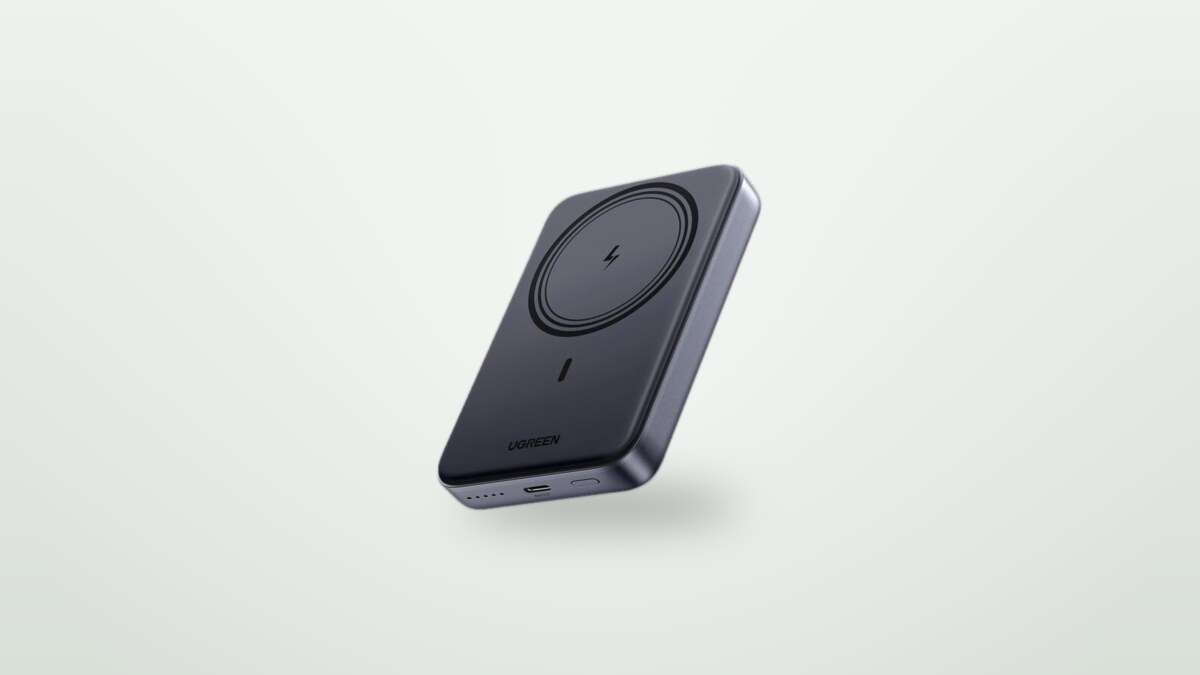
Five Ugreen batteries with similar names: identifying this one correctly
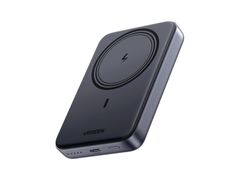
Ugreen sells at least five magnetic 10000 mAh power banks in very similar formats, under names that overlap depending on the market and retailer: a version with a plastic folding stand and LED indicators only (the model covered in this review, 7.5 W wireless, 20 W wired), a "Uno" version with a TFT screen, a "Nexode" version with a telescopic metal stand and 15 W Qi2, a "Zapix" version also at 15 W Qi2, and a "MagFlow" version at 25 W Qi2. All share roughly the same 37 Wh cell, but not the same power output or the same features.
The specifications in this review (7.5 W wireless, 20 W wired, 220 g, 19 mm, plastic folding stand, LED indicators without a screen) correspond to the oldest model in the range, sold since 2023 under several names depending on the market. The data below is specific to this version: figures found for the newer Qi2 variants (15 W or 25 W) are never carried over here without saying so.
7.5 W wireless: a certification cap, not a power limit
Magnetic charging is capped at 7.5 W on iPhone, versus 15 W for an Apple-certified MagSafe charger. This cap comes from the device's lack of official MagSafe certification (it uses the standard Qi protocol, not the full MagSafe protocol), not from a drop in power during charging: nothing found points to a step-down below 7.5 W during a session. On the wired side, the USB-C port reaches its advertised 20 W without particular reservation.
A factor-3 gap between two charging times: the real duration remains uncertain
The time needed for a full wireless iPhone charge varies enormously depending on the phone and the starting point: on an iPhone 13 Pro, 45 minutes of charging brings the battery to 62 %, extrapolating to around 90 minutes for a full charge; on an iPhone 14 Pro Max, a full charge takes 4 hours and 45 minutes. This gap, close to a factor of 3, is not explained solely by the capacity difference between the two phones: the most plausible explanation is a sharp slowdown right at the very end of charging, a classic lithium-ion behavior that the 90-minute extrapolation underestimates, since it never actually reaches 100 %.
In practice, this means quoting a single duration would be misleading: a full wireless iPhone charge can take anywhere from just over an hour to nearly five hours, depending on the starting point and how the device behaves at the end of the charge.
The label itself admits 31.25 Wh usable out of 37 Wh nominal
The product's official label states a typical output capacity of 6250 mAh at 5 V/3 A, or about 31.25 Wh, versus 37 Wh calculated from the cell (10000 mAh at 3.7 V). That is a loss of about 15 %, admitted by the manufacturer itself on its regulatory label, even before the loss specific to wireless conversion.
In real-world use, this battery delivers only one full wireless charge for an iPhone 14 Pro Max, where the raw arithmetic of the 37 Wh nominal rating would suggest close to two. Wired charging performs notably better, with up to 2.5 full charges. Wireless conversion therefore consumes a significant share of the stored energy, a physical phenomenon well known for this type of charging, not an anomaly specific to this model.
A magnet that holds firmly, a stand never tested over the long term
On magnetic grip: this one offers one of the firmest magnetic connections on the market, to the point of staying attached through a leather case. No report of accidental detachment in a pocket or while walking was found for this specific model. The 10-newton figure in circulation comes solely from the manufacturer's spec sheet and therefore remains a stated value.
The built-in folding stand proves sturdy in the first few days of use: it supports the weight of a large iPhone with a case, with no problem reported at this stage. No data on its wear, play, or resistance after several months or years of use is available to date: this isn't a case of no issue being reported, it's simply that no long-term testing exists at all.
220 g: a little heavier and thicker than the best competitor on the market
At 220 g for 19 mm thick, the device remains slim and light in absolute terms. But facing the most accomplished competitor on this specific criterion (Anker MagGo Slim, about 198 g for 15 mm), it is actually a little heavier and thicker, despite the "ultra-thin" claim being pushed. A telling sign: in 2026 Ugreen launched a new range (Nexode Air) with a smaller model going down to 117 g. The model covered in this review therefore belongs to the previous generation on this specific point.
iPhone 17 and Air: advertised compatibility, no confirmation
The product's original label (2023) explicitly named only the iPhone 12, 13, and 14. Current sales materials extend the advertised compatibility up to the iPhone 17 and Air, a physically plausible extension since the MagSafe ring position has not changed since the iPhone 12, but nothing to date shows an iPhone 17 or Air charged with this specific device.
With a MagSafe-compatible case, the attachment works normally, including with a leather case. However, with a case that has magnets built into the back, the whole assembly tips over in landscape use: the case then needs to be removed for good stability in that orientation. No data is available on how it behaves with a case that has no magnets at all.
An isolated fire report, to be read with the necessary caveats
A specific report exists: a fire is reported to have broken out on December 15, 2025, during overnight charging, involving an Ugreen 10000 mAh, 20 W magnetic power bank, with second-degree burns.
Several caveats apply before drawing any conclusion. The description matches the specifications in this review precisely, but Ugreen sells several very similar 10000 mAh battery models under different names (see above): nothing confirms with certainty that this is exactly this model rather than a close relative from the same family. No official recall has been issued to date, and no public response from Ugreen was found. This is not proof of a systemic defect, but a signal precise enough (date, matching technical description) to be worth knowing, particularly for unsupervised charging, for instance overnight during sleep.
Highly fluctuating price, no official Ugreen recall to date
The official price found directly on the Ugreen website is around €33 (down from a list price of €46), with prices floating between €27 and €46 at other retailers depending on the promo codes running at the time, which are very frequent for this brand. The official warranty is 2 years, with support handled through a web form rather than a local phone line; no structural problem has been identified on this model to date.
A useful point of comparison: in mid-2025, a wave of recalls hit the power bank industry after a cell supplier had its certification suspended over an unauthorized modification deemed risky. Anker (more than one million units), Baseus, and several other brands were recalled as a result. Ugreen states that it is not affected by the cells in question and has not, to date, been the subject of any confirmed official recall, either in the United States or in Europe, on any of its products.