
A 3-in-1 station that aims high: 25W over Qi2.2
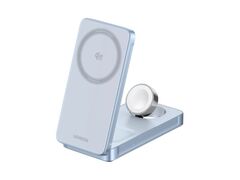
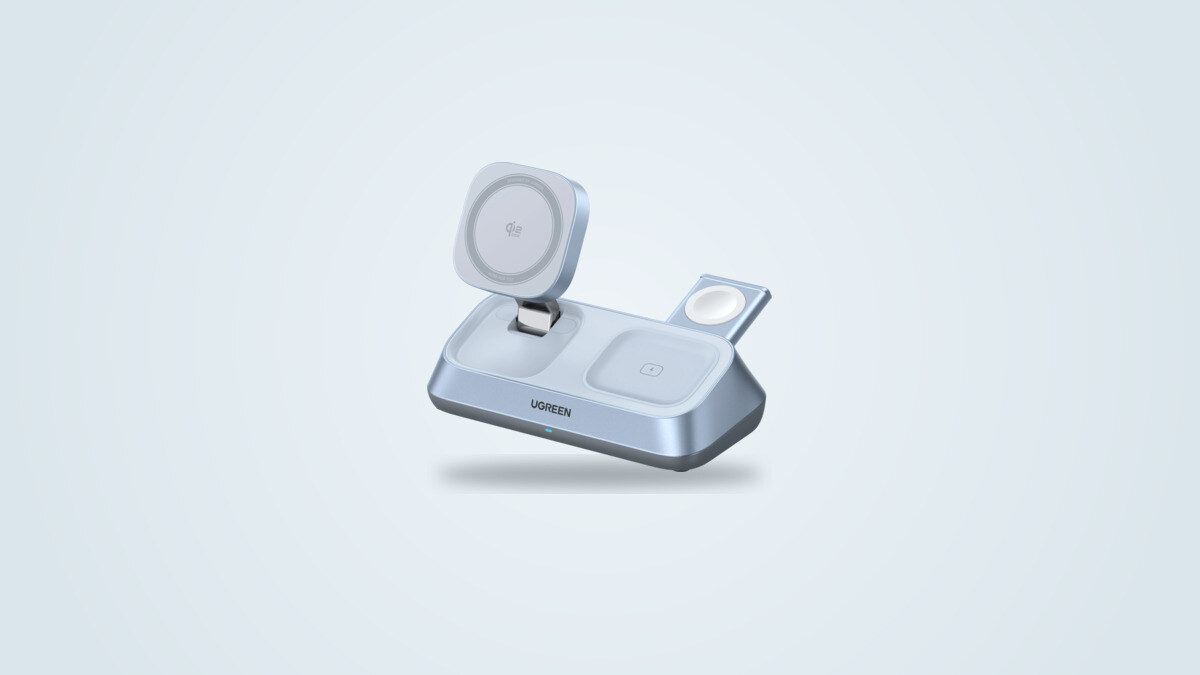
The MagFlow 3-in-1 is a magnetic wireless charging station built around the Apple ecosystem: one pad charges an iPhone, an Apple Watch and AirPods without a single cable to plug in every night. It is one of the first products to carry official Qi2.2 certification from the Wireless Power Consortium, the standard revision that allows 25W over magnetic charging where the first generation of Qi2 capped out at 15W.
The iPhone stand tilts up to 70° and rotates between portrait and landscape, with a StandBy mode showing the time or a widget while charging. Next to it, a small circular puck takes the Apple Watch, and a dedicated flat pad holds AirPods in a wireless charging compatible case. The whole thing folds flat for storage, an argument few rival 3-in-1 stations in this segment can make. On price, the station is listed at £113.73 in the UK, a bracket shared with far slower 15W only rivals despite doubling the wireless speed on the phone zone.
A real 25W, but limited to two iPhone generations
The number that sells the MagFlow 3-in-1 is its 25W over Qi2.2 on the iPhone zone, double what the first generation of Qi2 offered at 15W. On an iPhone 17 Pro Max, charging goes from 5 to 50% in just over 30 minutes at 25W, against 45 minutes at 15W on the same phone: the gap is real and shows up within the first few minutes.
The 25W tier is not universal, though. It applies to iPhone 16 and 17, provided the phone runs iOS 26 or later; iPhone 12 to 15 stay capped at 15W on this same pad, a limit that comes from the phone rather than the charger. On an older model or one missing the required update, the MagFlow 3-in-1 behaves like a plain 15W Qi2 charger, without the packaging flagging that as clearly as it deserves.
Three zones, one shared budget: does simultaneous charging hold up?
A 3-in-1 station has no ports in the traditional sense, but it runs on the same principle as a multiport charger: a total power budget split across several devices. Here, the maximum combined draw is 35W (25W for the iPhone, 5W for the Apple Watch, 5W for AirPods), while the bundled adapter can supply 45W. The manufacturer calls this allocation mechanism Smart Power Management.
That margin matters: nothing points to cross degradation when all three devices charge together, the iPhone keeping its full speed even with a watch and earbuds plugged in alongside it. The logic is simply arithmetic, but it explains why this station avoids the classic pitfall of cheap multiport chargers, where adding a second device drags the first one down. The one caveat worth keeping in mind is that this lack of slowdown rests on a limited number of independent write ups rather than a deep instrumented check: the theoretical budget is sound, the practical confirmation stays thin.
Apple Watch and AirPods: comfort over speed
The two secondary zones aim for comfort rather than speed. The circular Apple Watch puck carries official Made for Watch certification and delivers 5W: enough to take an Apple Watch Series 10 to 80% in 45 minutes according to the manufacturer, and to go from 10 to 100% in about 75 minutes in everyday use. This is an overnight charge, not a quick top up before heading out.
The AirPods zone is a simple 5W charging pad, with no particular technical trick beyond compatibility with wireless charging cases (Pro, Pro 2, AirPods 3 and 4). It still earns its keep by keeping all three devices in one spot, even if it does nothing a basic induction charger would not already do. Watch compatibility spans a wide slice of the installed base, from Series 6 through Series 10 up to Ultra and SE models, which limits the odds of owning an unsupported model.
Qi2.2 beyond Apple: Google Pixel compatibility
Qi2.2 is an open standard, not an Apple exclusive, and the MagFlow 3-in-1 takes advantage of that: the main zone also delivers up to 25W to a Google Pixel 10, itself Qi2.2 certified by the Wireless Power Consortium. That is a real difference next to rival stations built purely around MagSafe, which often offer no fast magnetic charging tier outside the iPhone at all.
That openness only goes so far, though. The Apple Watch and AirPods pucks keep a shape and protocol specific to those accessories: an Android watch or earbuds owner finds no equivalent there. In practice, the MagFlow 3-in-1 remains a station designed first for the Apple ecosystem, with a main zone that happens to also accept a recent, well specified Android phone, rather than a genuinely cross platform station.
Heat is the real friction point
Pushing 25W through a coil inside a compact housing generates heat, and the MagFlow 3-in-1 is no exception: with no active cooling, the unit and the phone get noticeably hot to the touch once fast charging runs for a while. The ThermalGuard system watches temperature continuously through internal sensors and can throttle output to protect the device, but it eases the heat rather than removing it entirely.
In everyday use, this heat does not appear to pose a safety risk, since the unit's electronic protections are designed to limit any runaway heating. It remains worth knowing before buying, though, for anyone who leaves a phone on it for hours at a stretch, say overnight on a nightstand in a poorly ventilated room in summer.
Foldable and light, until the adapter
Folded, the station measures roughly 4.7 x 2.4 x 0.9 in (119 x 60 x 22 mm) for 195g (6.9 oz), a size that fits in a pouch or a bag pocket. Set up on a desk, with the stand tilted and the Watch puck raised, the footprint grows to roughly 5.8 x 3.2 x 2.4 in (148 x 81 x 60 mm). Four rubber feet under the base keep it from sliding around during use.
| Criteria | Ugreen MagFlow 3-in-1 | Anker MagGo 3-in-1 | Belkin BoostCharge Pro 3-in-1 |
|---|---|---|---|
| iPhone charging | Qi2.2, 25W | 15W | 15W |
| Foldable | Yes, flat | Partly | No |
This travel friendly format is a genuine selling point against stations that stay bolted to a desk, but it needs some perspective: the bundled 45W mains adapter is noticeably bulkier than the pad itself. Packing it in the same bag as the station takes some shine off the ultra compact image the folding design suggests, even if the whole kit still travels better than a fixed station would.
Build quality: a mostly good finish that creaks in places
The shell wears a smart looking, bluish grey metallic style finish, but the build underneath stays mostly plastic; only the hinge that unfolds the Watch puck is metal. A small blue LED marks power on the base's front edge, visible enough to be a minor annoyance on a nightstand in the dark.
Two finish related complaints come up independently: the phone stand's hinge lacks smoothness and feels a touch stiff with repeated use, and the spring mechanism that ejects the Apple Watch from its dock feels less premium than the rest of the unit. A faint hum, likely tied to the internal electronics, can also be heard while charging, even though no fan is advertised on the product page.
On warranty, sales channels do not fully agree: some list 12 months, others 24, with no single consistent figure standing out clearly. It stays worth checking the exact duration stated by the seller at the time of purchase rather than relying on a generic number.
Safety and protections
Ugreen advertises eight layers of protection on the MagFlow 3-in-1: foreign object detection, overcharge, overcurrent, overpower, short circuit and static electricity protection among others, on top of ThermalGuard's continuous thermal monitoring. Qi2.2 certification from the Wireless Power Consortium itself sets interoperability and safety requirements a product must meet before earning it, a check independent from the manufacturer's own marketing claims.
No safety incident or recall shows up for this product to date. It remains a recent release, on sale since autumn 2025, which does not yet allow judging its long term reliability the way an accessory sold for several years would. MFi certification, granted by Apple for both the iPhone and Watch zones, adds a second layer of electrical compliance specific to the targeted ecosystem.
Against direct rivals in our catalogue
In our catalogue, the closest comparison is the Belkin BoostCharge Pro Qi2, a single zone pad limited to an advertised 15W with no independent measurement confirming it, rated 3.9. The MagFlow 3-in-1 beats it on nearly every point that matters: power that is both higher and confirmed, three zones instead of one, and a folding design where the Belkin stays a fixed pad.
| Criteria | Ugreen MagFlow 3-in-1 | Belkin BoostCharge Pro Qi2 | Anker Prime MagSafe car charger |
|---|---|---|---|
| Use case | Desk station, 3 zones | Desk pad, 1 zone | Car mount, 1 zone |
| iPhone power | 25W (16/17 up to date) | Advertised 15W | 25W (16/17 up to date) |
| Active cooling | No | No | Yes (TEC) |
| Rating | 4.1 | 3.9 | 4.1 |
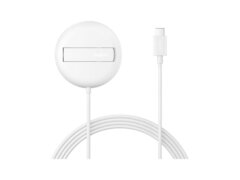
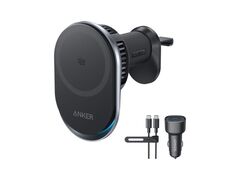
Against the Anker Prime, a MagSafe car charger rated 4.1 in a very different use case, the comparison stays partial but useful: both share the same iPhone generation limit and the same lack of a magic fix for heat under fast charging, but the Anker leans on active cooling built for its car specific use, while the MagFlow 3-in-1 leans on the versatility of three zones and portability instead. No other desk based multi zone MagSafe station is rated in our catalogue yet, which makes the MagFlow 3-in-1 the current reference point for this exact segment here.
Who the MagFlow 3-in-1 suits, and who it does not
This station suits anyone with several Apple devices (a recent iPhone, an Apple Watch, AirPods) who wants to centralise them on one pad without multiplying cables, with a mobility bonus for frequent travellers thanks to the folding design. The balance between the price charged and the power actually on offer also makes it a sound option next to pricier but slower rivals.
It suits less well anyone with an iPhone older than the 16 (capped at 15W, missing out on the product's central selling point), anyone who leaves a phone on it all night in a room that already runs warm in summer, or anyone after a station that stays completely silent with no perceptible heat at all. For those cases, a simpler Qi2 charger, slower but under less thermal stress, remains the more sensible pick.