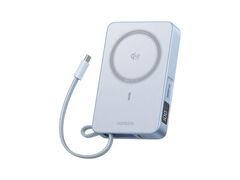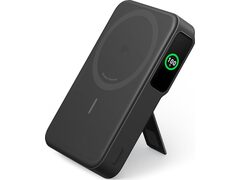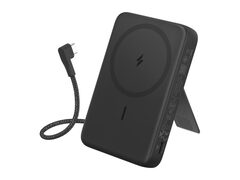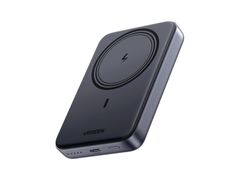

A 144% recharge score, behind despite 25 W wireless charging
In a head-to-head comparison (a power bank recharges a smartphone from empty until the power bank itself is fully drained, and the charge percentages obtained are added together), the MagFlow 10000mAh achieves a recharge score of 144%, meaning one full charge plus 44% of a second charge on a recent iPhone. This figure leaves the MagFlow clearly behind direct rivals from the same comparison: a 15 W variant from the same brand reaches 208%, a 15 W battery from another brand reaches 190%, and even a 25 W battery from a third brand, matching the MagFlow's own wireless power, reaches 177%.
This last comparison point matters: the MagFlow is not behind because it charges wirelessly faster than its rivals, it is behind despite having wireless charging among the fastest in its category. A rival magnetic battery from the same comparison, with 30 W wired like the MagFlow but only 7.5 W wireless, reaches 191%: both batteries therefore share the same wired power, only the wireless power differs, and yet the MagFlow delivers less total energy. The most likely factor is the pack's actually deliverable capacity itself: its technical sheet lists a nominal capacity of 10,000 mAh but a usable declared capacity of 6,000 mAh, a gap wider than for the rivals mentioned above.
Qi2 25 W charging speed, a promise kept and even exceeded
On charging speed itself, the promise is kept, even exceeded: a 0 to 50% charge in 32 to 33 minutes is achieved on a recent iPhone over Qi2 25 W, faster than the 38 minutes the manufacturer announces for the iPhone 17 Pro Max, a larger-capacity phone that explains the gap without contradicting it. On an older iPhone limited to Qi2.0 15 W, the 0 to 50% charge takes about 44 minutes.
Two conditions are needed to reach this 25 W: the iPhone must be a 16 or 17 model with iOS 26, and it must be used without a case or with a MagSafe-compatible case, a detail present in the manufacturer's documentation but not given much prominence. In addition, when all three outputs are used at the same time (built-in cable, USB-C port, wireless), wireless charging is disabled by default and needs a button press to activate, a limitation missing from the main marketing message.
Built-in cable, a mixed reception
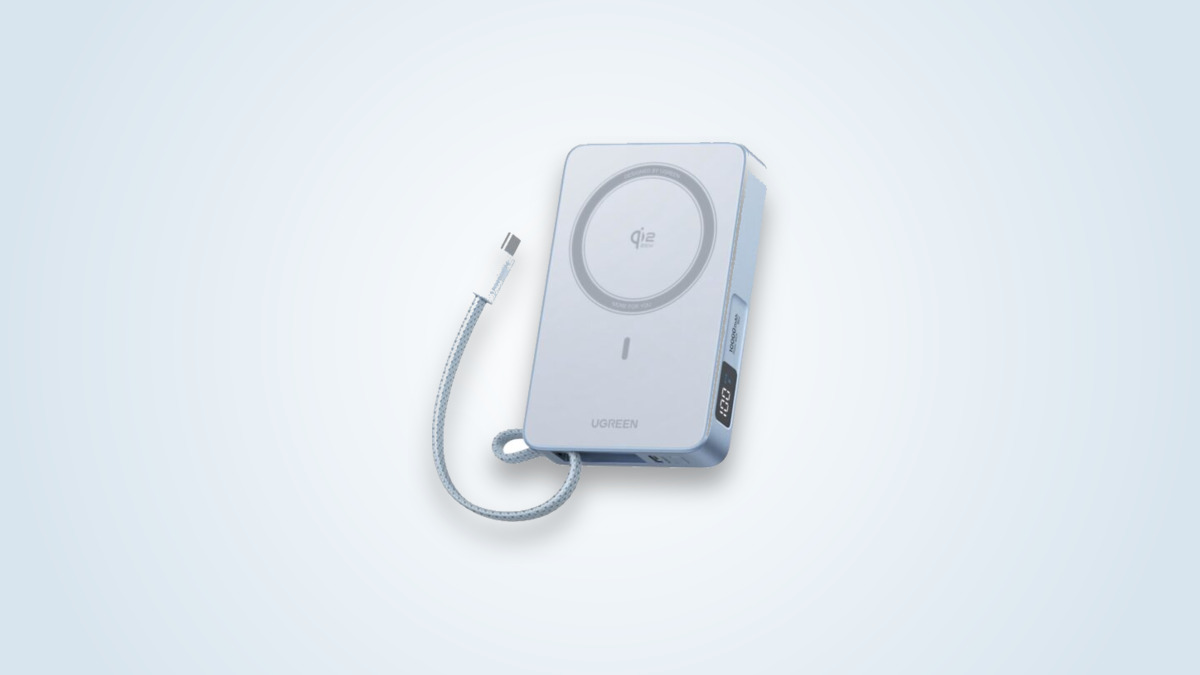
The built-in USB-C cable, which also serves as a strap, has a brick-like shape with pronounced edges, with a loop of cable that sticks out slightly once the phone is attached. This grip does not suit every hand: it can get in the way during extended wired use for some, while it goes unnoticed for others, with bulk and weight among the reservations most often mentioned by a minority of buyers. The cable's braiding itself remains sturdy, with no sign of premature wear. This is not an established manufacturing flaw, but a genuine point of individual sensitivity worth knowing before buying, especially for anyone with small hands or who carries the device in a pocket often.
Controlled heat during fast charging
No case of concerning overheating or temperature-related charging cutoff appears among the elements gathered as a whole. The sensation of heat during fast wireless charging varies from one impression to another, between staying cool and warming up a little without it being alarming, with no fully protocoled numerical measurement in degrees available to settle the matter more precisely. The manufacturer's thermal monitoring system, with a temperature check announced at 200 times per second and a set of 13 protections, is specific to this exact model in the range.
Magnets that keep their promises
The 17 magnets on the back of the casing, rated for a 9 N holding force, keep their promise overall: the hold stays stable even when moving or shaken, consistent with the manufacturer's claim of supporting up to 1 kg. On a Qi-compatible Android smartphone, the magnetic attachment works, but charging caps at 15 W, a limit coming from the phone rather than the battery.
89.99 € listed, rarely the real price
The catalogue price of 89.99 € shown crossed out on the listing appears rarely charged in practice. The price history Amazon itself displays puts the lowest price of the last 30 days at 59.98 €, and the price seen on the manufacturer's official store as well as on Amazon has moved since launch, in September 2025, between 55 and 70 € depending on the period, with no source reporting having seen the product sold at its full catalogue price. The discount on display therefore looks more like a usual price than a genuine one-off promotion.
Who it suits, and who it does not
This battery suits anyone with a recent iPhone 16 or 17 who wants the fastest magnetic wireless charging on the market, with a built-in cable and a display on top. The announced charging speed is kept, even exceeded, and nothing points to a safety or brand reliability issue on this model.
It suits less well anyone looking for the largest amount of total energy available: at equal nominal capacity, it delivers proportionally less charge than several direct rivals, including another 25 W battery in the same category. The price actually observed (55 to 70 € depending on the period) also remains higher than alternatives with slower wireless charging.