
The middle rung of a range that spans 36W to 130W
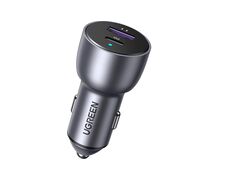
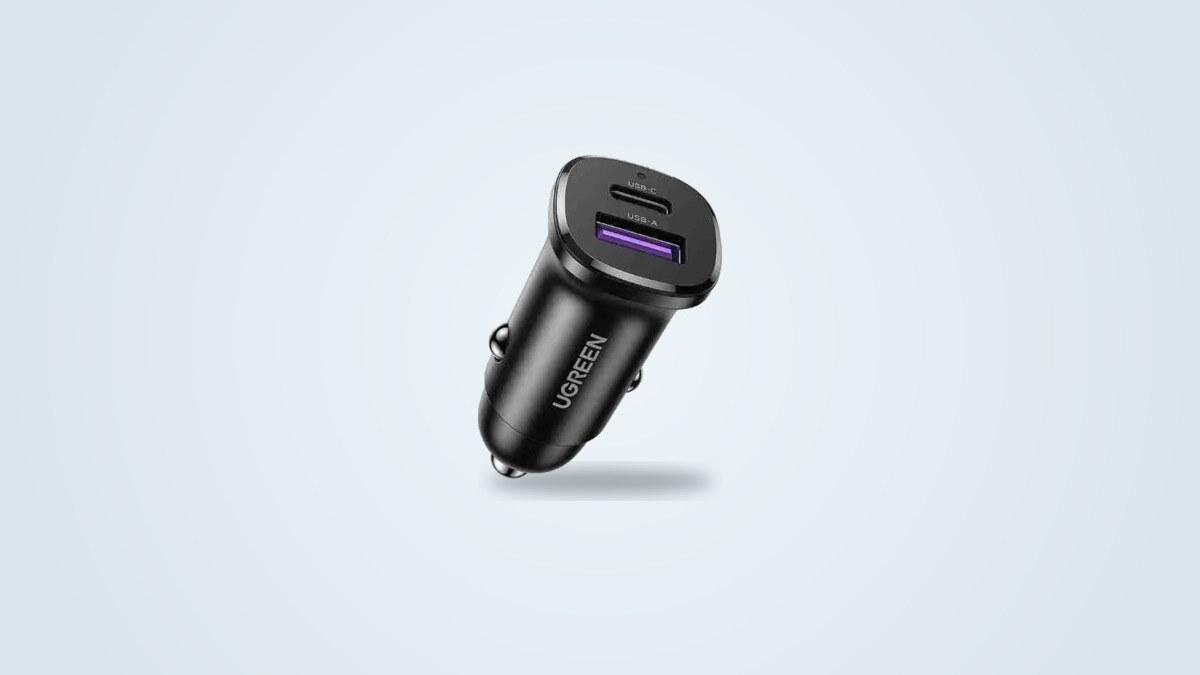
The Ugreen 52.5W car charger sits in a precise spot within the brand's car charger range: more powerful and better equipped than the 36W, which is limited to two USB-A ports with no USB-C, yet simpler than the 60W with its built-in retractable USB-C cable. It sticks to a classic two-port layout, one USB-C and one USB-A, for fast charging of two devices at once, without trying to pack in extra outputs or gimmicks.
The body plugs straight into the car's 12V socket, with no cable in between, and stays discreet once in place: the opposite approach to the brand's retractable-cable models, but one that keeps the advantage of simplicity and a lower price.
30W over Power Delivery and PPS on the USB-C port
The USB-C port lists up to four voltage steps depending on the connected device: 5V/3A, 9V/3A, 15V/2A and 20V/1.5A, for a maximum of 30W. Power Delivery 3.0 covers most recent smartphones and tablets, and support for PPS (Programmable Power Supply) allows finer voltage adjustments in smaller steps, in theory a more efficient charge that dissipates less heat than coarser fixed steps.
This 30W ceiling puts the Ugreen 52.5W in the same bracket as the USB-C port on the 60W in the same range, but well below the 45W on the 63W or the 100W on the 130W; the 36W, for its part, has no USB-C port at all. For a smartphone or tablet, the difference barely registers: most consumer devices cap their own draw well below 30W anyway. The limit becomes real as soon as a laptop enters the picture, even a light one, a use case this model was not designed for.
An extra 22.5W on the USB-A port, with no grey area on sharing
The second port, a USB-A, rounds out the set with two fast-charging paths: up to 18W over classic Quick Charge 3.0 (5V/3A, 9V/2A, 12V/1.5A steps), or up to 22.5W over the SCP (Super Charge Protocol) standard used by the Huawei and Honor ecosystem, with stated steps of 4.5V/5A or 5V/4.5A. The power actually delivered therefore depends entirely on which protocol the connected device recognizes, rather than on a single flat ceiling.
The notable point about this model lies in the arithmetic on its spec sheet: 30W (USB-C) plus 22.5W (USB-A) adds up to exactly 52.5W, the stated total. On some multi-port chargers, the sum of the individual maximums exceeds the stated total output, hinting at an unstated trade-off once several outputs approach their peak; here, there is no such grey area on paper, as each port can aim for its own maximum without arithmetically encroaching on the other. That does not rule out some caution over how well these two ceilings actually hold at the same time, covered further below.
PD, PPS, QC 3.0 and SCP: broad compatibility, with one clear limit
The combination of four protocols, Power Delivery 3.0, PPS, Quick Charge 3.0 and SCP, covers a good share of the devices in circulation: recent iPhones and iPads over Power Delivery on the USB-C port, a large slice of general Android smartphones and tablets over Power Delivery or Quick Charge depending on the port used, and Huawei and Honor smartphones over SCP on the USB-A port, an ecosystem plenty of generic chargers leave out.
This broad compatibility comes with one clear limit stated plainly on the spec sheet itself: the USB-C port caps at 30W, which rules out any laptop outright, even a light model that would settle for 20 to 30W in everyday office use. For that kind of device, the 63W (45W USB-C port) or the 130W (100W USB-C port) in the same Ugreen range are a better fit. This 52.5W model stays built for smartphones, tablets, GPS units and dashcams, not a mobile workstation.
The detail that costs you later: no cable in the box
The box holds only the charger and its printed documentation: no USB-C or USB-A cable is included. That choice, common on the brand's simpler car charger models, has a real consequence at checkout: without a Power Delivery-compatible USB-C cable already on hand, reaching the stated 30W on that port is impossible, and a basic USB-A charging cable will just as easily cap the second port's performance.
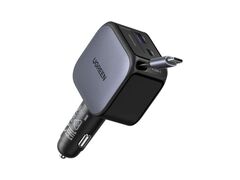
This sets it apart from the brand's Nexode models, which come with a built-in retractable USB-C cable, and even from the 60W in Ugreen's own car charger range, which packs a retractable cable alongside its two independent ports. For anyone who already owns good cables, the difference is purely theoretical; for anyone starting from scratch, it adds to the real cost of the accessory.
More than twice the weight of its direct rival, the Anker 323
At 57.2 grams for 65 x 30 x 30 mm, the Ugreen 52.5W reuses the exact footprint of the 36W in the same range, despite that model being noticeably less powerful (36W versus 52.5W) and lighter (40 g). Within its own family, the added USB-C port and roughly 17 extra grams of components stay in reasonable proportion to the extra power delivered.
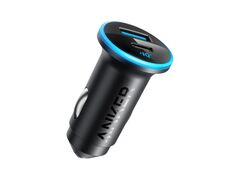
The comparison turns less flattering against the Anker 323, a direct rival that is identical on paper: the same 52.5W total power, the same USB-C 30W plus USB-A 22.5W port split. Its spec sheet nonetheless lists a weight of just 23 grams for a 56 x 30 mm footprint, more than twice as light as the Ugreen for an equivalent charging promise on paper. A gap of this size, at matched specifications, is not fully explained by the usual margin of error between different brands' spec sheets.
| Model | Power | Stated weight | Stated dimensions |
|---|---|---|---|
| Anker 323 | 52.5W | 23 g | 56 x 30 mm |
| Ugreen 52.5W | 52.5W | 57.2 g | 65 x 30 x 30 mm |
| Ugreen 36W | 36W | 40 g | 65 x 30 x 30 mm |
| Ugreen 130W | 130W | 45 g | 76 x 36 x 36 mm |
The Ugreen 52.5W still stays compact in absolute terms, easily small enough to stay clear of a gear lever or centre console. It is only against its closest rival on paper that its footprint loses the advantage.
Five standard protections, a warranty that shifts from site to site
Ugreen lists five internal protections on this model: against overvoltage, overcurrent, overheating, short circuits and overcharging. That is a solid baseline for this kind of accessory, left permanently plugged into the car's 12V socket, often unattended. The aluminum body also helps dissipate heat and guards against everyday knocks and scratches.
The comparison with the Anker 323 highlights a difference in approach rather than a gap in raw safety: the Anker carries a named technology, ActiveShield 2.0, which keeps monitoring temperature and adjusts the delivered power accordingly, while the Ugreen 52.5W relies on more standard protections, with no named active monitoring on its spec sheet.
Against the Anker 323 and other Ugreen chargers in the range
How does the Ugreen 52.5W stack up against its direct rival and the other power levels in its own range?
| Criterion | Ugreen 52.5W | Anker 323 | Ugreen 36W | Ugreen 60W |
|---|---|---|---|---|
| Total power | 52.5W | 52.5W | 36W | 60W |
| Ports | USB-C 30W + USB-A 22.5W | USB-C 30W + USB-A 22.5W | 2x USB-A 18W | Cable USB-C + USB-C + USB-A, 30W each |
| Protocols | PD, PPS, QC 3.0, SCP | PD, PowerIQ 3.0, PPS | QC 3.0/2.0, AFC, FCP | PD 3.0, QC 3.0, PPS |
| Built-in cable | No | No | No | Yes, retractable |
| Stated weight | 57.2 g | 23 g | 40 g | Not stated |
| Observed price | £10.79 | £19.99 | £15.99 | £13.98 |
Against the Anker 323, the Ugreen 52.5W is evenly matched on power and port split, with a paper advantage on protocols thanks to explicit SCP support for the Huawei and Honor ecosystem, but a clear disadvantage on weight and on how clearly the warranty is stated, even though it costs noticeably less here. Against the 36W in its own range, it adds a genuine modern USB-C port with Power Delivery and PPS, a decisive plus for anyone with a recent iPhone or Android device. Against the 60W, it loses the convenience of a built-in retractable cable, but keeps a simpler, more transparent power structure on paper.
Who the Ugreen 52.5W is for
This charger suits anyone wanting to equip a car with a modern USB-C port and a USB-A port for a second device, starting from their own cables and with no need to power a laptop. For a very similar budget but a noticeably more compact footprint, the Anker 323 is worth a look first. For a USB-C cable always within reach, the Ugreen 60W and its retractable cable are a better fit; to power a USB-C laptop, even a light one, the 63W or the 130W in the same range is the way to go.