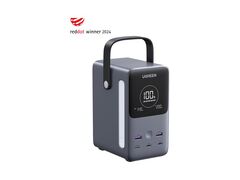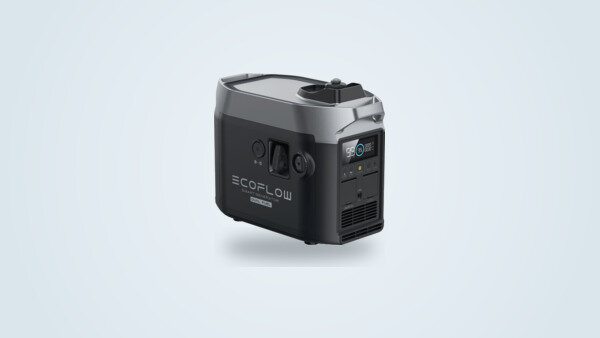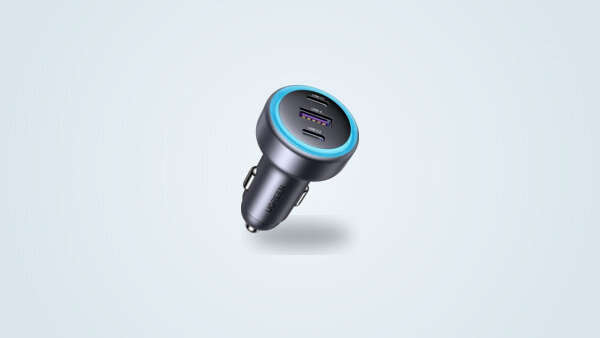

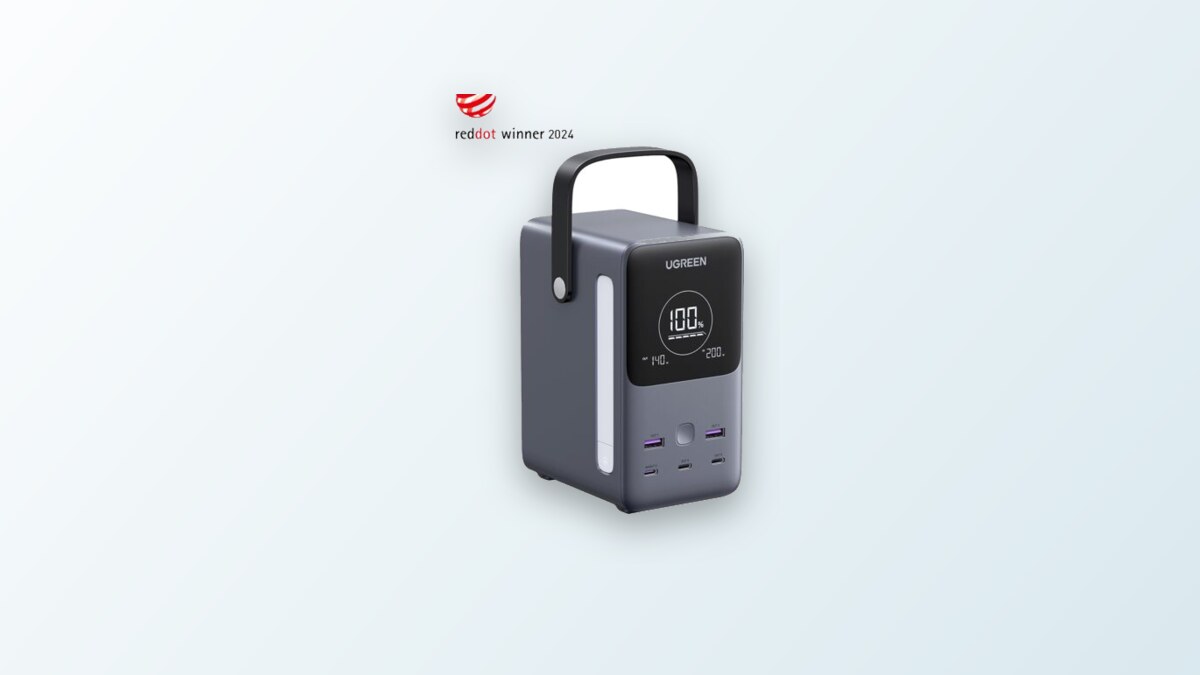
What it really is: a giant USB battery, not a power station
Sitting halfway between a power bank and a power station, the Ugreen 300W 48000mAh has no mains output: only USB ports (3 USB-C, 2 USB-A). It recharges devices that plug in over USB (phone, tablet, laptop via USB-C), not a household appliance or a tool that needs a standard mains socket. That is an important distinction before buying: despite the "300W" in its name and its record capacity, it is not a substitute for a true mains-output power station.
The real capacity gap: the most documented point in this review
This is the best-covered subject on this product, and the least flattering one. Charging a laptop and a tablet of known official capacity to full only delivers around 99 Wh, barely 65% of the 153.6 Wh nominal rating. On a recent phone, the number of full charges obtained falls short of the 7 to 8 charges expected for a capacity of this order.
The clearest signal is a direct comparison: another model from the same brand, much smaller and cheaper (25000 mAh), delivers laptop runtime nearly identical to this 48000 mAh model in some test protocols, which calls into question the value of paying for double the advertised capacity. LiFePO4 chemistry, less energy-dense than conventional lithium-ion at equal volume, mechanically accounts for part of this gap, but not its full extent: on comparable LiFePO4 power banks from the same brand, a combined efficiency (charge then discharge) of around 76 to 80% has been measured, a figure already far from 100% but still not enough to explain a gap of close to 35%.
The 140 W USB-C port in practice
Advertised at 140 W, the main USB-C port delivers more like 94 to 130 W in practice, a clear gap from the headline figure. On a power-hungry laptop, charging remains possible but slower, and sometimes incomplete within the allotted time, than the 140 W figure suggests. Recharging the unit itself through this same port, by contrast, works very well, more on that below.
Five ports, but not all at full power at once
With 3 USB-C ports and 2 USB-A ports, the connectivity looks generous enough to help out a whole group. But when all five outputs are used at the same time, they share a limited total power budget: output then drops to just a few watts on most of the secondary ports, far short of what fast charging needs across several devices at once. To get fast charging, it is better to stick to one or two devices plugged in at a time rather than relying on all five ports at full power.
Recharging the unit itself: the real strength
This is the clearest contrast in this review: where the delivered capacity disappoints, recharging the battery itself is fast and efficient. With the supplied 140 W charger and its PD3.1 cable, a full charge generally takes under 90 minutes, with a charging efficiency close to 100%. Pass-through, which lets a connected device draw power while the unit itself recharges, works and stays warm rather than hot in use, with no notable overheating, though no precise temperature measurement is available to confirm this with hard figures.
Air travel: the 100 to 160 Wh rule
At 153.6 Wh, this battery falls into the regulatory bracket where prior approval from the airline is mandatory to carry it as carry-on luggage (never in checked baggage), with a maximum generally set at two units per passenger. Below 100 Wh, boarding is unrestricted with no paperwork; above 160 Wh, it is generally refused. This constraint is not specific to this model, it applies to any battery in this capacity range, but it is worth knowing before a purchase made with travel in mind: boarding is not automatic, prior arrangement with the airline remains necessary.
Build and reliability
The design received a Red Dot Design Award 2024, a recognition that covers design, not energy performance. The power button needs a long press to switch the unit off rather than a simple tap, a point of ergonomics worth knowing. The warranty runs for 2 years, standard for the category.
On long-term reliability, data remains limited: one failure case, occurring several months after purchase, was handled under warranty, but the first replacement unit sent was the wrong model, before a second shipment resolved the situation, a genuine snag in the process rather than a minor detail. This is only an isolated case, not a failure statistic, but its nature (after-sales service getting it wrong on the first attempt) justifies mentioning it.
Against the competition: two opposing philosophies
In the segment of very high-capacity external batteries, two approaches compete. The Ugreen 300W 48000mAh chases maximum advertised raw capacity, even if that means crossing the 100 Wh threshold that triggers the airline constraint. The Anker Prime 26250 (300W), by contrast, is calibrated just under that same 100 Wh mark, a choice deliberately made to avoid any airline paperwork, at the cost of a more modest nominal capacity.
| Criterion | Ugreen 300W 48000mAh | Anker Prime 26250 300W | EcoFlow RAPID Pro 27650mAh |
|---|---|---|---|
| Nominal capacity | 153.6 Wh | ≈99.8 Wh | ≈99.5 Wh |
| Max power | 300 W combined (140 W main port) | 300 W | 320 W, 80% charge in 20 min |
| Air travel constraint | Airline approval required (100-160 Wh) | None (under 100 Wh) | None (under 100 Wh) |
| Weight | 1.637 kg | ≈0.6 kg | ≈0.7 kg |
On paper, the Ugreen's nominal capacity remains around 50% higher. Given the documented gap between advertised capacity and actually usable capacity, this theoretical advantage shrinks considerably once measured against real-world use, while both rivals avoid any travel constraint from the outset.
Camping, van life, home backup: where it really earns its keep
Camping or in a campervan, it can support a whole group over several days for charging phones and small devices, with its built-in LED torch doubling as backup lighting. A laptop plugged in for a work session also holds up, even though the main port's real power output falls short of the advertised figure (see above). The digital display lets you track the remaining charge without any app or Bluetooth pairing to set up, a simplicity that suits outdoor use well.
As a home backup during a power cut, it keeps phones, a 12V internet router via a USB adapter, or small LED lighting running for several hours, without being able to power a standard household appliance since it has no mains output. For regular nomadic use that does not involve flying, its capacity and built-in handle make it a practical reserve to keep in the boot or a bag.
Who it suits, and who it does not
It suits anyone looking for a large USB energy reserve for the home, camping or van life, without needing to fly with it, and who values LiFePO4 chemistry, total silence and how fast it recharges itself.
It does not suit anyone who flies regularly with their gear, anyone looking for a standard mains output for household appliances, or anyone who takes the 48000mAh figure as a promise of fully usable capacity.