
20,000mAh, 74Wh: what the conversion hides
On the box, one figure dominates: 20,000mAh. Sunslice itself converts that into a more useful number in its spec sheet, 74Wh, at a pack voltage of 3.7V. The maths is simple and checkable: 20,000mAh multiplied by 3.7V gives 74,000mWh, or an even 74Wh. Many manufacturers in this space use 3.6V for the same calculation, which would have produced a slightly lower figure; Sunslice isn't inflating its stated energy by picking a flattering voltage.
That 74Wh figure has a real consequence for travellers: the limit generally applied for carrying a power bank in cabin baggage without prior permission is 100Wh. The Gravity 20 clears that with a comfortable 26Wh to spare, more than enough to avoid ever having to justify the device at a check. Lithium batteries remain banned from the hold regardless of capacity.
The more practical question is how many phone charges that actually represents. Sunslice claims up to six full charges. A recent smartphone typically stores between 12 and 20Wh depending on the model; allowing for the usual conversion losses on this kind of device, six full charges from 74Wh is a consistent claim for the most modest phones on the market, and a more optimistic one for the largest.
18W across three ports: the promise and what it leaves out
The Gravity 20 has three active outputs, a USB-C port with Power Delivery and two USB-A ports with Quick Charge 3.0, each rated up to 18W. Sunslice's own marketing goes further, claiming it can charge up to three devices at once 'at full speed'. That's a generous promise: it implies the battery can deliver up to 54W combined across its three outputs at the same time, three times the power of its single charging input.
Nothing in Sunslice's published specifications explains how that power actually splits when all three ports are in use together. Several rivals publish a precise port-by-port breakdown as soon as a second or third device is plugged in; this one doesn't. That gap isn't proof of a problem, only of a lack of transparency on a point its own marketing highlights. Without a detailed specification, it's safer not to plan a group outing around the assumption of a guaranteed 18W on all three outputs at once.
For one or two devices, on the other hand, the promise is far easier to keep: 18W over USB-C with Power Delivery covers a standard fast phone charge, and the Quick Charge 3.0 protocol on both USB-A ports gives broad compatibility with older Android phones that never picked up PD.
Filling the 74Wh: what Sunslice doesn't say
The Gravity 20's charging input is capped, like each of its three outputs, at 18W over USB-C. Sunslice doesn't publish a full charge time for this model. As a simple calculation, at a constant 18W from start to finish, refilling the pack's 74Wh would take a little over four hours; in practice, the current a lithium cell accepts tapers off toward the end of a charge, which stretches that theoretical estimate further still.
That 18W ceiling puts the Gravity 20 well behind newer batteries on the market, some of which exceed 60W or even 100W on input and refill in an hour or less. For occasional back-up use, the difference barely matters. For anyone needing to top up their energy reserve during a short break, on the road or between activities, the gap is noticeable.
The supplied cable plugs in via USB-C, and the battery accepts either a standard mains charger or a Sunslice Fusion Flex solar panel, covered further below. No figure is given for cycle life, a number most major brands in the sector now publish and that Sunslice keeps to itself for this model.
400 grams for 140 x 69 x 26mm: neither the lightest nor the heaviest
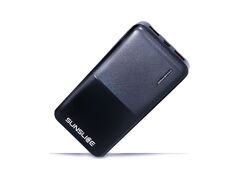
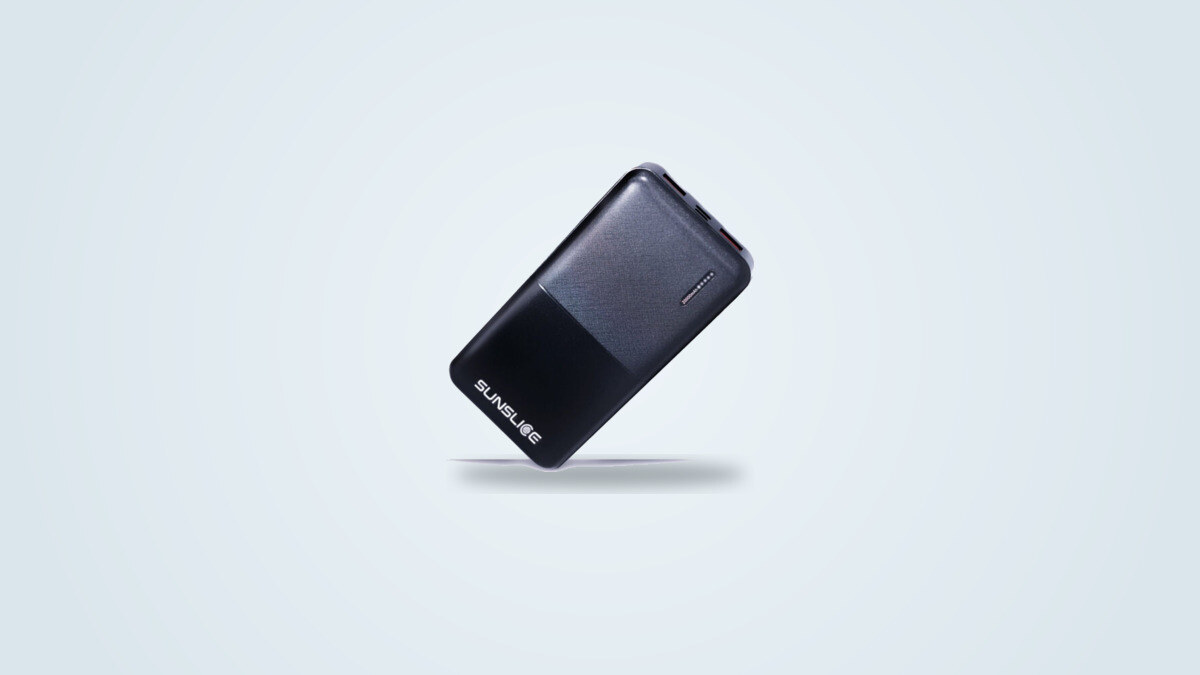
On the scale, the Gravity 20 comes in at 400 grams for a 140 x 69 x 26mm footprint, a block wider than a smartphone but one that slips easily into a backpack pocket. Relative to its 74Wh, its density works out to a little over 5.4 grams per Wh stored.
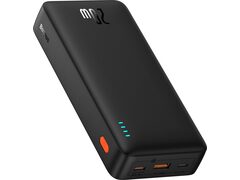
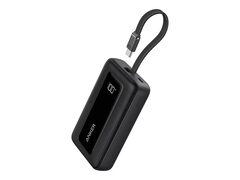
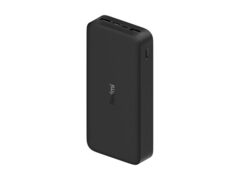
Against three 20,000mAh batteries sold at a similar indicative price, the Gravity 20 sits in the middle of the pack: heavier than the Baseus Bipow Pro 20000mAh and the Anker Zolo 20000, lighter than the Xiaomi Redmi 20000mAh.
The shell is entirely plastic with a textured finish, with no visible metal parts. A single attachment point sits on the edge, enough for a carabiner but less convenient than a built-in handle found on some of the category's larger models.
The LED torch, an edge its rivals don't have
Four indicator LEDs show the remaining charge in 25% steps, a cruder solution than a digital display showing an exact percentage, but enough to check at a glance whether there's enough energy left for the night. Sunslice adds a built-in LED torch, handy for camping, wild camping, or a power cut at home.
That torch makes a real difference against the three direct rivals of equal capacity named above: neither the Baseus Bipow Pro, the Anker Zolo 20000, nor the Xiaomi Redmi 20000mAh offer one. For outdoor use, it's a concrete argument rather than a marketing gimmick: an emergency light always sitting inside the same shell as the energy reserve saves carrying one more accessory.
A charging cable is included in the box, but no cable is built into or retractable from the shell itself, unlike newer, pricier models further up the category. A standard USB-C cable is all it needs day to day, which at least keeps replacement simple if one is lost or worn out.
Waterproof? No, and here's where the Sunslice range gets confusing
The Gravity 20's manual limits itself to a warning against exposure to rain and water; no IP rating is published for this model. That's a useful distinction, because Sunslice sells a separate 'Gravity 20 Extreme Pro' alongside it, a bigger, heavier unit marketed as shock and water resistant. The two products share part of their commercial name, which can cause confusion at the point of purchase.
For the version covered here, the one the catalogue links to, caution is therefore the sensible approach outdoors: a light shower on a closed shell generally isn't an immediate problem, but immersion or prolonged exposure to heavy rain falls outside the manufacturer's intended use.
This is an honest limitation rather than a hidden flaw: Sunslice doesn't claim a resistance it hasn't built into this particular model, reserving that argument for the pricier Extreme Pro version instead. For hiking or wild camping, keeping the battery in a closed pocket or a dry bag remains the safest habit, whichever model is in use.
Solar panel compatible: the promise and the real maths
The Gravity 20 charges via USB-C, which makes it compatible with Sunslice's foldable Fusion Flex solar panels without any adapter or extra accessory. That's a genuine ecosystem argument, one none of the three direct rivals in this review can match.
A simple calculation helps put that into real-world perspective. The Fusion Flex 12W, the entry model in the range, delivers 12W under ideal conditions. Refilling the Gravity 20's 74Wh from empty would take, at constant power and in uninterrupted full sun, a little over six hours. That figure is a theoretical floor: a flexible panel laid on the ground or strapped to a backpack rarely holds an ideal angle to the sun, and its output drops sharply the moment a cloud passes. Over a real day of hiking, refilling a full charge this way probably means spreading that calculation across several hours of cumulative sunshine rather than one continuous session.
Sunslice itself recommends, for its Fusion Flex panels, plugging them into a power bank rather than a phone directly, precisely to smooth out those swings in output. The Gravity 20 plays exactly that intermediary role within the brand's ecosystem, a coherent fit for anyone who already owns or is considering a Sunslice panel, though it adds nothing for anyone who isn't.
Sunslice, a Belgian brand in a niche market
Sunslice is a Belgian company founded in 2017 in Ottignies-Louvain-la-Neuve by two engineers, Geoffroy Ghion and Henri Gernaey, who started with a credit-card-sized solar charger project conceived during their studies. The brand has since specialised in foldable solar panels and the power banks that pair with them, with a small team and design work based in Belgium, while manufacturing takes place in China, with some hand assembly carried out in Tunisia.
Its products are now distributed through dozens of specialist and general retailers across Europe, notably through outdoor and sports chains. That physical retail presence, rather than an online-only channel, is a reassuring sign for a brand of this size.
The Gravity 20 carries a two-year warranty, the standard length for the category. After-sales support generally runs through the retailer the unit was bought from rather than directly through Sunslice. No product recall or safety issue is reported for this model to date.
Versus Baseus, Anker and Xiaomi: what justifies the price gap
In the 20,000mAh segment sold at roughly £25 to £45, the Gravity 20 faces dense competition. Three models of identical or very similar capacity fight over the same shelf space: the Baseus Bipow Pro 20000mAh, notably cheaper; the Anker Zolo 20000, more powerful; and the Xiaomi Redmi 20000mAh, the most accessible option.
| Criterion | Sunslice Gravity 20 | Baseus Bipow Pro | Anker Zolo 20000 | Xiaomi Redmi |
|---|---|---|---|---|
| Capacity | 20000mAh (74Wh) | 20000mAh (76Wh) | 20000mAh | 20000mAh |
| Max power | 18W | 22.5W | 30W | 18W |
| Weight | 400g | ≈ 340g | ≈ 353g | ≈ 434g |
| LED torch | Yes | No | No | No |
| Solar ecosystem | Yes | No | No | No |
The Baseus Bipow Pro wins on price and even lists two more Wh on paper. The Anker Zolo 20000 delivers 30W, nearly double, for a very similar weight. The Xiaomi Redmi remains the most affordable option, at the cost of a noticeably heavier shell. None of the three, however, offers a built-in torch or compatibility with a solar ecosystem.
The Gravity 20 wins on neither price nor raw power. Its case rests on the torch-plus-solar combination, a sensible choice for anyone already building a hiking kit around Sunslice gear, harder to justify for anyone after nothing more than the fastest charge at the lowest price.
Hiking, van life, family back-up: who it suits
On a long-distance hike or a bikepacking trip, the Gravity 20 fits the use Sunslice designed it for: topping up a phone, a GPS bike computer or a headlamp over several days, with the occasional boost from a Fusion Flex panel on sunny days. Its built-in torch earns its keep at camp without needing to pack a separate light.
With family or a group, its three active ports let it help out several devices during the same outing, though it's best not to count on a guaranteed 18W on all three at once. In a camper van or during a power cut at home, it serves as a simple back-up reserve, with no pretence of replacing a proper mains-output power station, something it never claimed to be in the first place.
It suits anyone after an honest energy reserve for a phone and small USB gadgets, who'd rather have a built-in torch than carry one separately, and who might add a solar panel from the same brand down the line.
It suits less anyone who regularly recharges a laptop or several power-hungry devices at once, wants the fastest charge on the market, or plans to expose it to rain often without extra protection.