
The declared efficiency: a stated value, not a measurement
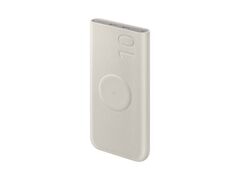
Samsung states an energy output of 29Wh at 5V for this 37Wh nominal battery, a theoretical ratio of 78%. This is the manufacturer's regulatory labelling figure, not an independent measurement: no accessible third-party test could confirm this number under real discharge conditions. Unlike most power banks already reviewed on this site, we therefore have no measured efficiency to compare against the stated figure, only the declared value. We would rather flag this clearly than present this number as a measurement.
Wired power, matching the spec sheet
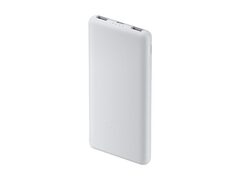
On a single USB-C port used alone, the stated 25W is indeed reached (measured via the Power Delivery standard). That is decent power for a 10,000mAh power bank, enough for fast smartphone charging. However, as soon as both USB-C ports are used at the same time, the manufacturer's spec sheet states a 10W-per-port split, a figure no independent test could precisely confirm.
Wireless charging, decent but behind the competition
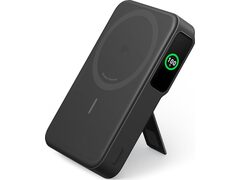
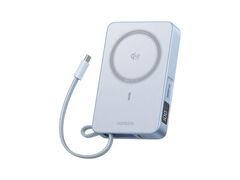
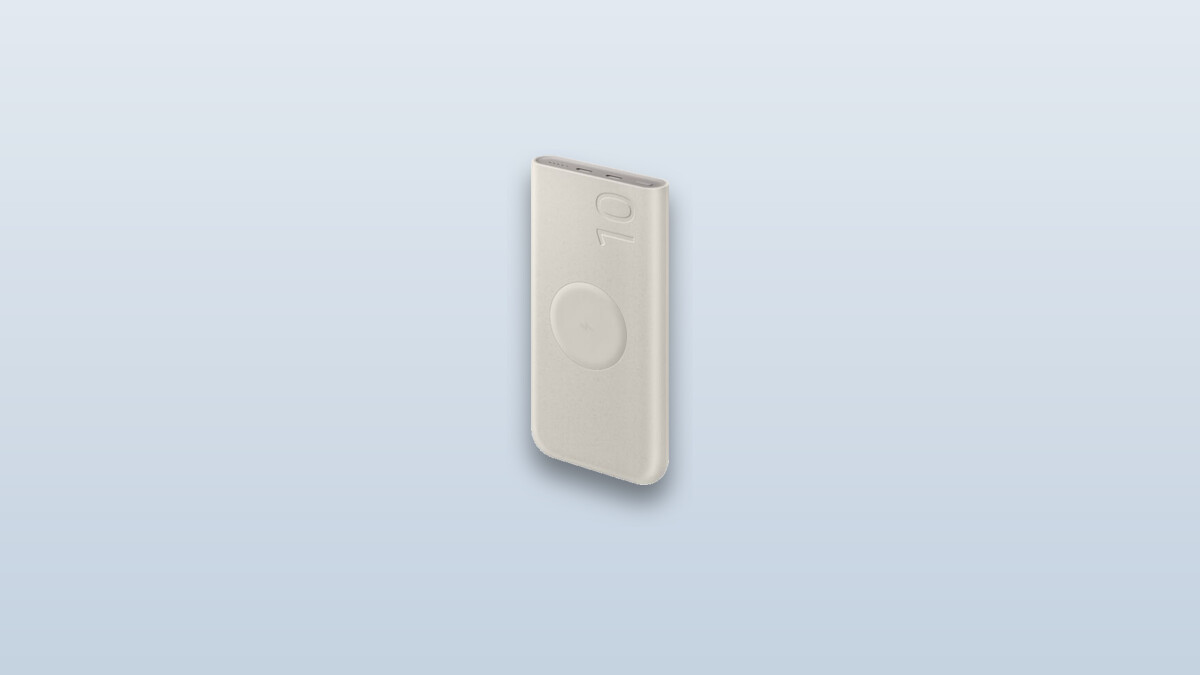
The Qi wireless charging pad delivers up to 7.5W. That is functional for topping up without a cable, but noticeably behind direct competitors fitted with magnetic alignment that reach 15W. The absence of a magnet also means the device has to be positioned by hand on the charging pad, without the automatic guidance a magnetic system provides.
Three-device mode: a sharply reduced speed for everyone
This is the most important point to understand before buying. When both USB-C ports and the induction pad are used at the same time, all outputs drop to 7.5W each, including both USB-C ports, which otherwise deliver 25W each when used alone. The ability to charge three devices at once is therefore real, but at a speed clearly lower than what each port can offer individually, a trade-off that is not clearly stated in the product's presentation.
Recharging the battery, slower than average
A full recharge of the battery takes more than 3 hours, considered slower than the average for comparable 10,000mAh power banks. That is a downside for anyone who needs to recharge the accessory quickly between uses.
Weight and size, matching the spec sheet
The 222g weight matches the stated figure, and the stated dimensions (148 x 72 x 16.4mm) are also accurate. It is a compact, slim shape, even though its length has been noted as a little long compared with other wireless charging power banks on the market.
Charge LEDs, handy but not always on
The charge level is shown through LEDs rather than a digital display. These LEDs do not stay lit continuously while charging: the dedicated button has to be pressed to check the remaining level, a minor but real inconvenience day to day compared with a display that shows the information at all times.
Build quality and reliability
Build quality comes across as solid, with a slight flex noted on the panels without this calling the overall sturdiness into question. Despite thorough research, no recurring reliability defect (early failure, overheating, faulty port) was identified. That is a fairly good sign, even though it is not proof of long-term reliability, only the absence of a negative signal at this stage.
Price and positioning against the competition
The catalogue price of 39.99 euros is consistent with the French market actually observed, between 35 and 47 euros depending on the retailer. Against competitors fitted with magnetic alignment that reach 15W in wireless charging, the Samsung EB-U2510 positions itself on versatility (induction plus two USB-C ports on the same shell) and price rather than on wireless charging speed.