
1000W continuous, 2000W peak: what they really cover
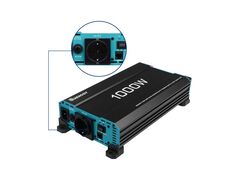
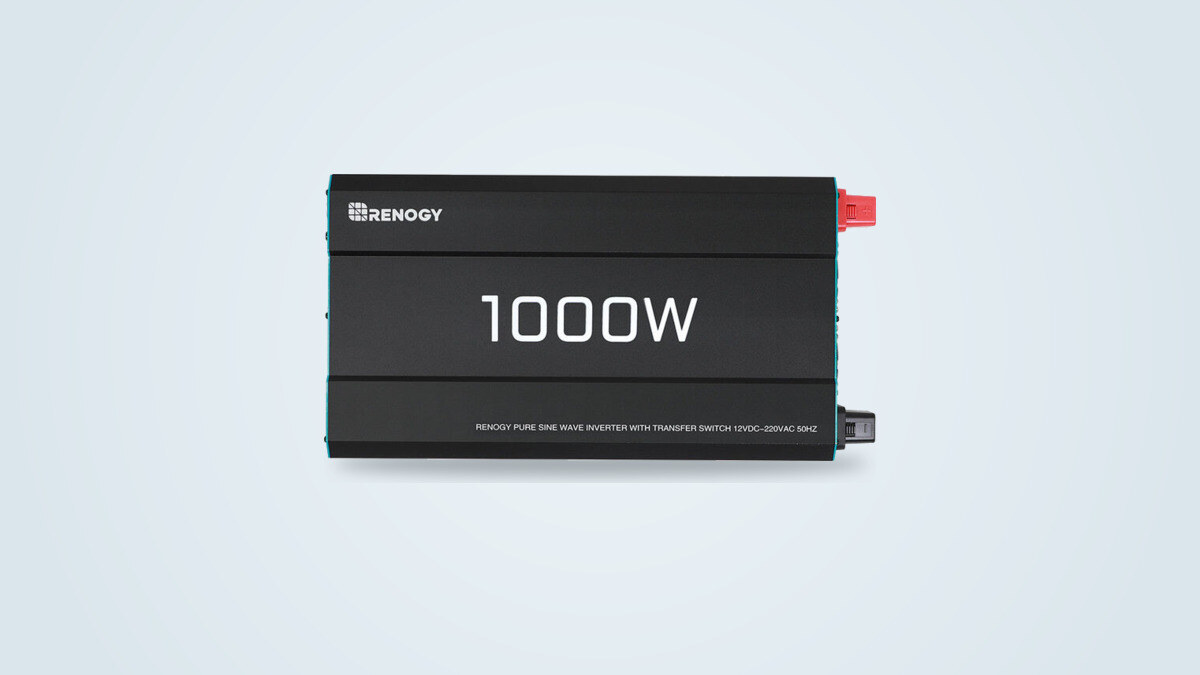
The rating plate lists 1000 watts continuous and a 2000-watt peak to absorb the start-up surge of motor-driven or switched-mode loads. Those are manufacturer figures, but they hold up against loads with a reputation for being hard to start: a heat gun or a camping hotplate rated at several hundred watts starts without tripping the electronic protection, with the unit then drawing roughly 35 amps at 12V for a resistive load of around 350 watts.
That peak margin mostly matters at start-up: a fridge compressor or a power tool draws several times its rated wattage for a few tenths of a second, and it is that peak, not the wattage printed on the appliance itself, that trips the overload protection or not. The manufacturer does not publish a temperature derating curve, unlike a reference in the segment that states its continuous power precisely at 25 °C and at 40 °C: here, all that is known is that the unit runs between 0 °C and 40 °C, without knowing how fast available power drops as it approaches that upper limit.
A pure sine wave with nothing to apologise for near sensitive electronics
A stepped signal, often called modified sine, is enough for a light bulb or a simple charger, but a motor runs hotter, a transformer hums, and some switched-mode power supplies refuse to start at all. The Renogy inverter produces a genuinely sinusoidal wave, designed to mimic mains power rather than approximate it.
The manufacturer does not publish a total harmonic distortion (THD) figure to quantify signal purity precisely, a level of transparency only a handful of premium references in the market provide. In practice, the output stays compatible with the loads that trip up a modified sine wave: laptops, chargers, small appliances and power tools all run without particular reservation, including the motor-driven or start-up-capacitor loads mentioned above. A few interference quirks remain possible, as with any electronic inverter: a faint hum through cheap, poorly filtered speakers or radios, or visible interference on a television screen in a weak-reception area. Moving the sensitive device away from the inverter and its cables, or improving reception, usually clears them up.
The mains priority function: what it really does, and its real limit
Wiring the inverter's dedicated mains input, separate from the output, to a campsite hook-up, a generator or another AC source automatically activates the mains priority circuit: as long as that supply is present, it passes straight through to the output, with the battery kept in reserve. As soon as the mains supply drops, the unit switches on its own to battery power in 50 milliseconds, with no intervention needed.
Having this function built in as standard remains rare at this price point: it usually equips dedicated, pricier backup inverters, or requires an external transfer accessory on pure sine references that do not include it natively. It comes into its own in a motorhome or on a boat, where the power source naturally alternates between a shore hook-up or a generator and the leisure battery.
Left on standby: the real electricity cost
An inverter left permanently connected to a leisure battery draws power even with nothing plugged into its output: that is what drains a reserve of energy over a few weeks of inactivity, on a storage pitch or at a marina. The manufacturer quotes an idle draw under 1 amp, roughly 12 watts at 12V. That figure varies from one unit to another, though: several draw noticeably more than that in practice, up to around 20 watts idle.
The gap comes down mostly to the lack of an economy standby mode on this model: unlike a reference in the segment that includes an ECO mode bringing idle draw down to 1 watt by shutting off the power stage between loads, the Renogy stays powered continuously whenever its switch is set to ON, with no dedicated low-power step. On a monitored setup switched off between uses, the gap does not amount to much. Left connected for weeks unattended, it eventually adds up, particularly on a small lead-acid battery.
Cables, fuse and terminals: what to plan for to draw 1000W
At full power, the unit draws in the order of 90 amps at 12V on the input side, a current that calls for heavy-gauge cabling and a battery able to supply it without its voltage collapsing. The manufacturer recommends a 150A battery fuse for this specific model, fitted as close as possible to the positive terminal, and supplies two 4 AWG (roughly 21 mm²) connecting cables fixed to the M8 terminals with nuts to be hand-tightened, not forced.
Worth knowing before wiring it up: the two supplied battery cables are aluminium rather than pure copper, a choice that trims the manufacturing cost but conducts current somewhat less efficiently at equal gauge, with a risk of heating at the crimped lugs if they are not perfectly tightened. For occasional, moderate-power use that is not a particular issue; to draw the full 1000W continuously over time, upgrading to an equivalent-gauge copper cable is the safer bet. The manufacturer's own sizing guides, elsewhere, actually discourage copper-clad aluminium cable for this type of connection, even as the cables supplied with the unit are exactly that.
Another point worth flagging: a starter battery is not built for this kind of regular load. A deep-cycle battery, lithium or lead-acid, rated for at least an 80% depth of discharge, is needed; if a vehicle's starter battery is used as an occasional source regardless, running the engine every hour or two to recharge it is the safer approach.
Protection and certification: a full list, two caveats
The electronic protection line-up covers the usual bases: battery under and over-voltage, overload, overheating with automatic shutdown, output short circuit, and an internal backup fuse built into the circuit. If battery voltage runs low, an audible alarm sounds before the automatic cutoff, giving enough time to shut down a computer or another sensitive device properly before the power actually drops; the unit then restarts on its own once voltage recovers, with no action needed.
Two caveats, though. The protection rating stops at IP20: shielded against solid objects and dust, but with no protection against water at all, which means it belongs in a dry compartment rather than anywhere exposed to spray or splash, including on a boat. And the manufacturer's warranty runs for 2 years, a fair term but short of the 5 years claimed by the most established reference in the pure sine inverter market. No safety recall has been identified for this range at the time of writing, and the CE and EMC certifications cover baseline European electromagnetic compliance.
Build quality and reliability: what usage reveals
The black metal casing with turquoise side panels sits squarely within the segment's norms: compact (34.2 x 17.3 x 7.6 cm) and light (2.6 kg) for this power class, with two load-driven cooling fans rather than an oversized passive heatsink. Fan noise varies noticeably from one use to another: quiet under light load in several accounts, clearly audible once the power drawn increases in others, a gap that probably owes as much to the actual load and compartment ventilation as to unit-to-unit variation.
Over the longer run, the overall picture stays reassuring for a product in this price bracket: most feedback points to trouble-free operation over months to years, including under sustained use (power tools, on-board kitchen appliances). A few isolated reports of a dead-on-arrival unit exist, as with nearly any consumer electronics range, generally resolved with a straightforward warranty replacement. No recurring structural fault, of the kind that keeps failing on a specific identified component, stands out clearly.
Against Victron and entry-level inverters
The table below places the Renogy between two worlds of the same 12V-to-230V inverter segment.
| Criterion | Renogy 1000W/2000W | Victron Phoenix 12/1200 | Bestek 200W |
|---|---|---|---|
| Continuous / peak power | 1000 W / 2000 W | 1000 W / 2200 W | 200 W / 500 W (rated) |
| Waveform | Pure sine | Pure sine | Modified sine |
| Automatic mains transfer | Yes, built in, 50 ms | No (optional Filax accessory) | No |
| Idle draw | < 1 A (~12 W), no ECO mode | 10 W (1 W in ECO mode) | No ECO mode |
| Weight | 2.6 kg | 7.4 kg | ~0.4 kg |
| Warranty | 2 years | 5 years | 18 months |
| Observed price | ≈ £120 to £130 | ≈ £220 to £320 | ≈ £30 |
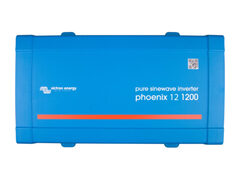
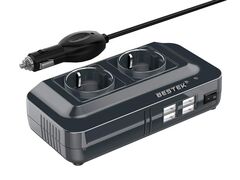
Against the Victron Phoenix 12/1200, the Renogy matches the nature of the signal (pure sine in both cases) and natively builds in a function that Victron reserves for a separate accessory, at under half the price and nearly a third of the weight of the 12/1200. In exchange, it offers no economy standby mode to match the Victron's 1-watt floor, and its warranty stops at 2 years against 5. Against the Bestek 200W, the comparison falls apart the moment a sensitive or motor-driven appliance comes into play: the Bestek's modified sine wave offers neither the same compatibility, nor of course the mains transfer function, reserved here for a much higher power bracket.
The Renogy therefore occupies a clear position: the power and automatic backup function of a higher-end inverter, the compactness and price of a more general-purpose model, at the cost of a standby draw and cable robustness a notch below the segment's premium reference.
Motorhome, boat, home backup: the right uses
This format and transfer function naturally suit three settings: leisure vehicles (motorhome, campervan, boat), an off-grid solar setup paired with a battery bank, and home backup power during a prolonged outage, wired to a battery and a way of recharging it.
In a motorhome or campervan, the mains priority function earns its keep the moment you switch between a campsite hook-up and the leisure battery alone: the unit switches over by itself, with no action needed when plugging in or unplugging. For home backup, it comfortably runs the essentials (a home router, lighting, chargers, a small compressor fridge) but replaces neither a generator nor a large domestic battery for cooking or heating loads. One point applies equally to all three uses: the IP20 rating calls for a dry compartment, never direct exposure to spray or splashing water, even aboard a boat.
Who this inverter suits, and who it does not
It suits, first and foremost, anyone who wants a genuinely reliable 230V socket for sensitive electronics, with automatic continuity through a mains outage, without paying the price or the weight of a dedicated backup inverter or a higher-end unit topped up with a separate transfer accessory. The budget stays contained for what the built-in mains priority function usually costs at much higher price points.
It suits less well anyone chasing the lowest possible standby draw for a setup left permanently connected unattended (a reference with an ECO mode will do better on that specific point), or anyone planning to install it somewhere damp without extra weatherproofing. For very occasional use at modest power, an entry-level modified sine inverter does the job for noticeably less money; the moment sensitive electronics or power continuity matter, this model's added cost earns its keep.