
The 2500A, and the engine class they cover
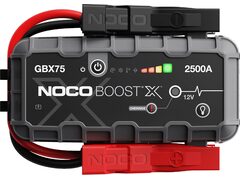
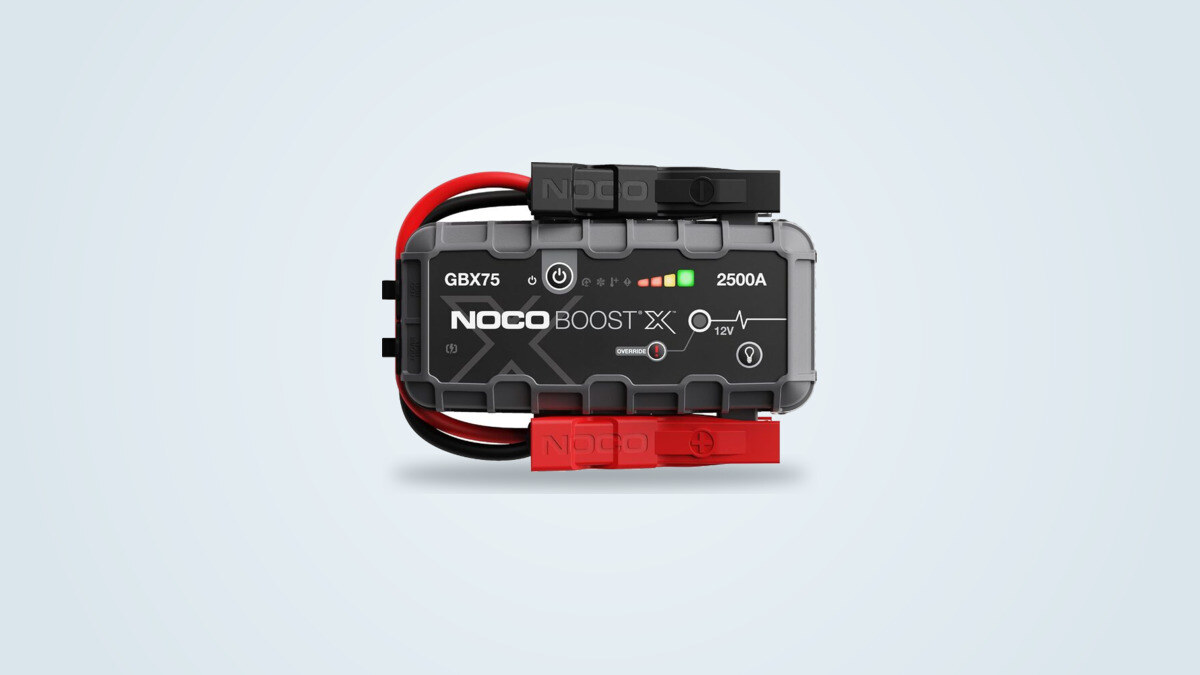
As with every jump starter, the figure printed large on the casing is a peak current: a very short electrical spike, not the current the unit sustains while the starter motor actually turns. The GBX75 is rated at 2500A, placing it above every younger sibling in the classic Boost range (GB20, GB40, GB50, GB70) and just below the GB150, the range-topper of the family.
On paper, this output class covers most of the vehicle park, up to a large diesel engine of 6.5 litres. Only the GB150 (3000A, 9L petrol, 7L diesel) goes further in the NOCO range.
One point deserves an honest mention: unlike some older boosters from the brand, no independent measurement of how long the GBX75 sustains a heavy current could be found for this exact model. The 2500A figure remains a peak rating set by the manufacturer, consistent with the stated engine class.
74Wh: the biggest battery ever fitted to a Boost
Under the electrical bonnet, the GBX75 carries a 74Wh lithium-ion battery. That is, to date, the biggest reserve across the whole Boost range covered on this site: more than triple the 24Wh of the GB20 and GB40, double the 35Wh of the GB50, and 32% more than the 56Wh of the GB70.
This reserve is not just a marketing figure. It directly explains two things. First, the number of jump starts rated per charge, up to 12, a deliberately cautious figure since a single start typically draws barely more than a fraction of a watt-hour: the margin allows for long cranks on a cold engine and occasional use of the torch or USB port. Second, a genuine backup capacity for electronic devices, covered further down.
Weight follows this jump in capacity: a rated 1.7 kg, against 1.11 kg for the GB40 and 1.22 kg for the GB50. The dimensions remain compact though (21.3 x 13.6 x 6.4 cm), and the unit fits without trouble in a boot or a large glovebox.
USB-C Power Delivery, the real novelty of the Boost X
This is what genuinely sets the GBX75 apart from its GB20-to-GB150 siblings: its USB-C IN/OUT port accepts and delivers up to 60W of Power Delivery 3.0, in both directions. On older references in the range, connectivity tops out at 10W over 5V, a trickle-charge power level meant for a phone, not a laptop.
In practice, the GBX75 can power or recharge a USB-C laptop at a credible speed, a function entirely absent from the rest of the classic Boost range. A second, regular USB-A port rounds things out, but stays capped at 5V and 2.1A, 10W at best, the same modest output as a GB40 or a GB70.
This asymmetry is worth knowing before buying: only one of the two ports genuinely benefits from the new generation. Plugging in two devices at once means one of them falls back to the older range's performance.
Fast charging comes with a condition missing from the box
The marketing promise is generous: from 0% to enough charge for a jump start in five minutes, and a full charge in 1.7 hours. Those figures are real, but they assume a precise condition the packaging does not highlight: owning a USB-C Power Delivery 3.0 charger able to supply 60W.
The box alone does not solve this equation: no mains charger comes with the unit (the full box contents are detailed further down in this review). To reach the maximum charging speed, you therefore need to already own a 60W USB-C PD charger, a recent laptop charger works fine, or buy a suitable one separately.
Without that proper source, the same port simply takes whatever it is given. Plugged into a basic 5W USB port, such as an old phone charger, a full charge climbs to roughly 20 hours, and up to 40 hours with an even weaker source, around 2.5W. The gap exceeds a factor of ten. Fast charging via a 12V car charger also requires the vehicle's engine to be running.
Cold weather, the axis that matters most in this family
On a jump starter, cold-weather resilience is not a secondary criterion: it is precisely when a vehicle battery is fading, on a winter morning, that the unit needs to deliver. The GBX75 is rated by the manufacturer for an operating range of -20 °C to 50 °C, identical to the rest of the Boost range.
| Scenario | Allowed range |
|---|---|
| Operation | -20 °C to 50 °C |
| Charging | 0 °C to 40 °C |
| Storage | -20 °C to 50 °C (average) |
One feature is worth detailing, as it genuinely changes the experience in severe cold: a dedicated indicator light, the “Cold” LED, warns the user before the unit becomes unusable. Lit solid, it signals the GBX75 is still working but approaching its lower limit. Flashing, it means it is too cold to jump-start a vehicle: only the torch function remains available while the unit warms up.
This graceful, staged behaviour, rather than an abrupt, silent shutdown, is a real difference from a unit that would simply stop responding without explanation. It does not remove a simple precaution though: charging itself stops at 0 °C, a narrower range than operation. A GBX75 left in a vehicle all winter can therefore perfectly well jump-start a car, yet will refuse to recharge until it is back above freezing.
With 74Wh of reserve, nearly triple that of the GB40, the GBX75 has a more comfortable energy margin before entering a critical voltage range. No independent measurement of current degradation at low temperature was found for this exact model though: this larger margin remains a reasoned expectation, not a verified figure.
UltraSafe 2.0: safety at connection, and its limits
The GBX75 inherits UltraSafe technology, here in its 2.0 version: the unit delivers no current until it has recognised a correctly connected 12V battery, which removes the risk of a spark at clamp contact and neutralises reverse polarity. The manufacturer states improved thermal and power management over the previous version of this protection, used across the rest of the Boost range.
This automatic detection works down to 3 volts. Below that threshold, the start indicator stays off and the unit assumes no battery is connected. A manual mode, switched on deliberately, then forces the output, but it fully disables anti-spark and anti-reverse-polarity protection. This mode targets extreme cases, a very deeply discharged battery, and requires a careful manual check of polarity before connecting.
A compatibility limit applies too, shared across the whole range but worth knowing: the GBX75 is restricted to 12V lead-acid batteries (standard, AGM, gel), and the manufacturer explicitly advises against any other chemistry, including the lithium starter batteries fitted to some motorcycles and a few recent vehicles.
On physical protection, the casing is rated IP65, with an important caveat: that seal only holds with the ports closed. A unit left open, cable connected, in a damp boot no longer benefits from the same protection.
Power bank function: a real rescue, not a spare battery
Thanks to its 74Wh and its 60W USB-C port, the GBX75 is the first reference in the Boost range that can genuinely recharge a laptop, not just a phone. NOCO rates it for up to four full smartphone charges on a single charge of the GBX75.
Unlike a figure that has proven questionable on older, smaller-battery models, this one stands up reasonably well to a simple calculation. A recent smartphone battery typically totals between 15 and 20Wh. With a 74Wh reserve and after usual conversion losses, four full charges is a reasonable estimate, where a 24Wh unit like the GB40 can no longer live up to the same claim.
The same reservation applies as elsewhere in the range: draining the GBX75 to rescue a phone leaves it without its primary function, jump-starting a vehicle, exactly when it may be needed most. The power bank function is a genuine rescue tool, not a substitute for a dedicated power bank over an extended trip.
What is actually in the box
The GBX75 ships with clamps built into the casing rather than separate jumper cables, a 60cm USB-A to USB-C cable, a second, equal-length USB-C to 12V socket cable, and a microfibre storage pouch. The manual and warranty documents complete the set.
Two omissions are worth knowing before buying. First, no mains charger is included (see above): there is no way to reach the maximum charging speed without already owning one or buying one separately. Second, the supplied pouch is a simple fabric bag, not a rigid carry case: it protects against dust and light scuffs, not against impacts.
The built-in, non-detachable clamps bring a matching advantage and drawback: they cannot be lost or swapped for another set, but they also cannot be replaced on their own if damaged, without going through the manufacturer's after-sales service.
GBX75, GB70 or GB150: which one to choose
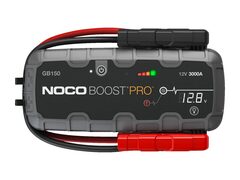
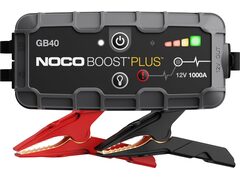
Within the NOCO range, the GBX75 sits in an unusual spot: it costs more than the GB150, even though the latter delivers a higher peak current (3000A versus 2500A) and covers a wider engine class (9L petrol and 7L diesel, versus 8.5L and 6.5L). The table below places the closest references, at prices observed in early September 2026.
| Criterion | GB40 | GB70 | GBX75 | GB150 |
|---|---|---|---|---|
| Price observed | £104.33 | £184.28 | £258.90 | £206.51 |
| Peak current | 1000 A | 2000 A | 2500 A | 3000 A |
| Petrol | 6.0 L | 8.0 L | 8.5 L | 9.0 L |
| Diesel | 3.0 L | 6.0 L | 6.5 L | 7.0 L |
| Battery | 24 Wh | 56 Wh | 74 Wh | not stated |
| Charging port | USB 5V/2.1A | USB 5V/2.1A | USB-C PD 60W | USB 5V/2.1A |
What the GBX75's price premium actually buys is not more cranking power: it is a different technical generation, a battery notably bigger than the GB70's, a USB-C Power Delivery port absent from both the GB70 and the GB150, and UltraSafe 2.0. For starting the biggest possible engine at the lowest price, the GB150 remains the more rational option. For a genuine laptop rescue function alongside modern fast charging, the GBX75 becomes the sound trade-off, provided you accept its higher entry price and the likely purchase of a suitable USB-C charger.
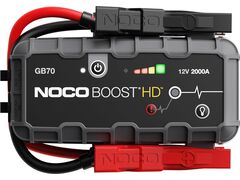
Against the GB70, its closest cousin on peak current, the GBX75 adds 500A, 18Wh of extra battery and, above all, USB-C Power Delivery, for a price gap of roughly £75 at current prices.
Reliability, warranty and what owners report
The GBX75's standard warranty runs one year from the date of purchase, a term extended by law to a minimum of two years for buyers in the European Union, the European Economic Area and the United Kingdom, under local consumer law rather than as a goodwill gesture from the manufacturer.
Over time, user feedback concerning several older references in the Boost range reports cells losing charging capacity beyond the first or second year, sometimes just after the standard warranty expires. This feedback concerns the range as a whole rather than the GBX75 by name, and no report specific to this model was found at the time of writing. It remains a reasonable trust reservation to bear in mind though, for an item whose very nature is to sit unused, sometimes for years, before being called on once.
No official recall of the GBX75 has been identified to date.
Who the GBX75 suits, and who it does not
The GBX75 targets a specific profile: the SUV, van, 4x4 or big-diesel driver who wants both enough output to start a large engine and a genuine backup reserve for electronic devices on the move. It also suits anyone who already owns a capable USB-C Power Delivery charger (a recent laptop, a high-end phone charger) and can therefore use its fast charging without an extra purchase.
It suits less well anyone chasing the single highest cranking current at the lowest price: the GB150, cheaper as things stand, does better on that one measure alone. It also suits less well anyone who only owns a basic USB charger or an old computer port, condemned to charges of several hours, or even several dozen hours, far from the promise on the box. Finally, for a simple petrol city car, the more affordable end of the Boost range (GB20 or GB40) is more than enough: the GBX75 would then be an oversized purchase.
What remains is the core of it: with the biggest battery in the range, a genuinely fast USB-C port and an output class that covers the vast majority of diesel engines on the road, the GBX75 keeps an honest promise, provided buyers know in advance the condition attached to its fast charging.