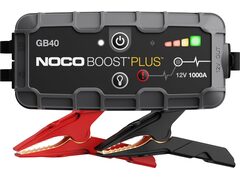

The 1000 A, and what they actually measure
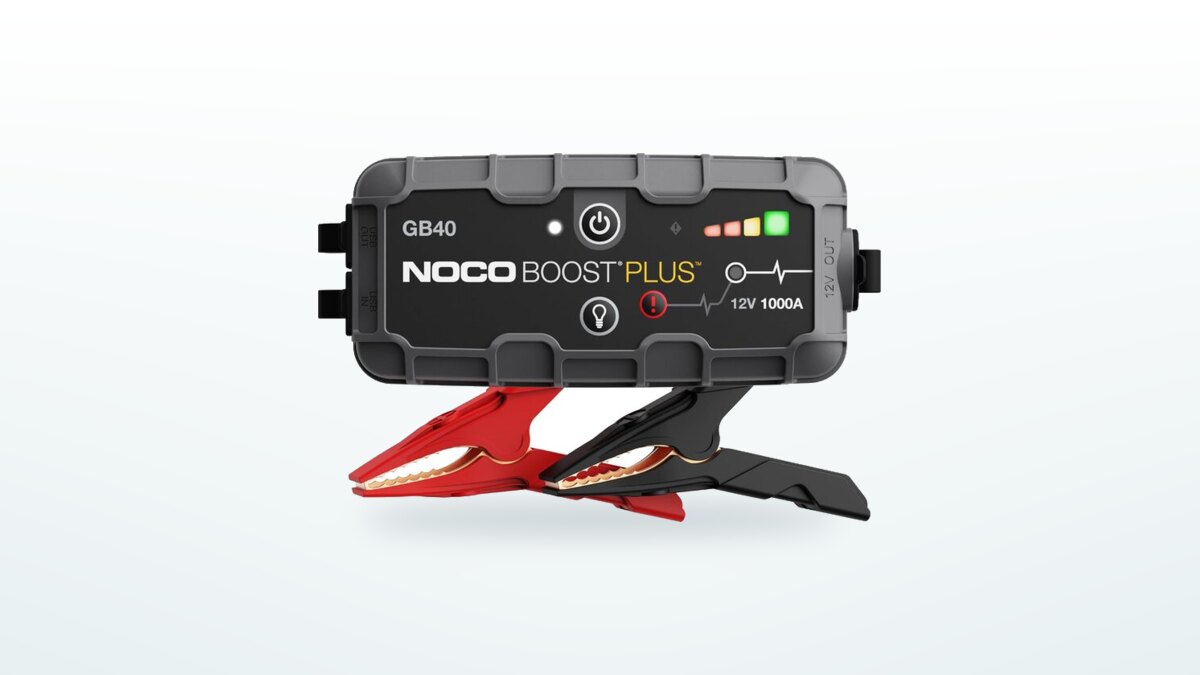
It is the figure printed large on the case, and also the one that causes the most confusion. The GB40's 1000 A is a peak current: an instantaneous spike, measured over a fraction of a second. It is not the current the unit sustains while the starter motor turns.
Yet starting an engine is not decided by a spike. A starter motor draws its current for several seconds, and a cold, tired or poorly tuned engine may need two or three attempts. What matters is therefore how long the unit holds a high current without collapsing. That is an entirely different exercise, and it is where the GB40 genuinely stands out.
Under a sustained demand of 300 A at room temperature, it holds for more than ten seconds without weakening. Most jump starters of this size give up between two and five seconds.
The 24 Wh, and why that figure matters
Behind the power sits the tank. The GB40's holds 24 Wh. That is little in absolute terms, and it is normal: a jump starter does not need much energy, it needs to release it very fast. One start consumes barely more than a watt-hour.
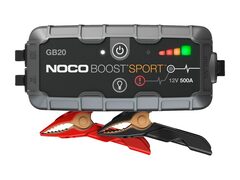
The figure still deserves to be known, for one precise reason. The GB20, half as powerful and sold around ten euros less, carries exactly the same 24 Wh battery. Same casing, same dimensions, same 100-lumen light, same ports.
What you pay for when moving from the GB20 to the GB40 is therefore not runtime: it is the power stage and the clamps. The GB40 doubles the peak current, goes from 4.0 to 6.0 L on petrol and becomes usable on a diesel up to 3.0 L, which the GB20 does not allow at all. For around ten euros the step is well worth it, but it will not translate into more starts.
This also explains why both models quote the same number of starts, around twenty. That number depends on the tank, not on the power. And it assumes short starts on an engine that responds quickly: a few long attempts on a cold engine eat into the reserve far faster.
The four smartphone recharges, a figure that has aged
The GB40 doubles as a power bank, and the claim comes with a number attached: up to four smartphone recharges. That promise was accurate when it was written. It no longer is.
The arithmetic is simple and needs no instrument. The total reserve is 24 Wh. A current smartphone battery sits between 15 and 20 Wh. Once conversion losses are deducted, unavoidable when the pack voltage is turned into 5 V, what remains covers one full charge, not four. The four recharges applied to phones with 5 to 6 Wh batteries, a generation now long gone.
A throughput limit adds to this. The USB output is capped at 5 V and 2.1 A, roughly 10 W. A modern phone routinely accepts three to four times that. Charging a smartphone from the GB40 works, but takes considerably longer than with an ordinary charger.
Charging: three hours at best, twelve at worst
This is where the GB40 shows its age most clearly. Its charging socket is indeed USB-C, but it is capped at 5 V and 2.1 A, around ten watts. The connector is modern, the speed is not: there is no fast charging.
Fill time therefore depends directly on the source used, and the spread is considerable.
Three hours for a device whose battery holds only 24 Wh is slow. The useful reference here is the same manufacturer's next generation, the GBX45, which accepts USB-C up to 60 W and fills in a fraction of that time, while doubling as a fast power bank. The GB40 keeps the connector without the throughput.
One further constraint is stated by the manufacturer: charging and discharging the unit at the same time is not advised. You therefore cannot leave it permanently connected to a socket in the vehicle while using it.
The cold, and why it lands at the worst moment
A car battery almost always gives up at the same moment: the first real frost. So it is in the cold that a jump starter has to convince, and that is precisely where the GB40 loses its edge.
At room temperature it dominates its group. At -12 °C, it is no longer among the units delivering good results. The mechanism is well known and applies to every lithium battery: cold raises internal resistance, which limits the current the pack can supply. A compact device with few cells copes with that degradation less well than a larger one.
| Situation | Permitted range |
|---|---|
| Operation | -20 to +50 °C |
| Charging | 0 to +40 °C |
| Storage | -20 to +50 °C |
The table holds a constraint few buyers anticipate. The GB40 operates down to -20 °C but only recharges above 0 °C. In other words, a unit left in a car through winter may well start the engine, but will refuse to recharge until it has been brought back into the warm. After an early-morning rescue, it has to come indoors to be topped up.
UltraSafe, and its trade-off
This is the GB40's strongest argument, and it is deserved. The unit delivers no current until it has recognised a properly connected battery. The result: no spark when the clamps touch, and no consequence if you swap red and black. For someone who has never jump started a car, that is a genuine safety net, where badly connected conventional cables can destroy electronics.
That intelligence comes with a direct trade-off, and it is better understood before the breakdown than during it. To recognise a battery, the GB40 must measure at least 2 volts across it. Below that, it considers nothing to be connected and refuses to operate. A deeply discharged battery, left all winter or drained by an interior light, falls precisely below that threshold.
The manufacturer has provided a way round: a manual mode, enabled by a three-second press, which forces the output on. But that mode disables every protection, including reverse-polarity safety, and using it voids the warranty. So in the hardest case you end up with a device as risky as ordinary jump leads, and with no cover.
Where to actually keep it
The sales pitch is clear: a pocket-sized device you forget in the glovebox until the day it saves you. That holds for the size, at 196 millimetres long and 1.11 kg. It is more debatable for preservation.
Permitted storage runs from -20 to +50 °C, and the manufacturer specifies that the unit should be stored indoors when not in use. Those two statements sit awkwardly with a car interior, which goes well beyond 50 °C in summer sun and drops below 0 °C in winter, the range in which charging becomes impossible. A lithium battery held at high temperature loses capacity irreversibly.
The IP65 rating also deserves close reading: it applies with the ports closed. The caps protecting the sockets are part of the sealing, and a unit left open in a damp boot is no longer protected.
GB20, GB40 or GB50: which one to take
The GB40 is the range's best seller, but it is closely flanked. Here is what actually separates them, at prices observed in mid-August 2026.
| Criterion | GB20 | GB40 | GB50 | GBX45 |
|---|---|---|---|---|
| Observed price | 82 € | 91 € | 132 € | 139 € |
| Peak current | 500 A | 1000 A | 1500 A | 1250 A |
| Battery | 24 Wh | 24 Wh | 35 Wh | 31 Wh |
| Petrol | 4.0 L | 6.0 L | 7.0 L | 6.5 L |
| Diesel | not advised | 3.0 L | 4.5 L | 4.0 L |
| Light | 100 lm | 100 lm | 200 lm | 100 lm |
| Charging input | 5 V, 2.1 A | 5 V, 2.1 A | 5 V, 2.1 A | USB-C up to 60 W |
| Weight | 0.95 kg | 1.11 kg | 1.22 kg | 0.98 kg |
Against the GB20, the nine-euro gap is the best money in the range. It doubles the peak current and unlocks diesel up to 3.0 L, which the GB20 cannot handle. Unless you will only ever rescue a small petrol car or a motorbike, the GB40 is the sensible entry point.
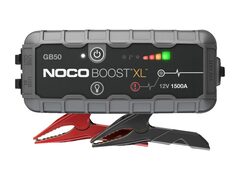
Against the GB50 the gap is real and justified less often. Forty euros more buys 50 % more peak current, a 35 Wh battery, a light twice as bright and diesel up to 4.5 L. That is the right choice for a large diesel, a van or professional use. For a city car or a hatchback, it is paying for headroom you will never use.
The GBX45 is the interesting case. At around fifty euros more than the GB40, what it mainly brings is what the GB40 lacks: a USB-C input up to 60 W, so a recharge on an entirely different scale, and an output to match that turns it into a genuine power bank. It is even lighter. If the GB40's slow charging bothers you, that is where to look, rather than towards more amps.
Warranty and compatibility: two things to check
Two points often go unnoticed at purchase and deserve to be stated plainly.
The warranty runs for one year. That is short for a device at this price, and above all for an object whose very nature is to sit unused for years before it serves. A lithium battery ages even when it is never called upon, and the typical failure of a jump starter is not a breakage but a loss of capacity that shows up after several seasons, well beyond the cover.
The GB40 is for 12 V lead-acid batteries only, which covers conventional, AGM and gel batteries, so the vast majority of the car fleet. It is not intended, however, for the lithium starter batteries found on some motorbikes, some competition vehicles and a few recent models. Nor does it suit the 6 V circuits of classic cars or the 24 V systems of trucks.
Who it suits, and who it does not
The GB40 does very well the job it was designed for. Its limits are not about starting itself but about everything around it: the size of its battery, its charging speed and its behaviour in the cold.
It suits the driver who wants insurance in the boot for a city car, a hatchback or a small-capacity diesel. It suits the driver who is uneasy with mechanics, whom the reverse-polarity protection shields from a wrong move. It suits vehicles that are driven rarely, a classic car, a stored motorhome or a boat, where the battery goes flat from lack of use. And it suits as a useful gift, because it demands no particular skill.
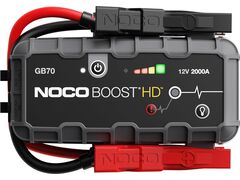
It suits poorly a large diesel, a van or repeated professional use: the GB50 or a bigger model will be more comfortable. It suits poorly anyone living in a very cold region, where its drop in performance below -10 °C and the impossibility of recharging below 0 °C become handicaps. And it suits poorly anyone hoping for an all-round power bank: with 24 Wh and 10 W out, it rescues a phone, it does not keep it going.
What remains is the essential, and it explains its success: on the day the battery dies, it holds a high current longer than most of its rivals, and it does so without your having to think about the connections. For an object bought in the hope of never using it, that is exactly the right compromise.