
What the claimed 10,000 mAh are really worth
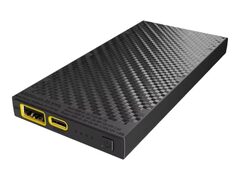
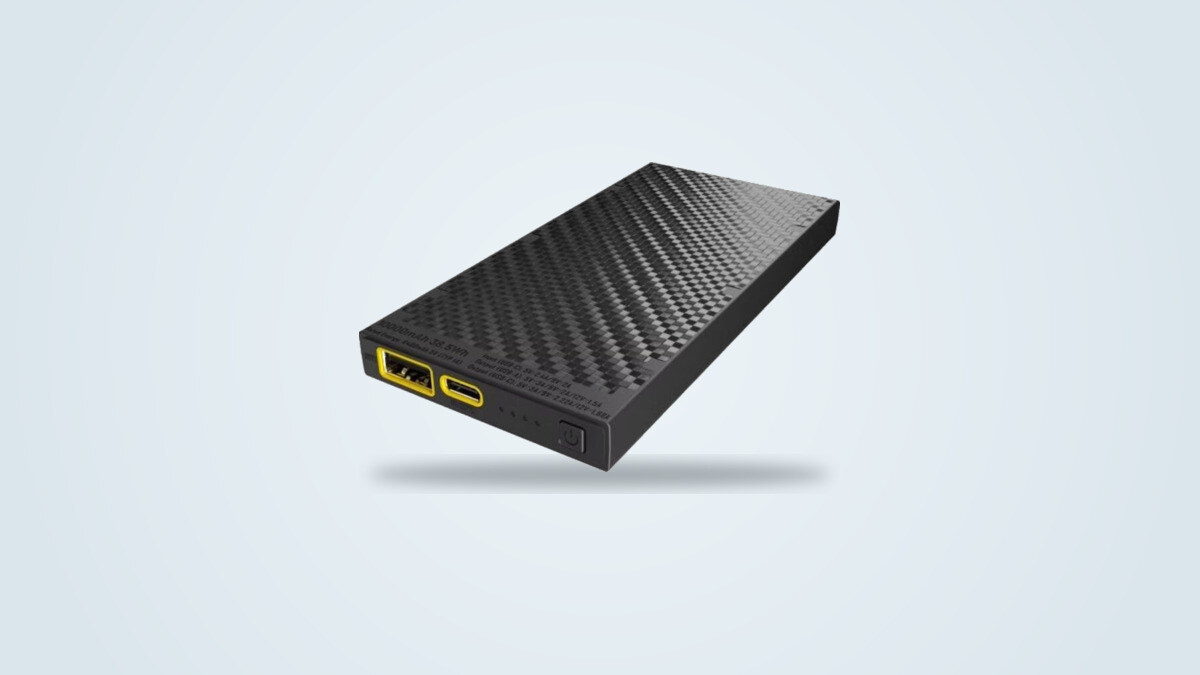
The carbon fibre shell prints the two figures that actually matter in plain sight: 10,000 mAh at 3.85 V, or 38.5 Wh of nominal energy, and a usable energy of 6,400 mAh at 5 V/1 A, or 32 Wh. This second figure is not a rounded marketing estimate, it is printed on the shell itself next to the input and output specifications. Delivered energy sits between 31.5 and 33.6 Wh, a range that brackets the claimed 32 Wh almost exactly.
This 83% figure sits in the upper range for the category: a voltage conversion inevitably uses up part of the stored energy, and many compact power banks settle for 65 to 75% under the same conditions. In practical terms, these 32 Wh fully recharge a current smartphone about twice over, with some to spare, or recharge a head torch several times.
Worth noting for travellers: at 38.5 Wh nominal, the NB10000 stays comfortably under the 100 Wh cabin limit that most airlines allow without special authorisation.
20 W and 18 W apart, 15 W with two devices plugged in
On paper, the sum is tempting: 20 W on the USB-C port, 18 W on the USB-A port, suggesting nearly 38 W available when two devices are plugged in at once. Reality is different: used together, both ports cap at 15 W total (5 V/3 A), whatever device is plugged into each output.
| Configuration | Maximum power |
|---|---|
| USB-C alone | 20 W (5 V/3 A, 9 V/2.22 A, 12 V/1.68 A) |
| USB-A alone | 18 W (5 V/3 A, 9 V/2 A, 12 V/1.5 A) |
| Both ports together | 15 W total (5 V/3 A) |
The most likely mechanism is a shared limit on the cell's maximum discharge current between the two outputs, an electrical constraint rather than an arbitrary manufacturer choice: a similar layout shows up on other compact power banks from the same brand. In practice, this 15 W ceiling remains plenty for two smartphones charging at the same time, but it rules out fast-charging two more demanding devices together, such as a tablet and a laptop.
The USB-C port deserves a separate mention: it is bidirectional, usable both to charge a device and to recharge the power bank itself, which saves hunting for a second cable or a second port for input.
Weight and size, the headline argument for this power bank
At a claimed 150 g for 10,000 mAh, the NB10000 aims for the top of its category, and that claim holds up well. Real weight sits between 150 and 153 g depending on the unit, a negligible spread that points to consistent manufacturing from one unit to the next.
The dimensions hold up just as well against the claimed spec (121.9 x 59 x 10.6 mm), within half a millimetre. This ultra-thin format, close to a thick deck of cards, slips into a jacket pocket or a side pocket of a bag without adding noticeable bulk.
The trade-off for this thinness shows up in the grip: without rounded corners, the shell feels a little slippery, and its sharper-than-average edges can wear out a soft storage pouch faster over time. That is a trade-off that comes with such a thin format, not a build flaw as such.
Recharging the power bank itself, and pass-through charging
Input, exclusively over USB-C, caps at 18 W (5 V/2.4 A or 9 V/2 A). A full recharge, from 0 to 100%, takes roughly 3 to 4 hours depending on the charger, a spread explained by the usual charging curve of lithium cells: current stays high through the first part of the charge, then tapers off as the cell approaches full to protect it.
Pass-through charging, which lets a connected device draw power while the bank itself recharges, works as expected. That is a useful function while travelling or during a break with only one power point available for two needs.
Low current mode and the button lock-up: two features worth a nuance
Low current mode addresses a real usability problem: many power banks automatically cut their output when the connected device draws too little current, making it impossible to charge earbuds or a smartwatch. This mode, switched on manually, keeps the output active for these small loads. Its benefit stays marginal, though, once the connected device is already recognised normally by the standard port: its real usefulness is for the very small loads that would otherwise trigger an automatic cut-off, not for a general gain in charging speed or efficiency.
A second point is worth knowing before buying: holding the power button down for roughly 15 to 20 seconds or more, particularly after switching on low current mode, triggers a locked state. A single blue LED stays lit, the power bank stops delivering any current regardless of its charge level, and it no longer shows its status. The only way out is to reconnect the unit to a power source to reset it. This is not a hardware failure, but a real firmware quirk worth knowing about before being caught without a backup option at the wrong moment.
The three-LED gauge, the most widely flagged interface weakness
Charge level shows on three blue LEDs, a coarser scale than the four or five steps common on rival power banks. This three-step ceiling means small, closely spaced LEDs that are hard to tell apart in daylight, with their single blue colour making them blur together further. At full charge, the display can even give the misleading impression that the bank is only half full.
This is an interface shortcoming, not a functional one: it does not call the reliability of the charge itself into question, only how comfortably the remaining level can be read at a glance, an area where several newer rivals do better with a screen or a percentage readout.
Water resistance and shock resistance: what holds up, what does not
The IPX5 rating is confirmed by the manufacturer: it protects against water splashes and low-pressure jets, in rain or from spray, but not against submersion. The initial X also means no dust protection is claimed, a nuance often left out of marketing copy.
On knocks, the woven carbon fibre shell holds up well to everyday use: it stays looking almost untouched after several accidental drops and repeated outdoor outings, with the shell's weave pattern effectively hiding small surface scratches. The shell shows no visible damage after a drop of 30 to 35 in (75 to 90 cm).
On temperature, the manufacturer places the operating range between 14 °F (-10 °C) and 104 °F (40 °C). In very cold weather, efficiency drops by around 9%, a behaviour expected of any lithium cell and not specific to this model: it is worth carrying extra capacity margin in freezing conditions.
Against other Nitecore power banks in the same class
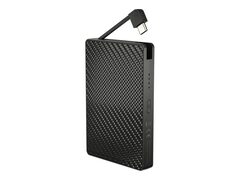
Nitecore spreads its carbon lineup across several close-sounding references, which creates real confusion when shopping. Against the Pocket 10000, same nominal capacity and the same family of materials, the NB10000 has a clear edge: its real-world efficiency (83%, 32 Wh usable) slightly beats the Pocket 10000's (around 80%, 31 Wh usable), and it offers a proper USB-A port on top of USB-C, where the Pocket 10000 is limited to a single USB-C port paired with a built-in cable. In exchange, that built-in cable avoids a common travel mishap, a convenience the NB10000 does not offer.
| Criterion | NB10000 | Pocket 10000 | NB20000 |
|---|---|---|---|
| Nominal capacity | 10,000 mAh (38.5 Wh) | 10,000 mAh (38.5 Wh) | 20,000 mAh |
| Usable energy at 5 V | 32 Wh (83%) | 31 Wh (around 80%) | uncertain efficiency, 40 to 74% depending on conditions |
| Weight | 150 g | 160 g | 288 g |
| Ports | USB-C 20 W + USB-A 18 W | USB-C 22.5 W + built-in cable | 2x USB-C, no USB-A |
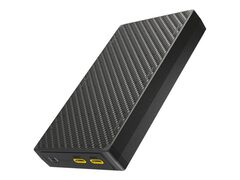
Against the NB20000, the choice mostly comes down to need: twice the nominal capacity, but a real-world efficiency that is far less stable from one measurement to another, for a nearly doubled weight and size. The NB10000 remains the most well-rounded of the three for a use centred on a smartphone and small accessories, while the NB20000 mostly earns its keep for several days without a recharge or for powering hungrier devices.
Against generalist rivals and the next generation
Against generalist power banks of the same capacity, the positioning gap is clear: a typical plastic 10,000 mAh power bank usually costs three to four times less, but comfortably exceeds 150 g, often past 200 g, and claims no water protection at all. The NB10000 is therefore mainly selling a weight and toughness advantage, not a power or price advantage: on those last two points, more generalist rivals do just as well, sometimes better.
Nitecore has also already moved this line beyond this generation: a newer version, a few grams lighter and rated IPX7 (brief submersion, versus splash protection only for this model's IPX5), is already on sale. The NB10000 covered here is therefore no longer the flagship of its own family, which can justify a discount on clearance or secondhand stock against a newer version sold at close to the same price.
Who it suits, and who should look elsewhere
The NB10000 wins over buyers with a specific use in mind first: hiking, trail running, bikepacking and light travel, where every gram and every millimetre of thickness counts, with capacity that comfortably covers several days of top-ups for a smartphone and small accessories. Its resistance to splashes and everyday knocks also makes it a sound choice for regular outdoor use, short of submersion.
It suits less well anyone looking to regularly fast-charge a laptop or tablet, or to plug in two demanding devices at once: the 15 W combined ceiling and the 20 W single-port maximum trail behind newer power banks offering 45 W or more. For a more sedentary use where light weight is not the priority, a heavier but cheaper and more powerful power bank will offer better value for the use case.