
What the advertised 6000mAh are really worth
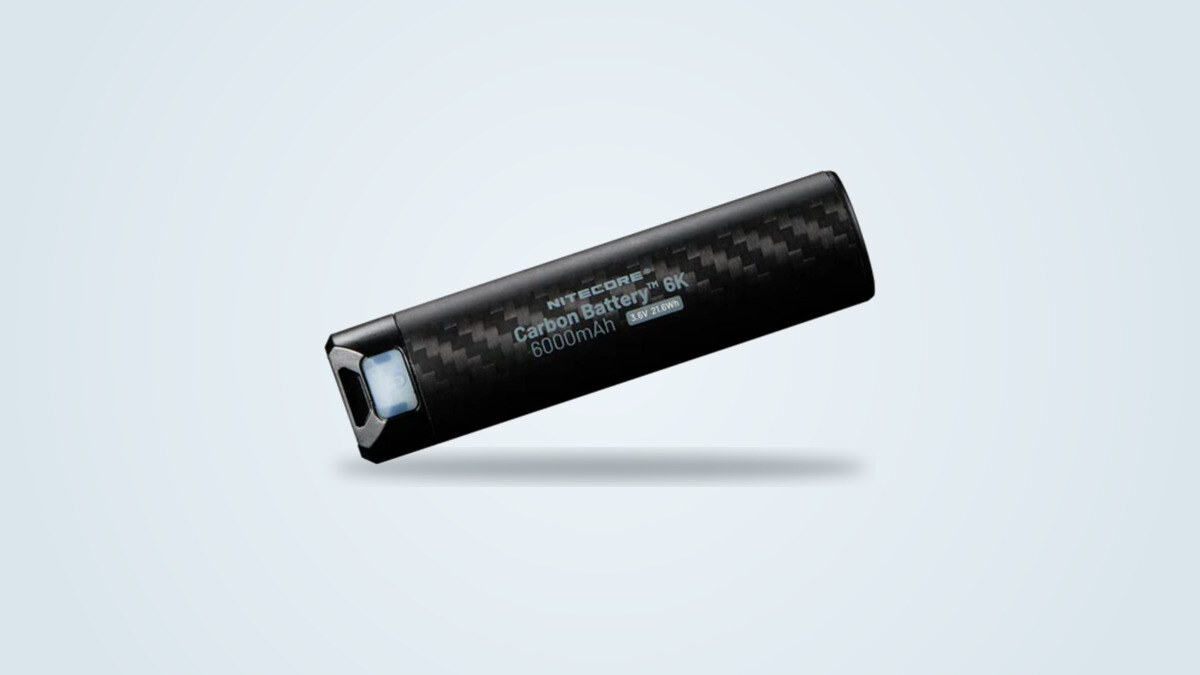
Nitecore rates the Carbon 6K at 6000mAh at 3.6V, or 21.6Wh nominal: the cell's raw capacity, before any conversion. That figure says nothing about the energy actually available at the USB-C port, which outputs 5V rather than 3.6V. On this point the manufacturer is explicit in its own technical datasheet: the declared usable energy is 3700mAh at 5V (typical value, at 1A), or roughly 18.5Wh.
The ratio between the two, around 86%, matches the efficiency of a boost converter feeding a standard USB-C port: part of the stored energy goes into the voltage conversion itself and is lost as heat rather than coming out of the port. That is not a flaw specific to the Carbon 6K, it is simply the physics of any single-cell power bank, but the figure is worth knowing before buying rather than discovering it in use.
In practice, 18.5Wh covers one full charge of a recent flagship smartphone (a leading model typically carries between 14 and 19Wh of battery), rarely two. The Carbon 6K therefore works as a one-off top-up battery, not as a buffer for several days of autonomy.
A single 21700 cell, in a shell that cannot be opened
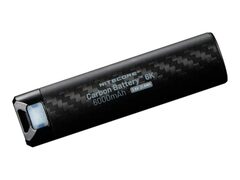
The carbon-fibre shell of the Carbon 6K houses a single cylindrical cell in the 21700 format, the same type of cell Nitecore sells separately for its flashlights. That choice explains much of the product's behaviour, for better and for worse.
On format, a single cylinder roughly 21mm in diameter and 70mm long fits inside a 22.8 x 90mm tube once the shell and the conversion electronics are added. On weight, the absence of a second cell, of a balancing circuit between cells, and of a multi-compartment shell explains the 88g figure: measured against the official capacity, that works out to a calculated energy density of 245Wh per kilogram (21.6Wh for 0.088kg), one of the best ratios on the market for this format.
The trade-off for this simplicity: the carbon shell is sealed and cannot be opened, according to the manufacturer itself. There is therefore no way to replace the cell at end of life, unlike a bare 21700 cell bought separately and usable in an external charger. The Carbon 6K gets replaced as a whole once its capacity has dropped too far for its intended use.
The real cost in use: a full charge in 3.5 hours, for just 10W
Charging the Carbon 6K fully takes about 3.5 hours (210 minutes) through its single USB-C port, capped at 10W (5V, 2A) both in and out. This figure, stated by the manufacturer, is consistent with the power on offer: at a constant 10W, filling 21.6Wh would take a little over two hours in theory, and a lithium-ion cell's charge curve slows sharply in its final third, which explains the gap with the stated 3.5 hours.
For such a modest capacity, this 10W ceiling is low by current standards: many small power banks in a comparable class now charge over USB-C at 18 or 30W, bringing a full charge down to under ninety minutes. By comparison, a power bank of equal capacity fitted with a modern 20W USB-C port would halve that time, without any noticeable change in size. The Carbon 6K, meanwhile, ties up the port for over three hours for barely 18.5Wh of usable energy, a real dead time for anyone counting on it for a quick top-up between two activities.
The real friction point: a shell that gets warm on charge
The Carbon 6K's carbon-fibre shell is fully sealed, with no vent whatsoever and no exposed metal surface to dissipate heat. Yet the voltage conversion carried out by the internal electronics (from the cell's 3.6V up to the USB-C port's 5V, and the reverse on charging) necessarily gives off part of the energy as heat, a phenomenon common to any power bank but usually eased by a larger or vented shell.
Here, the small internal volume around a single 21700 cell concentrates that heat rather than spreading it out: the shell warms up noticeably during a full charge, more than a flatter, wider power bank of equal capacity would. This is not a safety issue, the cell stays within its normal thermal operating envelope, but it is a real sensation to the touch that can surprise on first use.
Its real purpose: extending the runtime of Nitecore 6K headlamps
Beyond topping up a smartphone, the Carbon 6K's primary purpose is to extend the runtime of Nitecore's 6K-series headlamps, including the NU43, NU45, HC65 UHE and HC70 UHE. Connected by USB-C cable to one of these headlamps, it runs a priority circuit that draws on its own cell's energy first, before calling on the headlamp's internal battery.
The mechanism is simple but effective for its intended use: on a long night outing on the trail, underground or at camp, it doubles or triples the available lighting time without needing to open up the headlamp or fumble for a spare cell in the dark. The headlamp keeps working normally once the Carbon 6K is spent, with its own cell then taking over.
It is this dual function, rather than smartphone charging alone, that justifies the Carbon 6K's positioning and price against general-purpose power banks of similar capacity. For anyone without a compatible Nitecore headlamp, that argument disappears entirely and the buying calculation changes completely.
IP68 and impact resistance: a promise the carbon fibre keeps
The IP68 rating allows for accidental submersion down to 2 metres, and the manufacturer states impact resistance for drops of up to 1 metre. Both claims fit the outdoor use the product targets: trail running, kayaking, caving, hiking in the rain.
The woven carbon fibre making up the shell contributes to that resistance while staying very light, a trade-off rarely achieved with ordinary plastic of the same thickness. The flip side of this sealed construction has already come up: no opening, no visible screw, so no repair is possible for an internal failure once the manufacturer's warranty, set at one year, has run out, a duration worth weighing against the Carbon 6K's contained purchase price, noticeably lower than that of the other carbon-fibre power banks in the same catalogue.
| Protection | Stated level |
|---|---|
| Water resistance | IP68, submersion up to 2m |
| Impact resistance | Drops up to 1m |
| Manufacturer warranty | 1 year |
Minimal connectivity: one port, no pass-through, no cable in the box
Connectivity is limited to a single USB-C port, used alternately for charging and for output: there is no way to charge the Carbon 6K while powering another device at the same time, a pass-through function that is absent by design on a single-port product. No cable is included in the box, and there is no USB-A port for older accessories.
Remaining charge is shown through three red LEDs on the front: three steady lights signal a full charge, two steady plus one flashing means roughly 70%, and a single flashing light means roughly 30%. No precise percentage, no screen, but a quick read that is enough for the intended use. That same light, left in continuous flashing mode, also doubles as a night-time safety marker, a genuine plus for finding your way at camp or on a night hike.
Against the rest of the Nitecore range: NB10000, Pocket 10000 and NB20000
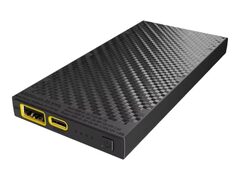
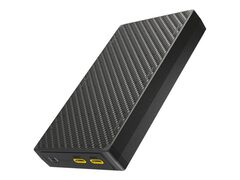
The Carbon 6K is not an outlier in Nitecore's catalogue: three other carbon-fibre power banks share the same lightweight philosophy, at different capacity tiers.
| Criterion | Carbon 6K | NB10000 | Pocket 10000 | NB20000 |
|---|---|---|---|---|
| Capacity | 6000mAh | 10,000mAh | 10,000mAh | 20,000mAh |
| Weight | 88g | 150g | 160g | 291g |
| Max power | 10W | 20W | 22.5W | 22.5W |
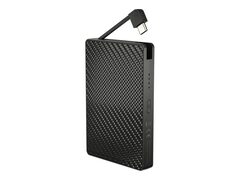
| Built-in cable | No | No | Yes | No |
| Price observed | £30.13 | £51.98 | £62.95 | £75.19 |
The choice mostly comes down to use: the Carbon 6K stays the lightest and cheapest of the group, ideal alongside a headlamp or for a one-off top-up. The Pocket 10000 adds a built-in cable and doubles the capacity for 72g more. The NB10000 targets the same outdoor use with more energy on tap. The NB20000 moves into a different category altogether, aimed at long-haul autonomy at the cost of a notably higher weight. None of these three other power banks, however, offers the headlamp-extension function unique to the Carbon 6K.
Reliability and warranty: what we know, what we don't
Nitecore first made its name as a maker of flashlights and headlamps, and that background directly explains why the Carbon 6K exists: it was designed first and foremost to go with those lamps, with the general-purpose power bank role bolted on as a secondary feature. Power banks in their own right are a more recent extension of the brand's catalogue, and that history also explains why the connectivity stays so basic next to power banks designed from the outset as stand-alone products: it started life as a lamp accessory, with the power bank function grafted onto it rather than the other way round.
The manufacturer's warranty is set at one year, shorter than some other products in the Best Batteries catalogue that carry an 18 or 24 month warranty. No recall or safety notice has been identified for this model to date. Beyond these points, real blind spots remain: no independent teardown has confirmed the exact make of the 21700 cell used or of its management circuit, and no complete acoustic or thermal measurement protocol has been found for this specific model.
None of this is a negative signal, just blind spots that limit what can be said about how the Carbon 6K holds up beyond its contractual warranty.
Who the Carbon 6K is really for
The Carbon 6K is aimed first at a specific use case: owners of a Nitecore 6K-series headlamp looking to double their night-time runtime, hikers or trail runners for whom every gram counts, cavers or kayakers needing a water-resistant backup, or everyday-carry fans wanting a spare battery that goes unnoticed in a pocket.
It suits far less well anyone after a general-purpose power bank for heavy daily use: 10W is not enough for fast-charging a recent smartphone, let alone a laptop, the lack of pass-through makes juggling several devices at once harder, and roughly 18.5Wh of usable energy is spent on a single phone charge. For those uses, a more general-purpose power bank, from Nitecore or another brand, even at the cost of extra weight, remains the more sensible choice.