
A voltmeter with coloured thresholds, not a conductance analyzer
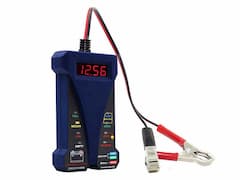
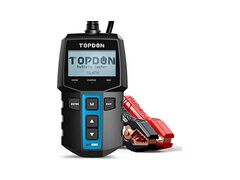
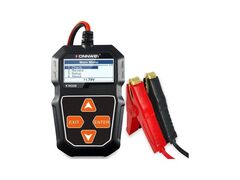
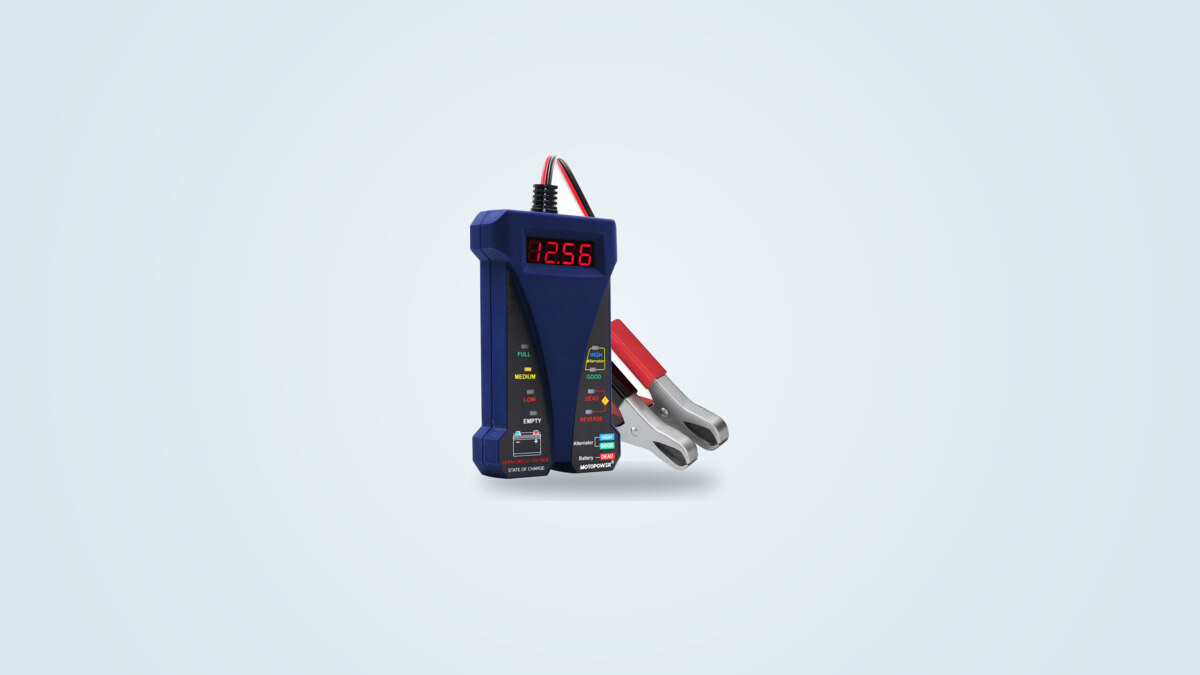
The Motopower MP0514B does neither conductance nor internal resistance: it is a digital voltmeter that reads the voltage across the battery terminals and sorts it against a threshold table fixed by the manufacturer. No CCA estimate, no state of health (SOH) percentage, no state of charge (SOC) comes out of the unit, unlike the Topdon BT100 and the Konnwei KW208 already reviewed on this site, both built on conductance technology that returns those three figures. This is a difference in kind, not degree: the MP0514B shows a raw value, while its two direct neighbours return a calculated diagnosis.
Its official documentation only quantifies two zones of that scale precisely. On the battery column (resting voltage, engine off), the FULL LED lights up between 12.6 and 13.5V to flag a battery in normal condition. On the column shared with the alternator, the GOOD LED lights up when the voltage with the engine running sits between 13.6 and 14.5V, which the manufacturer calls a normal alternator output. Above 14.5V, the HIGH LED takes over to flag a possible overvoltage.
Between these two quantified zones, four other states (MEDIUM, LOW, EMPTY, DEAD) stay purely qualitative in the manual: a voltage that is "a little low", "low, needs charging", "weak, needs charging", or "too low, have it checked by a professional". Anyone who genuinely wants to know at what voltage their battery moves from LOW to EMPTY will need to read the figure on the LCD screen rather than the LED colour alone, which the unit allows since both pieces of information show at the same time.
Below 4V, the screen shows "LO" instead of a value; above 20V, it shows "HI". This wide range is enough to cover a 12V battery across pretty much every real-world state, from deeply sulphated lead-acid to a slight overcharge. That said, this remains a figure stated by the manufacturer, repeated identically across its own documentation, but never checked against an outside reference instrument as part of this review.
No operating temperature range published by the manufacturer
Like its two direct neighbours in the same sub-category, the MP0514B carries no meaningful battery of its own: its electronics are powered through the clamps, directly from the battery under test. So the question of cold-weather performance concerns, as with the Topdon BT100 and the Konnwei KW208, the range within which the manufacturer itself guarantees reliable operation of that electronics, not the runtime of an internal battery.
On this specific point, the official documentation available for this unit, the instruction manual and the manufacturer's product page, mentions no operating or storage temperature range at all. That is a real difference from its two direct neighbours already reviewed on this site: the Topdon BT100 states -20 °C to 65 °C, the Konnwei KW208 states 0 °C to 50 °C. The MP0514B publishes no equivalent figure.
| Model | Stated range |
|---|---|
| Motopower MP0514B | Not published |
| Topdon BT100 | -20 °C to 65 °C |
| Konnwei KW208 | 0 °C to 50 °C |
This point needs some context, without playing it down: no fault in freezing weather has been identified for this model. The lack of a published range is not proof of a real fault at extreme temperature, only lower transparency than its two direct neighbours, which both give a figure the buyer can check before purchase. For occasional use kept in the glovebox between checks, this reservation matters little; for anyone wanting written assurance of operation on a frosty night, it is worth knowing before buying.
12V only: narrower coverage than its shelf neighbours
Here too, the gap with its two direct neighbours is clear. The Topdon BT100 and the Konnwei KW208 both cover a 100 to 2000 CCA range recognised across nine to ten international standards, and let the user pick a battery chemistry (lead-acid, AGM, EFB, gel) before calculating a state of health. The MP0514B offers neither step: no CCA range, no chemistry choice, no standard to enter. It simply reads a voltage and compares it against a fixed table, whatever the technology of the battery clipped on.
That simplicity has a direct downside: without knowing it, the unit cannot tell a recent AGM battery apart from an ageing flooded lead-acid one that happens to show a comparable resting voltage. A genuine conductance tester, calibrated to the chemistry the user selects, makes that distinction. The MP0514B does not.
Another point deserves to be raised rather than settled on the reader's behalf: the instruction manual supplied with the unit explicitly limits its use to "12V batteries or 12V charging systems", with no mention of 6V compatibility at all. That is worth knowing for anyone specifically after a check on an older 6V vehicle.
On what it does cover, though, the MP0514B stays true to the promise of its sub-category: it checks a battery's resting state AND, engine running, the alternator's output, with the same unit and the same clamps. Its alligator clamps can in practice clip onto a battery mounted in the vehicle or sitting on a bench alike, even though the manual only details this second use for the battery check, since the alternator check by nature needs a running engine.
Reverse-polarity and a DEAD alert: basic but real safety
The electrical risk of a tester has nothing to do with that of a jump starter: the MP0514B delivers no cranking current, it simply reads a battery already in place. Its official documentation claims two protections: reverse-hookup protection, flagged by a dedicated REVERSE LED as soon as the red and black clamps are swapped, and overvoltage protection, consistent with its upper measurement range capped at 20V (beyond that, the screen simply shows "HI" rather than an incorrect value).
The DEAD LED deserves to be read as a genuine safeguard rather than just another state among others: the manual explicitly recommends, when it lights up, having the battery checked by a professional before any other handling, a more cautious instruction than a plain "needs charging". This level of protection stays comparable to that of the Topdon BT100 and the Konnwei KW208, already reviewed on this site, both fitted with a similar reverse-hookup protection. No recall or safety incident has been identified for this model.
One honest nuance should be raised: unlike some rivals that explicitly claim a "spark-free" connection at the clamps, the MP0514B's official documentation does not repeat that exact wording. That does not mean the unit lacks it, only that this specific point is not confirmed by its own documentation.
50cm cable and 30A clamps, an unstated warranty
The MP0514B comes in a compact rubber-coated body (dark blue finish for the B reference, the same electronics also sold in other colours under the exact reference MP0514A/C/D), for a stated weight of 150g. The cable between the body and the clamps measures 50cm, a genuine length worth praising next to the Topdon BT100 already reviewed on this site, whose short, stiff cable was flagged as an explicit friction point, preventing the user from watching the screen from inside the vehicle during the cranking check.
| Element | Stated value |
|---|---|
| Weight | 150g |
| Cable | 50cm |
| Clamps | Alligator, 30A rated |
| Screen | Backlit 4-character LCD |
| Made in | China |
On longevity, though, transparency is noticeably weaker than that of its best-covered neighbour. The manufacturer's official warranty page states no precise duration: it only promises "hassle-free" support and points buyers to customer service to check the exact length case by case. That is a far less clear position than the Topdon BT100's, whose 24-month warranty is stated identically across several official pages, and even than the Konnwei KW208's, whose length already stayed unclear in its own review on this site.
No recall or recurring fault has been identified for this model. The manufacturer, a brand specialising in low-cost automotive accessories and diagnostic tools, runs an extensive catalogue on general marketplaces, with no recurring negative signal apparent.
Battery and alternator: two readings, not three tests
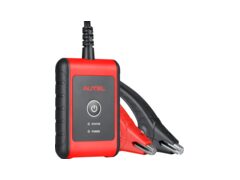
The Topdon BT100, the Konnwei KW208 and the Autel MaxiBAS BT506, all three already reviewed on this site, present their diagnosis as an explicit sequence of three distinct tests: battery, cranking, alternator, each with its own displayed result. The MP0514B works differently: it only has two real modes, a continuous display of the resting voltage (battery column, FULL to DEAD LEDs) and a continuous display while the engine is running (alternator column, GOOD or HIGH LED). There is no isolated "cranking test" with its own result.
In practice, nothing stops anyone watching the screen at the exact moment the starter is engaged to see the voltage drop at that instant: the manufacturer's official documentation simply does not describe that reading as a dedicated function, unlike its rivals, which announce it and display it as a separate result. That is a difference in ergonomics and readability more than a difference in what the unit can physically show.
Another, more awkward limit touches directly on the alternator check: the manual only defines two states, GOOD (13.6 to 14.5V) and HIGH (above that). No LED or indication is provided for an alternator that is undercharging, an output voltage that might for example stay around 13V with the engine running, one of the most common symptoms of a tired alternator or a slipping belt. Nothing stops an attentive user from noticing it themselves by reading the figure rather than the LED alone, but the unit does not flag it actively, even though that is exactly the kind of intermediate fault this type of tool should help spot.
What to know before clipping on the clamps
Unlike the Topdon BT100 or the Konnwei KW208, which need a standard (CCA, EN, DIN) and a value printed on the battery label entered beforehand, the MP0514B asks for no setup at all. Clip the red and black clamps onto the positive and negative terminals, the screen lights up and shows a voltage straight away: that is the logical trade-off for not calculating CCA or state of health, there is nothing to enter before the reading.
That simplicity does not remove the usual precautions that apply to any voltage reading on a lead-acid battery. A battery that has just been recharged or driven in the last half hour keeps a slight surface overvoltage that can make the reading look more favourable than reality: it is best to let the battery rest for a few tens of minutes before a resting check, to avoid an overly optimistic reading. That is a general rule for any open-circuit voltage reading, not specific to the MP0514B, but its total lack of compensation or a correcting algorithm makes it more sensitive to that bias than a conductance tester, which already factors this kind of adjustment into its calculation.
For the alternator check, the principle stays simple: keep the clamps connected, start the engine, and read the LED and voltage shown once the engine speed settles. The manual states neither a target engine speed nor a recommended wait time, unlike the Topdon BT100, which details a speed of around 2500rpm held for 5 seconds: here again, it is up to the user to interpret a continuous reading rather than follow a numeric protocol supplied by the manufacturer.
MP0514B against the Topdon BT100 and Konnwei KW208: the real price of simplicity
The MP0514B shares its sub-category with three other testers already reviewed on this site, from the most affordable to the highest-end. Price alone already tells much of the story.
| Criterion | MP0514B | BT100 | KW208 | BT506 |
|---|---|---|---|---|
| Technology | Threshold voltmeter | Conductance | Conductance | Adaptive conductance |
| CCA / SOH | No | Yes, 100-2000 CCA | Yes, 100-2000 CCA | Yes, 100-2000 CCA |
| Voltage coverage | 12V | 12V | 6V / 12V | 6V / 12V |
| Interface | LCD + 8 LEDs | Monochrome LCD | Colour LCD | Smartphone app |
| Clamp cable | 50cm | Short, flagged as too short | Not stated | About 60cm |
| Warranty | Not published | 24 months | Unclear | 12 months |
Against the Topdon BT100, already rated 4.1 on this site, the MP0514B falls behind on the axis that weighs heaviest in this sub-category's scoring, diagnostic capability itself: no CCA range, no state of health, where the BT100 covers 100 to 2000 CCA across ten standards. It makes up some ground on build, with a noticeably longer cable than the BT100's, already flagged as too short. Against the Konnwei KW208, rated 4.0 on this site, the gap comes down to nearly the same point: the KW208 also offers a full CCA range and 6V compatibility stated in its own documentation, two capabilities the MP0514B lacks.
The Autel MaxiBAS BT506, rated 4.1 on this site, plays in an entirely different league and mainly serves as a reference point: its catalogue price runs more than twelve times that of the MP0514B, for a smartphone-driven diagnosis with history and an exportable report. Comparing the two directly makes little sense, but the price gap shows clearly where the MP0514B sits within the whole sub-category: it is, by far, the most affordable of the four.
Who the MP0514B is for, and who it is not
The MP0514B suits anyone who wants a quick, frequent check without ever having to pick a standard or a battery chemistry: clip the clamps on, read the voltage and the LED colour, that is it. It also suits a tight budget, with a catalogue price noticeably below its two direct neighbours, for a function that stays genuinely useful: telling a normal battery apart from one that needs charging, and an alternator charging normally apart from one that is overcharging.
It suits less well anyone after a genuine diagnosis: with no calculated CCA or state of health, there is no way to know whether a battery will make it through another winter or is nearing the end of its real life, something the Topdon BT100 and the Konnwei KW208 can both estimate. It is also a poor fit for anyone running a 6V system, not covered according to the manufacturer's official documentation, or anyone after a clearly stated warranty length before buying.
What matters in the end: the MP0514B does what an upgraded voltmeter can do, with genuine transparency about what it shows and a price that stays consistent with that modest promise. Mistaking it for a conductance tester would be an error of expectation, not a fault of the unit itself.