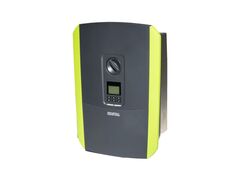


What the PLENTICORE plus 4.2 actually is
The PLENTICORE plus 4.2 is a rooftop hybrid inverter, grid-tied and mounted on the wall of a garage or utility room for the life of the installation, not to be confused with a balcony micro-inverter or a portable power station. Its job is twofold: convert the panels' DC output into three-phase AC power, and optionally manage a home storage battery.
On the generation side, the 4.2 belongs to the second generation (G2) of the PLENTICORE plus range, which spans 3.0 to 10kW on the larger models (3.0, 4.2, 5.5, 7.0, 8.5, 10): the 4.2 is the second most compact unit in the line-up, a sensible choice for a moderately to heavily loaded home rather than a large multi-family building.
97.1% peak, 96.5% European average: two figures, not one
Kostal publishes two efficiency figures for the PLENTICORE plus 4.2, a more transparent approach than a single headline number: a peak efficiency of 97.1%, reached under favourable conditions, and a European efficiency of 96.5%, a standardised weighted average that better reflects output spread across a sunny day followed by cloud cover. Both figures line up with the marketing claim of "over 97%", which refers to the peak rather than the average.
Two honest gaps remain, absent from any documentation reviewed: the round-trip efficiency actually achieved once a battery is paired (charging then discharging, necessarily lower than conversion efficiency alone), and its behaviour at very low power, decisive on overcast days or late in the afternoon. Kostal publishes only the two figures above, like most of the sector.
Far more than BYD: at least ten officially compatible batteries
The PLENTICORE plus's marketing, ours included on its product page, almost always spotlights a single battery partner: BYD, in its high-voltage HVS and HVM ranges. Kostal's full technical documentation tells a broader story: the PLENTICORE plus G2, the 4.2 included, is listed as compatible with at least ten brands and lines of storage batteries, all linked through the same RS485 interface.
| Brand | Range or reference |
|---|---|
| BYD | Battery-Box HV, Battery-Box Premium HVS/HVM, HVM+, HVS+, HVB |
| Kostal | HELIVOR HV (the manufacturer's own line) |
| LG Energy Solution | RESU FLEX |
| Pylontech | Force H1, H2, H3 |
| VARTA | wall.BM1, wall.BM2 |
| Dyness | Tower, Tower Pro, Stack100, Stack100 Pro |
| BMZ | HYPERION |
| AXITEC | AXIstorage Li (SH, SV1, SV2) |
| ZYC | SIMPO HV |
Compared with Huawei, locked to its own LUNA2000 range, and SMA, limited to its SMA Home Storage line, the PLENTICORE plus 4.2 turns out to be the most open of the three inverters in this comparison on this exact point, once the full technical documentation is weighed rather than just the product page or the marketing copy.
One real caveat is worth keeping in mind: depending on the exact reference chosen within a given line, the power actually drawable from the battery does not always match the inverter's 4200W ceiling. With the smallest BYD reference (HVS 5.1), for example, output power is capped at 3100W rather than 4200W: battery size needs to match the project to unlock the unit's full potential.
Zero-export and the app: the promise and its conditions
The zero-export function adjusts output to stay within a contractual grid-feed limit, down to 0W if the grid connection agreement requires it: the inverter shifts its operating point away from the maximum power point (MPP) to reduce output, rather than simply wasting the surplus.
Day-to-day monitoring runs through the KOSTAL Solar App (production, consumption, battery charge) and a web portal. Several real friction points have accompanied this app across its updates: loading times that can stretch to several minutes before data appears, freezes when adding multiple inverters to the same iPhone account, consumption figures that stop showing on some Android phones, and QR-code registration failures after certain updates. These issues affect the monitoring display, not the energy conversion itself, which keeps working normally even when the app stops reporting anything.
The arbitration between solar, battery and grid runs independently of the app once configured: it is the inverter's own firmware that arbitrates continuously, not a cloud service that would need to be queried for every decision.
Three-phase, MPPT and a warranty you have to activate yourself
The PLENTICORE plus 4.2 is three-phase only (3N~, 230/400V, 50Hz connection): a sensible choice for a home already wired for three-phase supply with power-hungry appliances (heat pump, EV charger), but one that rules out single-phase homes, still the majority among UK houses. Its 3 independent MPPT trackers, against 2 on the Huawei SUN2000-3K-LB0 in this comparison, offer real flexibility for splitting panels across several roof faces or working around partial shading.
Like any three-phase residential inverter wired into the consumer unit, installation must be carried out by a qualified electrician and registered with the grid operator before commissioning: a normal step for this type of equipment, neither more nor less involved than with its direct rivals.
This is where the PLENTICORE plus 4.2 compares least favourably with its two direct rivals: Huawei and SMA both state 10 years of warranty with no extra step, while Kostal delivers only 5 years by default and leaves the second half to an online activation, to be done by the buyer within 6 months of commissioning. Once that step is done, all three inverters end up level on total warranty length.
Build, reliability and the fan noise
Kostal manufactures its inverters in Europe and has been present in the residential solar market for several decades. The PLENTICORE plus 4.2's casing is IP65-rated (dust and water jets), operates from -20 to 60°C, and draws just 7.9W on standby. Its 19.6kg weight and 563 x 405 x 233mm footprint remain suited to indoor wall mounting (garage, utility room, basement), the recommended location for this type of unit.
The most genuine point of friction concerns active cooling: a fan kicks in once outgoing air reaches around 50°C, and switches off near 35°C. Under full load, this fan becomes clearly audible, an issue regularly raised across the PLENTICORE plus range for several years, sharper on the higher-power variants (10kW, more often pushed near their ceiling) than on the 4.2, whose more modest output triggers the fan less often in everyday use. Kostal has moved some replacement fans to a metal grille rather than plastic to cut the noise, without eliminating it entirely.
No product recall or safety defect has turned up for this G2 generation: the real friction points concern comfort (noise, app) rather than the unit's structural reliability.
Against the Huawei SUN2000-3K-LB0 and SMA Sunny Boy Smart Energy 4.0
In the residential hybrid inverter segment, two rivals come up most often in direct comparison with the PLENTICORE plus 4.2: the Huawei SUN2000-3K-LB0, cheaper but less powerful and single-phase only, and the SMA Sunny Boy Smart Energy 4.0, closer in power but also single-phase.
| Criterion | Kostal PLENTICORE plus 4.2 | Huawei SUN2000-3K-LB0 | SMA Sunny Boy Smart Energy 4.0 |
|---|---|---|---|
| AC power | 4200W, three-phase | 3000W, single-phase | 4000W, single-phase |
| MPPTs | 3 | 2 | 3 |
| Battery | 10+ compatible brands (BYD, LG, Pylontech, Varta...) | LUNA2000 (own line, plug and play) | SMA Home Storage (own line) |
| Warranty | 5 years (10 with activation) | 10 years | 10 years |
| Price observed | £1151 | £684.47 | £1340.80 |
The Kostal is the only three-phase unit of the three, a genuine plus for a home with a heavy, sustained load. On battery compatibility, it turns out to be the most open of the three once its full technical documentation is taken into account, where Huawei and SMA both stay locked to their own line. Its shorter base warranty remains the point where it compares least favourably: Huawei and SMA both offer 10 years with no extra step, while Kostal delivers only 5 years by default.
Who the PLENTICORE plus 4.2 suits, and who it doesn't
It suits a household already wired for three-phase supply, with sustained consumption (heat pump, EV charger, heavy appliances) and a storage project in mind, whatever battery brand is being considered from the long list of compatible options. That is exactly the setup where its 3 MPPTs, its efficiency and its zero-export management make the difference.
It suits less a single-phase home (ruled out by default), anyone wanting a full 10-year warranty with no extra step, or anyone who would rather have a monitoring app that is flawless from day one. For those profiles, the Huawei SUN2000-3K-LB0 or the SMA Sunny Boy Smart Energy 4.0 deserve a closer look before deciding.