
A signal, not a charging current: how the KW208 actually works
The KW208 is neither a charger nor a jump starter: it delivers no current, it reads one. Like other testers in its category, it relies on conductance technology: a low-intensity signal is sent into the battery, and the electrical response is used to work out the state of health (SOH), internal resistance and an estimated cold cranking amps (CCA) figure, across a wide 100 to 2000 CCA range.
This approach has three practical consequences. First, the unit does not replace a charger: it diagnoses, it charges nothing. Second, as with any instrument of this kind, the result depends directly on the battery type selected before the test (standard flooded, AGM, EFB or gel): an incorrect selection mechanically skews the reading, since the algorithm applies a different profile depending on the declared chemistry. Third, again as with any conductance tester, the reading depends on the state of charge at the moment of the test: a heavily discharged battery can come back with an artificially low percentage, while a fully charged one can mask early plate degradation.
Commercial listings claim a high accuracy figure for this model without ever stating the protocol or reference instrument used to establish it: a number with no known method does not carry the same weight as a verifiable comparison, so it is not repeated here. No comparison against a professional reference instrument has otherwise been identified for this specific model.
An operating range that stops at freezing point
Since the KW208 carries no battery of its own and is powered directly by the battery it tests, cold-weather performance is not framed the same way as for a jump starter. What matters here is not the runtime of an internal cell, but the range within which the manufacturer itself guarantees reliable operation of the measuring electronics.
This information does not come from a third-party listing: it is printed directly on the label stuck to the back of the casing, next to the model name and the input voltage range. An operating range of 0 to 50 °C is fine for indoor use or mild weather, but it stops right at the moment a driver has the most reason to reach for a tool like this: a frosty morning, when a tired battery refuses to turn the engine over.
That figure is worth putting in perspective, though: no cold-weather malfunction has been identified for this model. The range printed on the label is most likely a conservative safety margin set by the manufacturer rather than a hard failure point, but on paper it remains noticeably narrower than that of a direct rival in the same sub-category.
Five lead-acid chemistries, nine standards: coverage near the top of the segment
On paper, the KW208 aims wide. Its 100 to 2000 CCA range is recognised under nine different standards (CCA, CA, BCI, MCA, JIS, SAE, EN, DIN, IEC), covering the vast majority of battery labels found across Europe, North America and Asia.
The five chemistries covered (standard flooded, AGM flat plate, AGM spiral and gel) account for the vast majority of the lead-acid car fleet currently on the road. The unit remains 12V only, however: no 24V mode is offered for heavy trucks or some agricultural machinery.
One point deserves caution before buying: lithium compatibility is sometimes suggested on reseller listings, yet it appears neither in the chemistry list of the technical documentation nor on the label stuck to the back of the casing. Running an algorithm calibrated for lead-acid on a different chemistry can produce an unrepresentative reading: absent a clear confirmation, the use to favour remains lead-acid in the five forms listed above.
No current delivered, a clearly bounded input range
The electrical risk of a tester has nothing to do with that of a jump starter: the KW208 supplies no cranking current, it simply reads a battery already in place. The advertised protections nonetheless remain useful for anyone without particular experience: reverse-polarity protection is claimed by the manufacturer, preventing damage to the unit or the battery from a reversed connection on the terminals.
This 8 to 16V range, also printed directly on the unit's own label rather than only advertised online, bounds the unit's real-world use: below 8V, a battery is already very deeply discharged and a reliable reading becomes questionable anyway for this type of instrument. That floor is higher than that of some direct rivals in the same sub-category, which will power on down to 6V: worth knowing for anyone specifically looking to diagnose a very deeply flat battery.
The restriction to lead-acid chemistries also has a safety dimension, not just a compatibility one: trusting a state-of-health percentage calculated for a different chemistry than the one actually under test risks a false sense of reliability on a battery that could carry an entirely different risk profile. No recall or incident has been identified for this model to date.
Galvanised jaws and a colour screen: what the spec sheet reveals
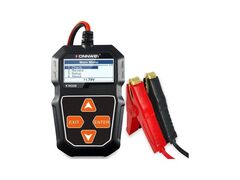
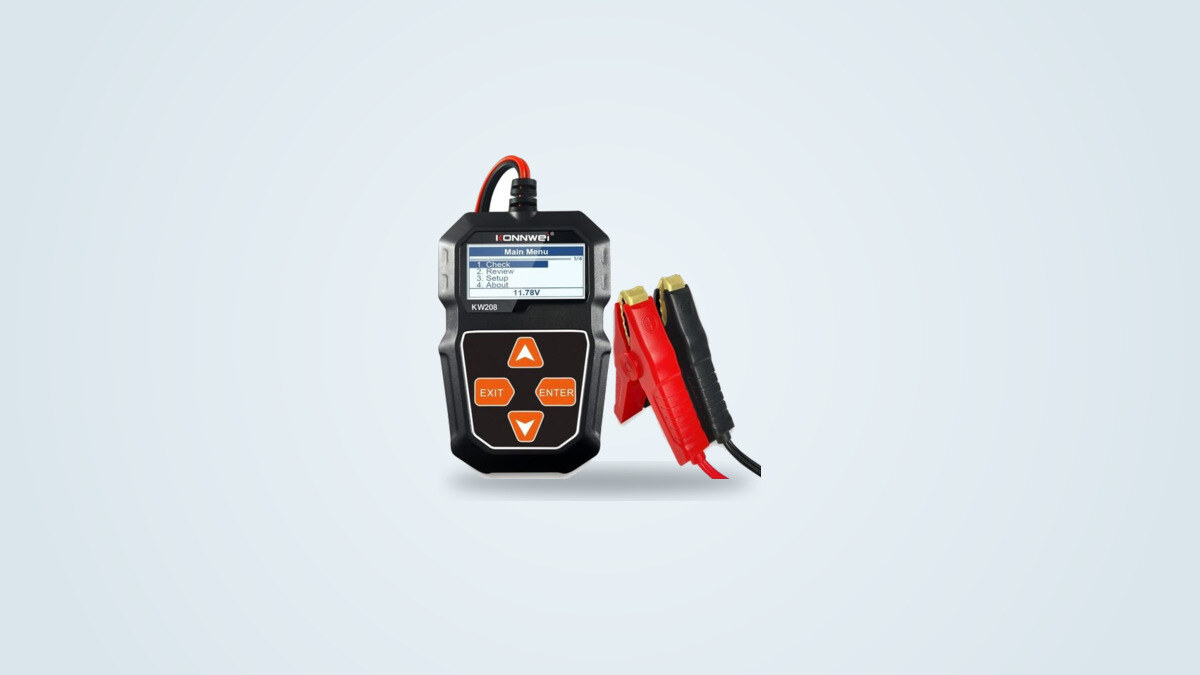
The KW208 comes in a compact, rounded-corner casing with four buttons (two arrows, EXIT, ENTER) and a colour screen, a detail several product listings state explicitly and that the manufacturer's own visuals confirm. The crocodile clamps, with toothed jaws and a galvanised finish according to several spec sheets, are linked to the casing by a coiled cable rather than a short, straight one: a design choice that leaves more slack to keep an eye on the screen once the clamps are fixed to the battery.
The casing also carries CE and RoHS markings, along with a made-in-China notice, directly visible on the rear label next to the operating and voltage ranges already mentioned.
On lifespan and warranty, though, the available documentation is markedly less clear. The advertised warranty length varies widely from one seller to another depending on the page consulted, with no single, dated manufacturer policy identified for this specific model: a less clear-cut situation than the Topdon BT100, whose 24-month warranty is shown identically across several official pages. No recall or recurring fault has been identified for this model, however.
Three readings from one set of clamps: battery, starter, alternator
The KW208 does not take a single reading, it runs three in sequence, which sets it apart from a plain voltmeter and lets it pin down the source of a fault rather than guessing at it.
The battery test shows voltage, internal resistance, an estimated CCA figure and a state of health (SOH) expressed as a percentage: enough to tell at a glance whether the battery is worth recharging or needs replacing. The cranking test assesses circuit behaviour during the starter's current draw, with the engine started. The charging test, finally, checks that the charging system (the alternator and its rectifier) properly recharges the battery once the engine is running.
The documentation available for this model does not spell out, unlike some rivals, the exact engine speed or precise duration required for the charging test: worth keeping in mind, as the unit is more forthcoming about its results than about its own test procedure. Navigating the three modes takes just four buttons (two arrows, EXIT, ENTER), a deliberately minimal interface.
KW208 versus the Topdon BT100: two near-identical testers
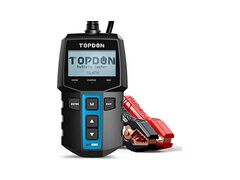
The KW208 shares its sub-category with the Topdon BT100, already reviewed on this site, and both units target exactly the same use case: a quick, app-free, battery-free diagnosis for a 12V lead-acid battery. Here is where the real differences lie between the two.
| Criterion | KW208 | BT100 |
|---|---|---|
| Test range | 100 to 2000 CCA | 100 to 2000 CCA |
| Standards recognised | 9 | 10 |
| Lead-acid chemistries | Flooded, AGM flat, AGM spiral, EFB, gel | Flooded, AGM flat, AGM spiral, EFB, gel |
| Operating range | 0 to 50 °C | -20 to 65 °C |
| Screen | Colour (TFT) | Monochrome LCD 128x64 |
| Interface languages | 8 | 6 |
| Manufacturer warranty | Not confirmed consistently | 24 months |
The two units are evenly matched on the essentials: same CCA range, same lead-acid chemistries covered, no lithium compatibility claimed by either one. The KW208 wins on the screen (colour versus monochrome LCD) and on the number of available languages. The BT100 wins on operating range, noticeably wider towards the cold, and on the clarity of its warranty policy, shown identically across several official pages where the KW208's remains uncertain. The choice between the two therefore comes down less to the basic functions, which are very close, than to these two specific points.
What to check before connecting the clamps
The KW208 does not guess anything: the correct battery type (standard flooded, AGM flat, AGM spiral, EFB or gel) must be selected before starting the test, or the result will be skewed. It also pays to locate in advance the standard and value printed on the battery under test, since that label is sometimes partly hidden by a plastic cover or turned to face the side of the engine bay.
The unit offers its interface in eight languages, a genuine convenience for a product sold across such different markets. In return, no result-storage or export feature has been identified in the available documentation: each check runs independently, with no history kept from one reading to the next.
Who the KW208 suits, and who it does not
The KW208 suits the driver who wants a quick answer to a simple question: is my battery still good, or has the alternator stopped charging properly? It also suits the home mechanic checking a battery in mild weather or inside a garage, and the small workshop after an affordable first diagnostic instrument.
It suits less well anyone needing an impromptu check in a hard morning frost, since its operating range stops at 0 °C according to the manufacturer's label, where the Topdon BT100 goes down to -20 °C. It is also a poor fit for anyone running a lithium starting battery, not claimed by the unit, a 24V system, or anyone who needs to keep a history of readings over time.
What matters most: for its price, the KW208 covers a wide range of standards and lead-acid chemistries, with a colour screen and a multilingual interface that set it apart positively from its direct rival. Two real reservations, the operating range and the warranty, are worth reading before buying, without undermining the unit's value for everyday use.