
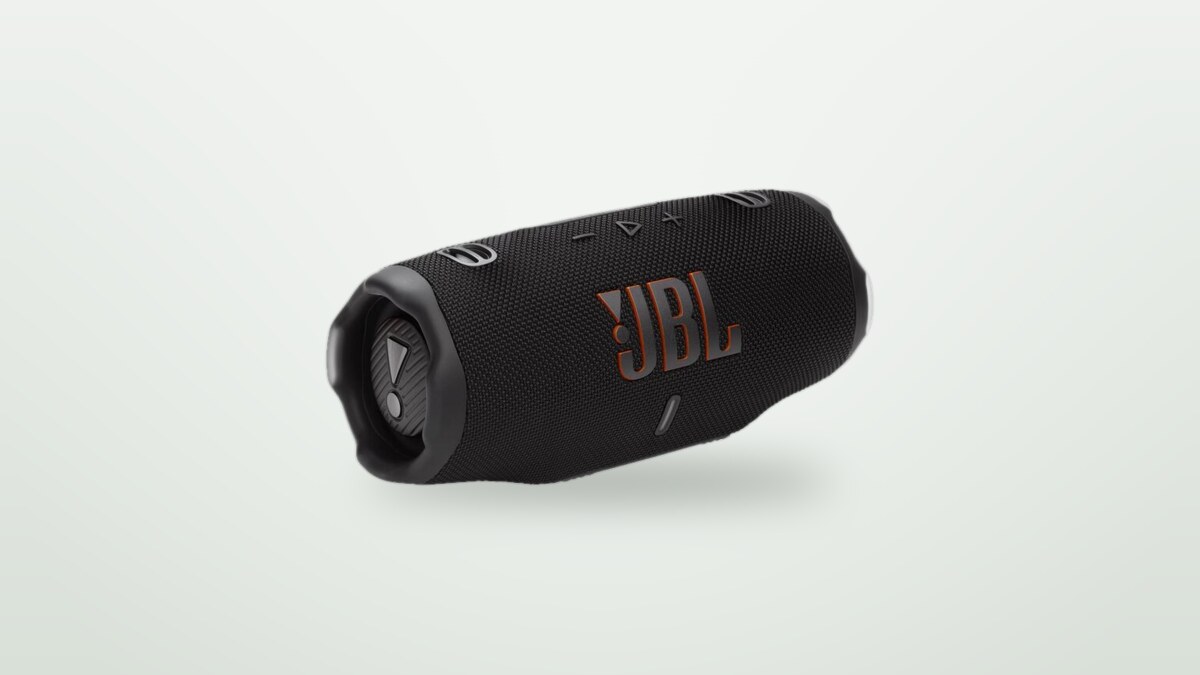
45 W announced: the official documentation contradicts itself
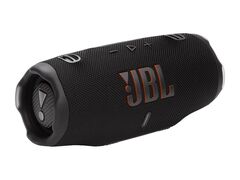
The acoustic architecture remains unchanged from the Charge 5: a single oval Racetrack-type driver (53 x 93 mm) for the low and mid frequencies, a single 20 mm dome tweeter for the highs, and two lateral passive radiators that reinforce the bass without drawing any power of their own. So this is neither a new topology nor two tweeters.
The announced power, on the other hand, raises a real question: the manufacturer's official technical documentation contradicts itself depending on the version consulted. One version lists 30 W RMS for the main driver and 10 W RMS for the tweeter, for 40 W RMS total, with a separate line for 45 W presented as a distinct maximum power figure. Another version directly lists 30 W plus 15 W, for 45 W RMS. Depending on which version is used, the drivers' RMS power either increased by 5 W compared to the Charge 5 (already 30 W + 10 W), or it has not changed and only a new 45 W peak figure has appeared. Neither official document nor any spec sheet consulted mentions a 180 W peak power figure, a figure sometimes cited without a verifiable source: this figure should be treated with caution.
AI Sound Boost and Playtime Boost: two distinct features, often confused
Two features have similar-sounding names and are frequently confused, including in simplified marketing documentation.
AI Sound Boost analyzes the audio signal in real time and "learns" the transducer's capabilities to maximise sound output while limiting distortion and protecting the drivers. It is an adaptive limiter that is active at all times, not a battery life gain: it only becomes perceptible at very high volume on content that is already bass-heavy.
Playtime Boost is a separate feature, explicitly responsible for the extra 4 hours of battery life (24 h to 28 h). It works in the opposite way from AI Sound Boost: by reducing the bass response and the signal's dynamics, which lowers the demand on the amplifier and therefore its power consumption. It is a deliberate sound trade-off made to gain endurance, not a free energy-efficiency improvement.
No independent measurement confirms, to date, a quantified peak power gain from AI Sound Boost: the only observations available are qualitative (less perceived distortion at high volume).
94 dB at 1 metre, yet a composite score that lags behind
The maximum sound level measured at 1 metre reaches 94 dB, with a bass rise measured at 75 dB around 47 Hz and at 94 dB around 67 Hz. This is an improvement over the 92.3 dB already measured on the Charge 5. Against two similarly sized speakers from other brands, the Charge 6 is both the loudest and the least distorted of the three, though without a percentage-based harmonic distortion measurement.
The Charge 6's composite sound evaluation score, which weighs several listening criteria (timbre, distortion, immersion, sound level, artifact handling) rather than raw level alone, is slightly lower than the Charge 5's. The distortion sub-score improves markedly (the Charge 6 distorts less), but the timbre and immersion sub-scores decline, which pulls the overall score down despite a higher measured sound level. Both results, the dB level and the composite score, are real: they simply do not measure the same thing, and the Charge 6 is therefore not a uniform improvement in sound.
24 to 28 hours announced, more like 13 to 15 hours at sustained volume
The manufacturer announces up to 24 hours of battery life in standard use, extended to 28 hours thanks to the Playtime Boost described above. At sustained volume (80 dB continuous at 1 metre), battery life sits between 13 h15 and 14 h45. The fair comparison with the Charge 5 (20 h announced) is against the 24 hours in standard use, a real gain of 4 hours, not against the 28 hours with Playtime Boost enabled, which is not measured under the same protocol.
| Scenario | Battery life |
|---|---|
| Sustained volume, 80 dB continuous at 1 m (measured) | 13 h15 to 14 h45 |
| Standard use (announced) | 24 h |
| With Playtime Boost, reduced bass (announced) | 28 h |
As for fast charging, 10 minutes of charging is enough for about 2 h30 of playback, and a full charge takes about 3 hours, versus 4 hours for the Charge 5.
A single USB-C port: one audio input gained, two simultaneous uses lost
The Charge 6 drops the Charge 5's USB-A / USB-C pair for a single USB-C port, which now combines three functions: charging the speaker, power bank output, and now a digital audio input. No cable is included in the box. A direct consequence of consolidating everything onto one port: it is impossible to charge the speaker while using the wired audio input at the same time.
The real novelty is this lossless digital wired audio input, at 16 bit / 48 kHz, expandable up to 24 bit / 96 kHz if the source allows it. It requires a firmware update via the JBL app to be activated, unlike Auracast, which works without an update. This wired mode also does not allow pairing two Charge 6 units in stereo: only Bluetooth and Auracast allow that.
Auracast replaces PartyBoost, with no bridge
The Charge 6 drops PartyBoost in favour of Auracast, an open Bluetooth standard. The change is clean and without compromise: a Charge 6 cannot pair with any older-generation PartyBoost JBL speaker, including the Charge 5, in any form. No software bridge is planned by the manufacturer. The only exception across the entire current JBL lineup is the Xtreme 4, which supports both PartyBoost and Auracast, though not at the same time, confirming that the choice made on the Charge 6 is deliberate rather than a technical constraint.
The actual number of speakers that can be paired simultaneously via Auracast could not be established precisely beyond the standard's theoretical limit: no test pushing the feature beyond two speakers has been found. No firmware update is required to use Auracast itself, unlike the lossless wired audio input mentioned above.
The power bank function, still without a real independent measurement
As with the Charge 5, no rigorous independent test to date quantifies the number of smartphone charges the Charge 6's power bank function allows via its USB-C port, limited to 10 W output. Only a theoretical estimate is available: from the battery's 4722 mAh (34 Wh) and with a typical USB conversion efficiency of around 80 to 85 %, the energy actually transferable is close to 27 to 29 Wh. Since a current smartphone typically holds between 11 and 20 Wh, the Charge 6 can fully recharge one, with some margin, but not several times in a row. This is a calculation based on known specifications, not a measurement of the actual number of charges performed.
IP68, new removable strap, no widespread failure reports
Water resistance moves from the Charge 5's IP67 to IP68 on the Charge 6, meaning immersion up to 1.5 m for 30 min versus 1 m for the previous generation, in addition to full dust protection.
The removable carry strap is a new addition in this generation compared to the Charge 5's system, with no widespread reports of breakage or mounting failure to date. The single USB-C port likewise shows no reports of premature wear. No widespread failure pattern or product recall concerns the Charge 6 to date, a judgment that nonetheless remains cautious for a device that has only been on the market since April 2025.
Versus the Charge 5: an evolution, not a uniform improvement
| Criterion | Charge 6 | Charge 5 |
|---|---|---|
| Battery | 34 Wh | 27 Wh |
| Announced power | 45 W | 40 W |
| Sound level measured at 1 m | 94 dB | 92.3 dB |
| Composite sound evaluation score | 2.7 / 5 | 2.9 / 5 |
| Announced standard battery life | 24 h | 20 h |
| Water resistance | IP68 | IP67 |
| Full charge | 3 h | 4 h |
| Ports | Single USB-C | USB-A + USB-C |
| Multi-speaker pairing | Auracast | PartyBoost |
| Bluetooth | 5.4 | 5.1 |
The overall picture is not one-sided. The Charge 6 genuinely improves on battery capacity, raw sound level, water resistance, and charging speed. It steps back on connector ergonomics (a single port instead of two) and breaks compatibility with the existing PartyBoost ecosystem, which directly penalises anyone who already owns a Charge 5 or another PartyBoost-compatible JBL speaker. The composite sound evaluation score, finally, is a reminder that louder does not automatically mean a better score across every listening criterion.
Who it suits, and who it does not
It suits anyone looking for a rugged, loud portable speaker for outdoor use, who wants stronger water resistance than the previous generation, and who does not need to pair it with older PartyBoost JBL speakers.
It does not suit anyone who already owns PartyBoost-compatible JBL speakers and planned to pair them with a new purchase (no bridge exists), nor anyone who needs to charge the speaker and use the wired audio input at the same time.