

What the advertised output power really means
The BK1600 Ultra is marketed as a 3600 W system pretty much everywhere: on the product page, in the technical documentation, even in the expansion mode the manufacturer highlights. That figure is real, but it applies neither to the standalone unit nor to just any multi-unit setup: it depends on which pairing mode is used between units.
On its own, a single BK1600 Ultra delivers 1200 W continuous, with an 1800 W peak for 15 seconds. Pairing two units by cable, in what the manufacturer calls a centralised cluster (all power flows through the main unit before reaching the grid), raises the ceiling to 2300 W, not 2400 W as simple doubling would suggest: it is the main unit's own output port capacity that sets the limit, regardless of how many sub-units sit behind it. Reaching the advertised 3600 W requires switching to a coordinated cluster instead, where each of up to 3 units (one main, two sub) connects independently to the grid and synchronises over WiFi or a network cable.
On the grid-injection side, the limit stays fixed at 800 W by default no matter how many units are installed: that is the simplified regulatory ceiling applied across France, Germany, Spain and Italy (see below), and the BK1600 Ultra meets it by design rather than leaving the installer to configure it manually.
In practice, the standalone unit covers a fridge, a router and a few lights during an outage, but not a hob. Anyone after the full 3600 W from day one needs the three-unit coordinated setup, not a simple wired pair.
Measured efficiency, ahead of its bigger sibling
The BK1600 Ultra's round-trip efficiency reaches 82.2% under a constant 800 W load (solar panels disconnected). That is a good figure for this segment: it beats the SolidFlex 2000, already reviewed on this site, at 80.1%, and sits well above a HomeWizard home battery (around 74% under the same conditions), while approaching the levels of a Zendure 2400 AC or a Marstek Venus A.
Against the 1636 Wh rated capacity, this efficiency works out to an estimated 1345 Wh returned under the same conditions. The manufacturer separately advertises a solar-to-battery conversion efficiency of up to 98%, a figure that measures something different: it is conversion in one direction only (generation to storage), not the full charge-and-discharge cycle measured above. The two figures do not contradict each other, they answer two different questions.
On noise, the manufacturer claims a level under 30 dB. Under active cooling, the average noise level reaches around 33 dB, slightly above that claim, though it remains unobtrusive in everyday use.
Capacity and expansion: a promise kept, unlike its bigger sibling
The BK1600 Ultra packs 1636 Wh of LiFePO4 cells in a single unit. Up to two further units (BK1600 Ultra or standard BK1600) pair wirelessly to bring total capacity to 4.9 kWh (4908 Wh), a figure that works out to exactly three times the single-unit capacity.
This point is worth spelling out: unlike the SolidFlex 2000, whose advertised expansion ceiling (22 kWh per group) turned out to be nearly double the confirmed real ceiling (10.8 kWh), the BK1600 Ultra's 4.9 kWh figure is identical throughout the manufacturer's documentation, from the product page to the online technical specification. It is a more modest expansion in absolute terms, but with no grey area attached.
In the pairing architecture, only a BK1600 Ultra unit can act as the main unit; the standard BK1600 can only serve as a sub-unit. A household starting with a standard BK1600 will therefore need at least one BK1600 Ultra to manage any future expansion.
Against the Growatt NOAH 2000 (2048 Wh, expandable to 8192 Wh per its own spec sheet, already reviewed on this site) and the SolidFlex 2000 (1792 Wh, 10.8 kWh genuinely confirmed), the BK1600 Ultra remains the smallest capacity of the three, in line with its entry-level positioning.
Two built-in MPPT trackers: half the SolidFlex 2000's, but real
The BK1600 Ultra packs 2 MPPT trackers rated at 600 W each, for a maximum solar input of 1200 W on the standalone unit. This figure is confirmed throughout: the product page and the manufacturer's technical documentation converge on 1200 W, with no gap between the claim and what is actually usable.
That is half the SolidFlex 2000's 4 trackers and 2400 W. But it is a genuine advantage over the Growatt NOAH 2000, whose DC-coupled design needs a separate micro-inverter (native Growatt or a compatible Hoymiles/APsystems unit) to convert the current to AC: the BK1600 Ultra, like the SolidFlex 2000, packs its own bidirectional inverter and needs no extra box at all.
In the three-unit expanded configuration, total solar input climbs to 3600 W (3 x 1200 W), a simple addition with no hidden ceiling on this side, unlike the output power discussed above.
For anyone who already owns a solar inverter, the BK1600 Ultra remains compatible via AC coupling, a flexibility that avoids having to choose between the two approaches at purchase time.
The EPS switchover: what actually sets the Ultra apart from the standard BK1600
The BK1600 Ultra and the standard BK1600 share exactly the same capacity (1636 Wh) and the same two MPPT trackers (1200 W). The one real technical difference between them is the EPS (Emergency Power Supply) function: during a power cut, the Ultra switches to battery automatically in under 10 milliseconds, fast enough that a computer or a router will not reboot. The standard BK1600 lacks this automatic switchover and is limited to manual off-grid use.
That switchover feeds a dedicated backup output, limited to the power of whichever configuration is installed (1200 to 3600 W per the previous section), not the whole house circuit: appliances that need protecting must be plugged directly into that output, or into a circuit an installer connects to it.
The price gap between the two versions stays modest: on the German market, where a direct comparison was found, it runs to about 100 € (349 € for the standard model against 449 € for the Ultra). Observed pricing then varies from one market to another, £499 for the Ultra in the UK, but the gap between the two Indevolt versions stays roughly the same order everywhere: a feature that alone justifies choosing the Ultra whenever backup power matters.
The app and tariff control: what needs adding to go further
The BK1600 Ultra is controlled through the Indevolt app (Bluetooth, 2.4 GHz WiFi, 4G), with a zero-export mode that automatically adjusts output to send nothing back to the grid. This mode works reliably once configured.
The manufacturer states compatibility with several third-party communicating meters: Shelly Pro 3EM, Shelly 3EM, Shelly Plug, and HomeWizard P1. Unlike the SolidFlex 2000, which ships with its own branded meter included, no meter comes bundled with the BK1600 Ultra: a Shelly or a Solarman P1 reader needs to be added separately, at roughly £35 to £85 depending on the model, to enable zero-export control with genuine consumption metering.
App ergonomics could be more intuitive on first use, even though the automatic functions (zero-export in particular) need no manual intervention once set up. A local API access, described in the manufacturer's technical documentation, is aimed at advanced users, with a Home Assistant integration common to the wider Indevolt ecosystem.
Installation rules: the same European framework as the SolidFlex 2000
Like its bigger sibling the SolidFlex 2000, already reviewed on this site, the BK1600 Ultra targets the European balcony-storage market, where injection rules vary from country to country. The table below summarises the picture at the time of publication.
| Market | Self-install threshold | Main process |
|---|---|---|
| United Kingdom | 800 W, but for solar-only systems | As of 27 August 2026, a plug-in solar microgenerator became legal below this threshold under new legislation (SI 2026/848). That exemption explicitly excludes any system designed to store energy: a battery-equipped unit like the BK1600 Ultra still needs the full G98 notification process through a certified MCS installer |
| Germany | 800 W inverter output (VDE-AR-N 4105) | Simplified notification to the local grid operator plus registration on the Marktstammdatenregister; above that, installation by a qualified electrician |
| France | 800 W inverter output | A free, online no-export self-consumption agreement (CACSI) with grid operator Enedis, required even without exporting surplus; no Consuel compliance certificate below 3 kVA |
| Spain | 800 W, a regime modelled on Germany's since 2024 | Exemption from the standard self-consumption registration (RD 244/2019) below this threshold; permission from the residents' association is needed if the facade is shared property |
| Italy | 800 W for the solar side | Simplified notification to the local distributor (technical rule CEI 0-21 V2, ARERA 315/2020 threshold); a kit that also bundles a battery, like this one, remains a commercially less established category in the country |
This is the single most important thing for a UK buyer to know before treating this as truly plug and play: unlike the mainland European rules above, the UK's newly simplified route is solar-only. A battery-equipped system like the BK1600 Ultra needs a certified installer and the standard G98 paperwork regardless of how it is marketed, and that adds real cost and lead time that a French or German buyer would not face for the same unit. On the plus side, its 800 W grid-injection cap is fixed by design rather than left to the installer to configure, and its 16 kg weight (against 21.5 kg for the SolidFlex 2000) makes it the easiest unit in the range to fit single-handed.
Build quality, a young brand, and practical limitations
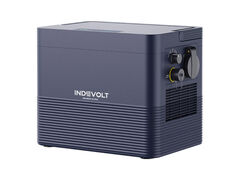
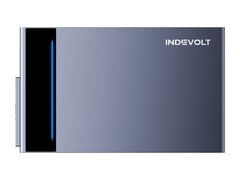
The enclosure follows the Indevolt range's visual language: anthracite grey casing, a control dial and mains socket at the rear, an active-cooling vent on the front. Rated IP54, it operates from -20 °C to 45 °C. At roughly the size of a large suitcase (300 x 215 x 250 mm, 16 kg), it is noticeably easier to move and install single-handed than the SolidFlex 2000 (21.5 kg).
Indevolt remains a young brand in this segment: the BK1600 Ultra has been on sale since September 2025, roughly two months ahead of the SolidFlex 2000. No product recall or documented safety incident has been found for this model to date. The manufacturer warranty runs for 10 years, targeting 6000 cycles to 80% remaining capacity, a figure behind the 8000 cycles targeted by the SolidFlex 2000 and its newer semi-solid cells, though applied here to a conventional LiFePO4 chemistry with a long track record across the market.
Two practical limitations stand out: app ergonomics could be more intuitive on first use, and no communicating meter is bundled as standard, unlike the SolidFlex 2000. These are minor reservations, not structural flaws: zero-export works reliably once configured, and installation itself wraps up in about ten minutes.
Against the SolidFlex 2000 and the Growatt NOAH 2000: who should buy what
On paper, the SolidFlex 2000 (rated 4.0 on this site) leads on nearly every raw spec: more capacity (1792 against 1636 Wh), twice the MPPT (4 against 2, 2400 against 1200 W), a bigger confirmed expansion (10.8 against 4.9 kWh), and a bundled communicating meter. Yet the BK1600 Ultra earns an equal rating on this site (4.0), for two specific reasons: a slightly higher measured round-trip efficiency (82.2% against 80.1%), and no gap at all between what the manufacturer states and its own technical figures on the expansion ceiling, where the SolidFlex 2000 advertises 22 kWh against a genuinely confirmed ceiling of 10.8 kWh.
| Criterion | BK1600 Ultra | SolidFlex 2000 | Growatt NOAH 2000 |
|---|---|---|---|
| Capacity | 1636 Wh | 1792 Wh | 2048 Wh |
| Confirmed maximum expansion | 4.9 kWh (3 units) | 10.8 kWh (manufacturer's own UK site) | 8192 Wh (manufacturer spec sheet) |
| Backup output, standalone unit | 1200 W (1800 W peak) | 1000 W | Not applicable (no EPS function) |
| Built-in MPPT | Yes, 2 x 600 W (1200 W) | Yes, 4 x 600 W (2400 W) | No, separate micro-inverter required |
| Communicating meter included | No (£35 to £85 as an option) | Yes, as standard | Not disclosed |
| Weight | 16 kg | 21.5 kg | Not disclosed |
| Observed price | £499 | £799 | Priced separately, without built-in MPPT |
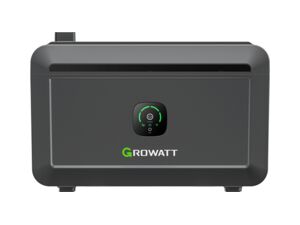
The Growatt NOAH 2000 (rated 3.6) claims a measured efficiency of around 89% across the full chain (from panel to home) at full power, but under a different protocol from the one used here (a constant 800 W AC-only charge/discharge cycle): the two figures do not compare directly. Against both Indevolt units, it remains held back by the lack of a built-in bidirectional inverter: it needs a separate micro-inverter (native Growatt or a compatible Hoymiles/APsystems unit) to convert the current, an extra box and extra wiring that neither the BK1600 Ultra nor the SolidFlex 2000 requires.
In short: the BK1600 Ultra suits a first installation, a narrow balcony, or a tighter budget; the SolidFlex 2000 suits a more ambitious expansion project willing to accept its higher entry cost; the Growatt NOAH 2000 remains relevant for anyone who already owns a compatible micro-inverter and prioritises raw capacity.
Who the BK1600 Ultra suits, and who it does not
The BK1600 Ultra suits a household installing a first storage system on a narrow balcony, wanting automatic backup power without paying for a bigger-capacity system, and living in a market where the 800 W self-install regime is already well established (France, Germany, Spain, Italy).
It suits less well anyone after a large storage capacity or serious backup power from day one: its 4.9 kWh and 3600 W ceiling (in a three-unit coordinated setup) stays well below the SolidFlex 2000's. It also suits less well anyone wanting a bundled communicating meter with no extra purchase, a feature currently reserved for the SolidFlex 2000 in Indevolt's range. In the UK specifically, it suits less well anyone expecting a genuinely no-paperwork install: the battery exclusion from the new SI 2026/848 exemption means a certified installer and full G98 paperwork are still required here.
Against the historically cheaper Growatt NOAH 2000, which lacks a built-in inverter, the BK1600 Ultra justifies its extra cost for anyone wanting the simplest possible install with no additional box to wire in.