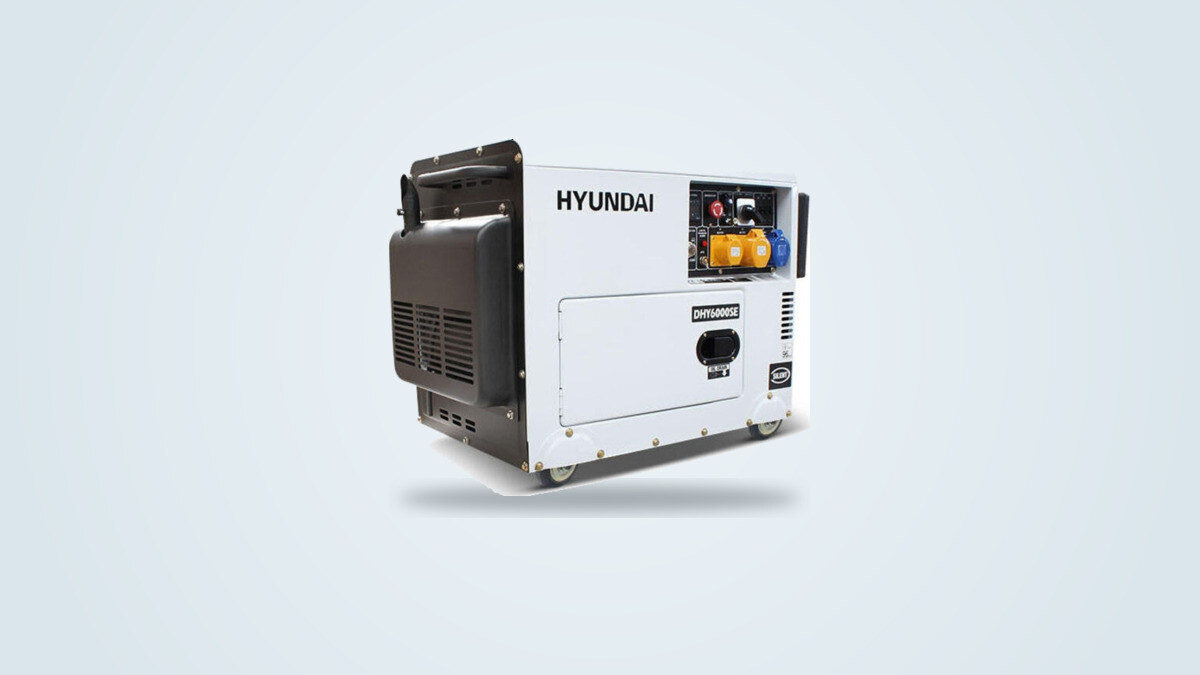
A backup diesel, not a three-phase worksite generator
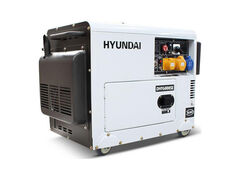
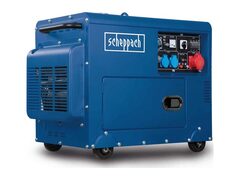
The Hyundai DHY6000SE occupies a distinct spot among the diesel generators already reviewed on this site. Where the Scheppach SG5200D targets worksites with its three-phase 400V outlet, the DHY6000SE stays single-phase and aims at a different job: backing up a home or small business during a power cut, ideally on an automated basis. Under its acoustic canopy, a single-cylinder Hyundai D400/D400E diesel engine of 418 cc, air-cooled and rated at 10 hp at 3000 rpm, drives an AVR-regulated alternator feeding one 230V/32A socket plus two 115V sockets (16A and 32A), switchable between the two voltages from the control panel. That is the exact same engine displacement as the Scheppach SG5200D, a direct point of comparison between the only two diesel units in this catalogue.
At around £1,250 from a specialist retailer, it costs about £310 more than the Scheppach SG5200D. It is also worth checking the exact model before buying: a separately branded "Pro" version sold in some other markets carries a slightly different continuous rating, so the figures in this review apply to the standard DHY6000SE rather than that variant.
4.5 kW continuous, already a conservative figure next to other markets
The DHY6000SE's product page states 4.5 kW continuous and 5.2 kW peak, on 230V. That distinction lines up with how the wider industry separates a continuous rating (sometimes called "prime"), usable at variable load with no time limit, from a backup rating ("standby"), reserved for occasional use during a power cut: 4.5 kW here, 5.2 kW there. It is worth noting that some other regional listings for this same generator round the continuous figure up to 5000 W, closer to the backup rating than to the continuous one in the strict sense used here.
This nuance changes nothing about the unit's main purpose: home backup power is by nature intermittent, exactly the scenario the backup rating covers. It matters more for anyone considering running it continuously over a long stretch, say on a worksite or off-grid: in that case, the figure to remember stays 4.5 kW.
A 13-litre tank: up to 16 hours at half load
The product page states up to 16 hours of runtime at 50% load from the 13-litre tank, and around 9 hours at full load, close to 1.44 litres per hour flat out. At 50% of the stated 4.5 kW continuous rating, that works out to around 2250 Wh produced per hour; over roughly 16 hours from 13 litres, consumption at that reduced load comes in at about 0.81 litres per hour, for a calculated efficiency of around 2.8 kilowatt-hours per litre of diesel burned at that load.
Either way, the practical takeaway is straightforward: one full tank comfortably covers a working day at reduced load, and the DHY6000SE refills in minutes from a jerry can, without depending on a mains socket that has just gone dead. It can also run on standard road diesel or on off-road (red) diesel where local rules allow it, worth knowing for anyone already storing the latter for other equipment.
"Silent" by name: 70 dB(A) at 7 metres, no better than an open-frame unit with half the power
The product page states 70 dB(A) at 7 metres at 75% load, the manufacturer's own figure for this unit. The guaranteed sound power, the value that regulates this kind of outdoor equipment under EU rules and typically appears on the unit's own rating plate, comes out at around 96 dB(A).
| Criterion | Hyundai DHY6000SE | Scheppach SG5200D | SDMO Perform 3000 | Knappwulf KW3400 |
|---|---|---|---|---|
| Stated sound pressure | 70 dB(A) at 7 m (75% load) | 77 dB(A) at the operator's position (≈ 1 m) | 67 dB(A) at 7 m | 76 dB(A) at 4 m |
| Guaranteed sound power (LWA) | ≈ 96 dB(A) | 96.2 dB(A) | 96 dB(A) | 96 dB(A) |
| Design | Acoustic canopy (Silent range) | Full steel canopy | Open frame | Open frame |
| Continuous power | 4500 W | 4200 W | 2400 W | 2600 W |
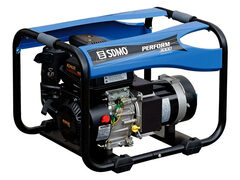
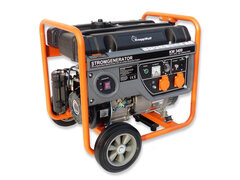
The SDMO Perform 3000, an open-frame unit with no claim to being quiet at all, states 67 dB(A) at that same 7-metre distance for roughly half the DHY6000SE's continuous power. The Hyundai's acoustic canopy and "Silent" name do not, then, translate into a clear noise advantage over a unit with half its power and no canopy at all. Reviews from owners echo this: several describe the DHY6000SE as calmer than an open-frame petrol unit but still loud enough to annoy neighbours, not a machine to leave running under a bedroom window overnight.
In practice, this level rules out night-time use right next to neighbours, but stays consistent with occasional daytime or evening backup use, the job the unit is built for.
AVR regulation and electric start, no inverter technology
The DHY6000SE fits an automatic voltage regulator (AVR) driving a brushed alternator. This is not an inverter unit: it produces plain alternating current, with no electronic reconstruction of a smoothed sine wave, the same architecture as the four other conventional generators already reviewed on this site. No official ISO 8528-5 classification (the G1, G2 or G3 classes that govern electrical stability for this kind of equipment) could be found for this specific model, unlike the Scheppach SG5200D, whose G1/B class is published by its manufacturer. Without that figure, caution is still warranted before plugging in sensitive electronics without a separate inverter, as with any conventional generator in this segment.
Starting is by key, from a dedicated battery, with a digital display showing voltage, frequency and cumulative running hours. That is a real convenience over a recoil cord, especially in cold weather or for a remote start via an ATS unit: three of the petrol generators already reviewed on this site (SDMO Perform 3000, Einhell TC-PG 35, Einhell TC-PG 25/1/E5, Knappwulf KW3400) only offer a recoil cord. A low-oil alarm shuts the engine down automatically before damage occurs, and access for routine oil changes is reported as a bit tight rather than genuinely difficult.
ATS/MTS compatible: the key argument for automated home backup
The DHY6000SE is stated as compatible with an optional ATS (Automatic Transfer Switch) unit, or it can be wired through a simpler manual transfer switch (MTS). Once fitted to a building's electrical system, the ATS option detects a mains outage, starts the generator automatically and switches the supply over, with no human intervention; once mains power returns, it stops the generator and switches back. That is precisely what separates a home backup generator from a stand-by unit you have to wheel out, plug in and start yourself.
This point is worth weighing against the Scheppach SG5200D, the closest diesel by architecture already reviewed on this site: its compatibility with this kind of unit is not stated by its manufacturer. The DHY6000SE shows a concrete edge here for the job it is built for, a home or small business that wants an unattended backup switchover, rather than worksite support started on demand.
150 kg on wheels: a semi-permanent fixture, like the Scheppach SG5200D
At 150 kg, the DHY6000SE lands almost exactly in the same weight class as the Scheppach SG5200D (148 kg), the only other diesel already reviewed on this site. A wheeled frame lets it be rolled on hard ground, but loading it into a vehicle needs a ramp or a tailgate, plus a second person: this is not something you carry along day to day, but a unit you set up once near the fuse board or the plant room it is meant to serve.
This weight follows directly from the 418 cc diesel engine and the full acoustic canopy, the exact same reasons behind the Scheppach SG5200D's own mass. Against the three petrol generators in the catalogue, between 37 and 47 kg, the gap is clear and shows up identically on both diesel units: it is a feature of the format, not a design shortcoming specific to either one.
A one-year warranty, and after-sales support worth watching despite a proven layout
Commercial terms found for the DHY6000SE state a warranty of one year or 1,000 running hours, whichever comes first. That is shorter than the three years stated for the SDMO Perform 3000 already reviewed on this site, and among the shortest in the consumer diesel segment. The unit shares its 418 cc displacement with the Scheppach SG5200D, a simple single-cylinder, air-cooled engine, with a brushed alternator and no electronics beyond the AVR regulator and the control display.
One unit reviewed online developed a major fault at around 800 hours of use, needing a repair costing around €600 outside warranty after the seller could not be reached for a claim. A single case does not point to a structural flaw in the unit, but it does illustrate a real point of caution: beyond the one-year contractual warranty, access to responsive after-sales support depends heavily on the sales channel chosen. Build quality overall is reported as solid rather than premium, with access for routine oil changes described as a bit tight.
The low-oil automatic shutdown already mentioned remains a useful baseline protection on a unit built to run unattended during a power cut.
Against the other generators already reviewed on this site
The table below places the DHY6000SE against four generators already reviewed on this site, two diesel and two petrol.
| Criterion | Hyundai DHY6000SE | Scheppach SG5200D | SDMO Perform 3000 | Knappwulf KW3400 | Einhell TC-PG 35 |
|---|---|---|---|---|---|
| Fuel | Diesel | Diesel | Petrol | Petrol | Petrol |
| Continuous power | 4500 W | 4200 W (400V) | 2400 W | 2600 W | 2600 W |
| Three-phase outlet | No | Yes, 400V | No | No | No |
| ATS compatible | Yes, optional | Not stated | No | No | No |
| Starting | Electric key | Electric key | Recoil cord | Recoil cord | Recoil cord |
| Tank | 13 L | 16 L | 4.1 L | 15 L | 15 L |
| Weight | 150 kg | 148 kg | 45 kg | 47 kg | 40 kg |
| Observed price | ≈ £1,250 | ≈ £940 | ≈ £560 | ≈ £247 | ≈ £293 |
Against the Scheppach SG5200D, the DHY6000SE gains on stated continuous power and on clearly stated ATS compatibility, but gives up three-phase 400V power, a slightly smaller tank, and around £310 in price. Against the three petrol units, the gap in power, efficiency and price reflects a change of category: those suit occasional, light-duty backup, not a structured home backup setup.
Who the DHY6000SE suits, and who should skip it
It suits a household or small business that wants to secure its power supply during outages, ideally without manual intervention thanks to the optional ATS unit, and that needs a comfortable continuous output (4.5 to 5.2 kW) without moving to three-phase power. Electric start, the dual-voltage sockets and the control display also suit frequent use or cold-weather conditions.
It does not suit anyone after a generator to move around day to day (150 kg, a semi-permanent fixture), genuinely quiet running right next to neighbours at night (70 dB(A) at 7 metres, in the same range as an open-frame unit), three-phase 400V power for worksite equipment (see the Scheppach SG5200D instead), or a tight budget for occasional, light-duty backup, for which a conventional petrol generator from the catalogue is more than enough at a noticeably lower price.