

A tester that needs nothing but the battery itself
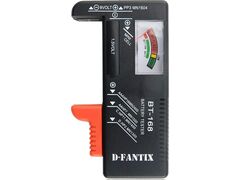
Faced with a drawer of batteries of uncertain age, the question always comes back: still good, or time to bin? The D-FantiX BT-168 answers it in a second, without needing any power source of its own: it draws just enough current from the battery placed on its contacts to move its needle.
A reading under load, more revealing than a simple voltmeter
The most important technical difference between this type of tester and a simple voltmeter lies in the method: the BT-168 measures a battery's voltage while it delivers a light current, not at rest. A nearly dead battery can show a deceptively normal no-load voltage and then collapse as soon as a device asks it for current; a reading under load reveals this true condition far more faithfully. The trade-off for this simplicity is the resolution of the reading: the needle settles on a three-zone colour scale (green, yellow, red) rather than displaying a numerical voltage value or an estimated remaining capacity in mAh. For everyday sorting and checking at home, this qualitative reading is more than enough; to know the exact capacity of a rechargeable battery, an analysing charger remains better suited.
Six common formats, disposable and rechargeable
The BT-168 tests AA, AAA, C and D batteries, 9V blocks and button cells, covering almost all of a household's needs on its own. It works equally well on disposable alkaline batteries and rechargeable NiMH batteries, which also makes it possible to tell whether a battery deserves recharging before it goes back into a device. Its compatibility limit concerns the more specialised cylindrical formats used in some tools, torches or electric bikes (such as the 18650), which fall outside its scope.
An instant reading, with no button or setting
No button, no format setting to select: simply place the battery on the correct contacts for its size. The analogue needle immediately settles on the colour-coded dial, a reading anyone in the family can understand at a glance. This is a genuine ease of use compared with digital devices that sometimes require selecting the battery format before measuring.
A virtually indestructible principle, with contact wear to watch
The casing remains basic but functional, and having no internal battery removes any risk of failure linked to a flat or corroded power source of its own: the device is always ready, no matter how long it has been since its last use. Gradual wear of the contact wires remains possible with repeated heavy use, a genuine point to watch on a device sold at a very accessible price.
Who the D-FantiX BT-168 is for
This tester suits anyone who wants to quickly sort a stock of household batteries or check a rechargeable battery before throwing it away, without investing in a pricier digital device or learning how to use one. For a precise numerical reading of a rechargeable battery's remaining capacity, an analysing charger such as the XTAR VC4 remains better suited, at the cost of a much longer measuring time.