
What the built-in USB-C cable is really worth
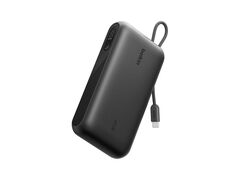
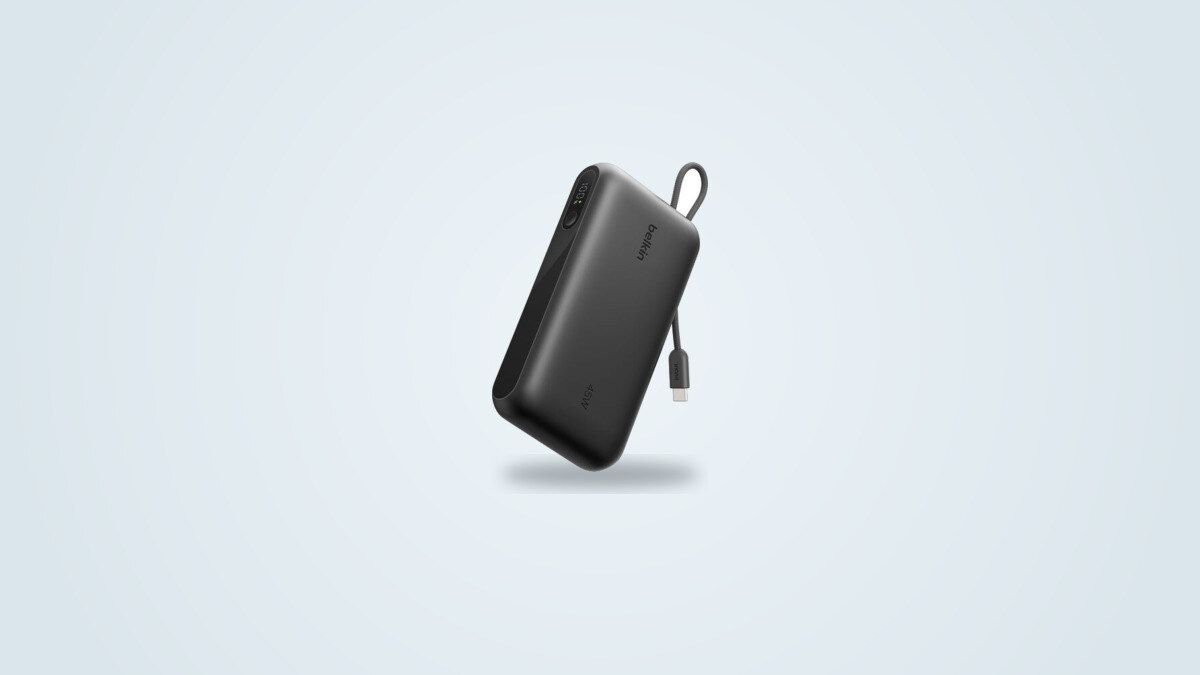
The Belkin UltraCharge 20K stands out first for its braided USB-C cord, permanently attached to the housing and held in place by a magnet when not in use. Just unwind it to plug in a phone or tablet, with no need to dig through a bag for a separate cable. This is the core selling point of the whole UltraCharge line, already seen on the higher-end UltraCharge Pro 25K (reviewed separately on this site), and it works as advertised: the cord stays firmly clipped to the housing even under daily nomadic use.
An additional USB-C port and a USB-A port back up the built-in cable, for three usable outputs in total. The extra USB-C port also reaches 45W when used alone, while the USB-A port tops out at 18W. This redundancy avoids being stuck if the built-in cable does not fit a device’s connector: a Lightning iPhone, for instance, needs a separate USB-A to Lightning cable plugged into the third port.
45W split across three outputs: what Belkin does not spell out
On paper, 45W is a modest output for a power bank of this capacity sold at a comparable price. Of the three direct rivals compared later in this review, only the UGREEN Nexode 45W shares the same ceiling: the Anker Power Bank 20000 claims 87W and the INIU 20,000mAh 65W, almost double for the latter.
Support for USB PD and PPS lets the battery automatically adjust its output voltage to whatever is plugged in, rather than sticking to a few fixed steps. That is what allows better-matched fast charging on a recent Samsung Galaxy phone or a compatible iPhone, where plain standard USB PD would force a less optimal voltage step.
Belkin states the battery can power up to three devices at once (built-in cable, extra USB-C port, USB-A port), without spelling out exactly how the 45W is shared between those three outputs once all are active. Splitting 45W evenly between two active outputs would leave roughly 22 to 23W each, a simple calculation that gives a sense of scale, even though Belkin does not confirm this port by port. What is certain is that plugging in all three outputs at once noticeably slows down charging on each device compared with a single 45W connection.
In practice, the UltraCharge 20K works well for charging a single phone or tablet at full speed, but it should not be relied on to quickly power three demanding devices at the same time. A laptop such as a MacBook Air can be plugged in and will charge, but more slowly than with its original mains adapter, especially if another device is drawing power from one of the other two outputs at the same time.
74Wh under the cabin limit, an honest voltage calculation
The advertised 20,000mAh translates to 74Wh of nominal energy, which works out to a cell voltage of around 3.7V, the standard figure for lithium-ion. That is an honest calculation: some spec sheets on the market inflate their Wh figure by using a higher voltage than the cells actually fitted inside, which is not the case here.
At 74Wh, the UltraCharge 20K stays comfortably under the 100Wh limit most airlines and the TSA allow in the cabin without special permission, a genuine advantage for travel. It also ships pre-charged to around 80%, a practical touch that lets you use it straight out of the box without waiting for a first full charge.
No independent measurement of the share of energy actually recoverable through the ports, once charging-circuit losses are deducted, has been found for this specific model to date. This review therefore does not publish a numeric estimate of real-world output beyond the nominal 74Wh, rather than putting one forward without a solid basis.
Recharging the battery itself: 30W input, a duration calculation
Recharging the UltraCharge 20K itself tops out at 30W, with USB PD and PPS support to adjust the voltage to whatever charger is used. A simple calculation gives a theoretical minimum: 74Wh split across a 30W input works out to roughly 2 hours 30 minutes under ideal conditions, without accounting for conversion losses or the slowdown near the end of a charge cycle, a common trait of any lithium-ion battery past roughly 80% charge.
This 30W input leaves the UltraCharge 20K behind the newest power banks on the market, which accept 65 to 100W and can fully recharge in an hour to an hour and a half. It nonetheless stays in line with a good share of 20,000mAh power banks sold at the same price, even if several newer models now do better on this specific point.
The Pass-Through feature, capped at 15W, lets you charge a device plugged into one of the ports while the battery itself charges from the mains. That is useful for keeping a small accessory topped up (earbuds, a smartwatch) during an overnight charge, but 15W is well below the 45W the unit is otherwise capable of: this mode is not meant for quickly charging a power-hungry device at the same time.
Real-world battery life: how many phone charges
With its 74Wh, the UltraCharge 20K recharges most current smartphones 3 to 5 times over, depending on the phone’s battery size, typically between 15 and 20Wh on a recent model, and more still for small accessories such as wireless earbuds. For a tablet, whose battery often sits around 30 to 40Wh, expect one to two full charges.
These ballpark figures, worked out from the nominal 74Wh, do not account for conversion losses in the charging circuit: the number of charges actually obtained will therefore be slightly lower. For a weekend trip or a day of remote work away from an outlet, this capacity is comfortably enough for single-device use; it drains faster if all three outputs are used in parallel throughout.
Weight and thickness, the accepted trade-off
At 390g for 136 x 76 x 31mm, the UltraCharge 20K sits in the middle of the pack for its capacity. It is lighter than two of its three direct rivals compared in this review, but noticeably thicker and heavier than a small 10,000mAh backup battery.
Against its closest rivals, it comes out well: 41g lighter than the Anker Power Bank 20000 and 78g lighter than the UGREEN Nexode 45W, but 66g heavier than the INIU 20,000mAh, the lightest of the four thanks in part to having no built-in cable. None of the four slips discreetly into a trouser pocket: this format travels in a bag or a case, an accepted trade-off rather than a hidden flaw for a capacity this size.
A digital percentage display, and Smart Protect
Triggered by a side button, the UltraCharge 20K’s digital display shows the exact percentage of charge remaining. That is a real plus over the plain LED rows still common at this price point, including on other batteries from the same brand: Belkin’s own BoostCharge Pro 10K, for instance, makes do with four approximate lights rather than an exact percentage.
Belkin also describes its Smart Protect technology on this line: protection against overcurrent, overvoltage and undervoltage, a dedicated thermal sensor on the cell, and automatic cutoff in case of excessive heat. The manufacturer also states it sources cells from certified suppliers. The housing uses at least 75% post-consumer recycled plastic, in fully plastic-free packaging.
UltraCharge, BoostCharge, Pro: a lineup where it is easy to pick the wrong model
Belkin sells several external batteries carrying the number "20K" in their name, which creates a real risk of buying the wrong one. This review covers only the UltraCharge Power Bank 20K (with no "Pro" in the name), model BBA008ttBK in the US and BPB030 in Europe, recognisable by its digital percentage display and its 45W output.
| Product | Distinguishing feature | Power | Display |
|---|---|---|---|
| UltraCharge Power Bank 20K (BBA008 / BPB030) | Built-in, magnetic USB-C cable | 45W | Digital (%) |
| BoostCharge Power Bank 20K (BPB012) | Separate USB-A to USB-C cable included | 20W | LED |
| BoostCharge Pro 3-Port Laptop Power Bank 20K (BPB020) | Laptop-oriented, three ports | 65W | Digital (%) |
| UltraCharge Pro 25K (reviewed separately on this site) | Built-in USB-C cable, 25,000mAh | 158W shared | Digital (%) |
The most frequent mix-up involves the BoostCharge line, older and distinct from UltraCharge: it comes in several power levels, from 20W for the BPB012 up to 65W for the laptop-oriented BPB020, and its older versions make do with LED indicators rather than an exact percentage. An UltraCharge Pro 20K also exists, sold notably through Apple’s accessory network: despite the very similar name, it is a distinct product from this one, and its precise specifications could not be confirmed for this review. The UltraCharge Pro 25K, more powerful and larger (140W per port, 25,000mAh), is reviewed separately on this site, for a use case centred on laptops.
Anyone looking for information on this 45W built-in cable and percentage display should therefore check they are reading about the non-Pro UltraCharge 20K, not one of these other products.
A Belkin safety recall in 2025, on a different model
In November 2025, Belkin recalled around 83,500 units in the United States and 2,385 in Canada of a different 20,000mAh power bank, the BoostCharge USB-C PD Power Bank 20K (models BPB002 and PB0003), over a risk of the lithium-ion battery overheating and causing a fire or burn. This recall, announced on 13 November 2025, covers units sold between August 2020 and August 2025. It lists one fire in the United States and fifteen reports internationally, including two minor burns. Belkin is offering a full refund or store credit to those affected.
This episode still matters for gauging the brand’s reliability in this specific corner of the 20,000mAh power bank market: same manufacturer, very similar capacity, a risk of the same kind (a lithium-ion cell overheating) that the current line’s Smart Protect technology is meant to prevent. No such history is tied to the UltraCharge 20K to date, but the track record available on its long-term reliability remains limited given how recently it reached the market.
Against the Anker Power Bank 20000, the UGREEN Nexode 45W and the INIU 20,000mAh
In this crowded segment of 20,000mAh power banks with a built-in cable, three references help place the UltraCharge 20K precisely.
| Criterion | Belkin UltraCharge 20K | Anker Power Bank 20000 (87W) | UGREEN Nexode 45W | INIU 20,000mAh (65W) |
|---|---|---|---|---|
| Capacity | 20,000mAh (74Wh) | 20,000mAh (72Wh) | 20,000mAh | 20,000mAh |
| Max power | 45W | 87W | 45W | 65W |
| Built-in USB-C cable | Yes | Yes | Yes | No |
| Display | Digital (%) | Digital (%) | LED | LCD |
| Weight | 390g | 431g | 468g | 324g |
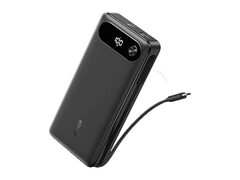
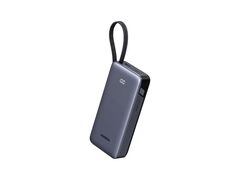
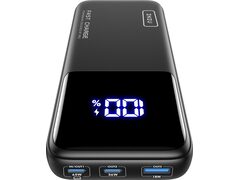
The Anker Power Bank 20000 wins comfortably on raw power (87W versus 45W) for a very similar weight and capacity (72Wh, 431g), also with a built-in USB-C cable and a digital percentage display: it is the most direct and most complete rival of the three. The UGREEN Nexode 45W matches the UltraCharge 20K on power but falls behind with a plain LED display and a higher weight (468g). The INIU 20,000mAh is the lightest of the comparison (324g) and beats the Belkin on power (65W), but gives up the built-in cable, one of the UltraCharge 20K’s central selling points.
None of the three rivals combines the built-in cable, the digital percentage display and more than 45W all at once: the Anker Power Bank 20000 comes closest, and remains by far the least favourable comparison for the Belkin on power alone.
Who it suits, who it does not
It suits anyone who charges a phone or tablet daily and wants to never be without a cable again: the built-in, magnetic cord solves that problem once and for all. Its 74Wh cover several days of phone use, travel in the cabin without special permission, and Belkin’s 2-year warranty plus Connected Equipment protection are reassuring over the long run.
It suits less anyone who wants to charge a laptop quickly (the Anker Power Bank 20000 and the INIU 20,000mAh do better on this specific point, at 87W and 65W), anyone who regularly plans to plug in three devices at full power at once, or anyone after the lightest, thinnest possible format to slip into a pocket rather than a bag.